By Penny Langford
The global mining sector entered the third week of April 2026 with a series of high-stakes maneuvers that underscore a deepening urgency across the critical minerals supply chain. From a massive $1.5 billion consolidation in the uranium sector to a significant billion-dollar capital injection into Peruvian copper, the narrative of 2026 is becoming clear: major players are choosing to secure existing assets and streamline permitting rather than risk the decade-long timelines of greenfield development.
As global markets navigate a projected 5 million ton copper deficit and a tightening Western nuclear fuel cycle, the events of the last 48 hours signal a decisive pivot toward “buy over build” and administrative “fast-tracking” in Tier-1 jurisdictions.
Uranium Royalty Corp Secures $1.5B Sweetwater Acquisition
In a move that significantly reshapes the North American uranium landscape, Uranium Royalty Corp (URC) has announced a definitive agreement to acquire Sweetwater Royalties for $1.5 billion. The deal represents one of the largest consolidations of uranium interests in recent history and is being viewed by analysts as a “hard signal” that Western fuel security has moved from a policy goal to a primary driver of corporate M&A.
More Read

The acquisition provides URC with a commanding royalty position over several of the most productive uranium basins in the United States and Canada. By absorbing the Sweetwater portfolio, URC is essentially betting on the rapid revitalization of the domestic nuclear supply chain. As of early 2026, the demand for carbon-free baseload power: driven largely by the massive energy requirements of AI data centers: has pushed uranium spot prices into a sustained high-altitude range.

Industry experts note that this consolidation is timely. With geopolitical tensions continuing to complicate supply routes from traditional sources like Kazakhstan and Niger, the “Sweetwater Play” secures a strategic foothold for Western utilities looking to de-risk their fuel procurement. The market responded favorably to the news, seeing it as an “investor magnet” that simplifies the entry point for institutional capital into the uranium space.
Chinalco Injects $1.7B into Peru’s Toromocho Copper Mine
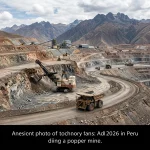
While uranium consolidates in the West, the copper sector is seeing a massive infusion of capital in South America. Chinalco has confirmed a $1.7 billion investment into its Toromocho mine in Peru. This capital injection is specifically targeted at expanding production capacity and adding a specialized molybdenum circuit to the existing operation.
More Read

This move comes at a critical juncture for the Peruvian mining industry. Despite historical permitting delays and local resistance in certain regions, the Toromocho expansion suggests that major operators are willing to double down on proven assets to meet the 2026 copper deficit. The expansion is expected to boost annual throughput significantly, providing a much-needed buffer as global supply remains constrained by smelting caps and a lack of new Tier-1 discoveries.

The $1.7 billion commitment is also a geopolitical marker. As the United States and Europe attempt to secure cooperation in the Congo and other regions, China’s continued dominance in South American copper infrastructure remains a formidable hurdle for Western resource security. For Peru, the investment provides a boost to the national treasury, though it arrives amid ongoing technical reviews of other major projects like Tia Maria.
British Columbia Policy Shift: Fast-Track Permitting and Regulatory Reform
In a development that has sent shockwaves through the junior mining sector, the provincial government of British Columbia has announced a temporary suspension of certain administrative portions of Indigenous Rights Law to fast-track permitting for critical mineral projects.
The policy shift is aimed at reducing the bureaucratic backlog that has historically seen projects languish for years in the “permitting valley of death.” By streamlining the approval process for “Strategic Grade” assets: primarily copper, lithium, and rare earths: B.C. is attempting to reclaim its status as a top-tier destination for global exploration capital.
While the move has sparked intense debate regarding the balance of resource development and Indigenous sovereignty, the industry has largely welcomed the clarity. “In the current competitive environment, speed is a commodity in itself,” noted one Vancouver-based mining executive. The suspension is part of a broader provincial “Critical Minerals Strategy” designed to align B.C. with the federal government’s goal of making Canada a global leader in the battery revolution.
Silver Momentum: Restart at Reliquias and High-Grade Nevada Discoveries
The precious metals sector is also showing renewed vigor, with silver emerging as a standout performer in the Q2 2026 outlook.
Silver Mountain Resources (AGMR) has confirmed that it is on track for a Q3 2026 restart of its Reliquias mine in Peru. The project, which has undergone extensive rehabilitation and modernization, is expected to benefit from silver’s dual role as both a monetary asset and a critical industrial component in solar and electronics manufacturing. The restart is a testament to the viability of high-grade brownfield projects in high-cost environments.
Meanwhile, in the United States, Hycroft Mining continues to report high-grade silver and gold discoveries at its Nevada operations. The latest drill results indicate a significant expansion of the high-grade silver zone, reinforcing Nevada’s reputation as a premier jurisdiction for mineral wealth. These discoveries are particularly noteworthy given the ongoing debates regarding the future of American industrial capacity and the need for domestic mineral independence.

Market Snapshot: April 20, 2026
| Commodity | Price (USD) | 24h Change | 2026 Outlook |
|---|---|---|---|
| Copper (lb) | $5.12 | +1.4% | Bullish – Supply Deficit |
| Uranium (lb) | $108.50 | +0.8% | Strong – Consolidation |
| Silver (oz) | $32.40 | +2.1% | Bullish – Industrial Demand |
| Gold (oz) | $2,485.00 | -0.2% | Neutral/Positive – Geo-hedging |
| Lithium (t) | $18,500 | +0.5% | Rebounding – Supply Tightening |
Analysis: The “Buy vs. Build” Realignment
The common thread linking the $1.5 billion URC deal and the $1.7 billion Chinalco injection is the recognition that new discoveries are not coming online fast enough to meet 2030 decarbonization goals. In 2026, the mining industry is no longer in a “wait and see” mode; it is in an “acquire and expand” mode.
The British Columbia policy shift suggests that even the most environmentally and socially conscious jurisdictions are beginning to prioritize supply security as a matter of national economic survival. This trend is likely to continue as the “Silicon-Lithium Nexus” and the AI energy boom place unprecedented pressure on the existing grid and the minerals required to sustain it.
For investors, the current environment favors companies with proven reserves, existing infrastructure, and the scale to navigate shifting regulatory landscapes. As we move deeper into 2026, the gap between the “resource haves” and the “permitting have-nots” is expected to widen, making strategic intelligence more valuable than ever.