By Charles Pitts

The gold market just sent a clear message to the world: stability is a relic of the past. As we cross the threshold of March 26, 2026, the industry isn't just dealing with price fluctuations; we are witnessing a fundamental re-architecting of global resource security. From the high-altitude salt flats of the Atacama to the copper-rich belts of Zambia, the "wait and see" era is over. It’s been replaced by a "get it now, at any cost" mentality.
Gold hitting $4,500 isn't a fluke. It's a reaction. And while the shiny metal grabs the headlines, the real war is being fought in the trenches of terbium oxides and Direct Lithium Extraction (DLE).
Here is the intelligence briefing you need for Thursday, March 26.
Gold’s $4,500 Bounce: The Geopolitical Risk Premium
The Headline: Gold prices tore through the $4,500/oz mark today, ignited by President Trump’s sudden pause on planned strikes in Iran.
More Read

This isn't your grandfather’s gold rally. This is a sovereign-led flight to safety. While retail investors are nibbling, central banks are devouring supply. We’ve tracked 850 tonnes of central bank gold purchases already in 2026. That is not a rounding error; it is a systemic shift in reserve management.

- The Catalyst: The temporary de-escalation in the Middle East didn't cool the market; it highlighted the sheer volatility of the current administration’s foreign policy. Investors are betting that the "pause" is merely a breath before the next storm.
- The Trend: Sovereign nations are de-risking away from the dollar at a pace we haven't seen in the post-Bretton Woods era. If you’re not holding physical, you’re not hedged.
- Market Impact: We expect $4,500 to act as the new psychological floor. Any dip below $4,200 is being met with aggressive institutional buying.

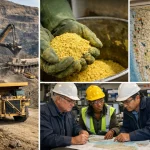
Two mining engineers overseeing an active gold operation as prices hit historic highs in March 2026.
Critical Minerals: Energy Fuels and the Terbium Breakthrough
The News: Energy Fuels (NYSE: UUUUU) just achieved a 99.9% purity milestone for terbium oxide at its White Mesa mill in Utah.
More Read

This is the big one. If you understand the rare earth supply chain, you know that China has held a stranglehold on "heavy" rare earths for decades. Terbium is the "vitamin" of the permanent magnet industry: without it, high-performance EVs and defense systems don't work.
- Why it matters: 99.9% purity means commercial-grade, "Made in USA" critical minerals are no longer a PowerPoint promise. They are a reality.
- The Uranium Nexus: Energy Fuels is leveraging its uranium processing DNA to crack the REE code. This vertical integration is the blueprint for Western mineral independence.
- Outlook: Expect the Department of Defense to move quickly on multi-year off-take agreements. The strategic value of this Utah facility just tripled overnight.
Zambia’s Copper Surge: Makor Resources Moves In
The Strategy: Makor Resources has announced a $30 million entry into the Zambian copper sector, specifically targeting the Kasempa and Mkushi regions.
Zambia wants to triple its copper output to 3 million tonnes per year. To do that, it needs more than just the "Big Four" miners; it needs aggressive mid-tiers and juniors to de-risk greenfield sites.
- The Play: $30M is a surgical strike. Makor is moving into areas that have been historically under-explored but sit on the same structural trends as some of the world’s largest deposits.
- The Environment: Under President Hichilema, Zambia has become the "darling" of African mining investment. The fiscal regime is stable, and the government is actually answering the phone.
- Risk/Reward: The infrastructure in Mkushi remains the primary bottleneck. If Makor can solve the logistics, the ore is there.
Albemarle’s $3.1B DLE Pivot: The End of Evaporation?
The Shift: Lithium giant Albemarle (NYSE: ALB) is committing $3.1 billion to a massive Direct Lithium Extraction (DLE) pivot in the Salar de Atacama.
The traditional "pond and pray" method of lithium extraction: relying on the sun to evaporate brine over 18 months: is officially being phased out by the market leader.
- The Reason: Environmental pressure and Chilean government mandates. If you want to stay in the Atacama, you have to use less water and return the spent brine to the aquifer.
- The Tech: DLE promises to cut production time from months to hours while increasing recovery rates from 50% to over 90%.
- The Cost: $3.1 billion is a staggering Capex bill. It’s a bet-the-company move that signals Albemarle believes the lithium "bottom" is behind us.

A modern mineral processing facility reflecting the advanced technology required for the DLE transition in Chile.
The $120B Blitz: China’s Global Mining Hegemony
The Reality Check: While Western miners struggle with permitting and ESG audits, China has unleashed a $120 billion "Green Energy Statecraft" fund for overseas mining acquisitions.
- The Target: Africa, Southeast Asia, and South America.
- The Tactic: They aren't just buying mines; they are building the railroads, the ports, and the power plants that make the mines viable.
- The Result: China now controls roughly 60% of the world’s refined lithium and 80% of its cobalt processing. The $120B blitz is designed to lock up the remaining 20% before 2030.
Corporate Moves: SSR Mining and Pan American Silver
SSR Mining’s $1.5B Exit: SSR has finally closed its $1.5 billion sale of the Çöpler mine in Turkey. After the catastrophic landslide in 2024, this is a "clean break" strategy. They are walking away with a heavy heart but a much lighter balance sheet. The market is cheering the de-risking, even if it comes at a steep discount to the asset’s 2022 valuation.
Pan American Silver’s $1.9B Optimization: The La Colorada Skarn project in Mexico is getting a $1.9B injection to optimize production. In an era of $40 silver, Pan American is doubling down on its flagship. Despite the security risks in Zacatecas, the grade is too good to ignore.
Featured Deep-Dive: The Ultimate Guide to Critical Minerals
The transition to a low-carbon, AI-driven economy is a mineral-intensive undertaking. We are moving from a fuel-intensive energy system to a mineral-intensive one. If you don't own the supply, you don't own the future.
1. Copper: The "Electrification" Backbone
Copper is the new oil. By 2026, we are seeing a structural deficit that no amount of recycling can fix. The world needs a "New Escondida" every two years to meet the 2050 net-zero goals. Currently, we aren't even finding a "Half-Escondida" every decade.
2. Lithium and Cobalt: The Battery Nexus
While sodium-ion batteries are making inroads, lithium-ion remains the king of energy density. The volatility in lithium prices over the last three years has scared off junior explorers, creating a massive supply gap that will hit in 2028.
3. Uranium: The Nuclear Renaissance
Uranium Energy Corp (UEC) is leading the charge in the US, expanding its value chain from Wyoming to the NRC. With the "AI Boom" demanding massive amounts of baseload power for data centers, nuclear is the only carbon-free solution. Uranium is no longer a "dirty word" in ESG circles; it's a necessity.
4. Rare Earth Elements (REEs): The Magnet Problem
As mentioned with Energy Fuels, the focus has shifted from "Light" REEs (Neodymium/Praseodymium) to "Heavy" REEs (Terbium/Dysprosium). Without these heavies, magnets lose their ability to operate at high temperatures: making them useless for high-performance motors.

A collage of critical minerals and the strategic defense funding driving junior mining de-risking in 2026.
The Final Frontier: NOAA and Deep Sea Mining
The Policy: The National Oceanic and Atmospheric Administration (NOAA) has issued a regulatory pledge to fast-track deep-sea mining (DSM) exploration permits.
For years, DSM was a pipe dream. Now, with terrestrial grades declining and ESG costs skyrocketing, the seafloor is looking attractive.
- The Prize: Polymetallic nodules sitting on the ocean floor contain more nickel, cobalt, and manganese than all known terrestrial deposits combined.
- The Conflict: Environmentalists are horrified. The mining industry says it’s more "ethical" than clearing rainforests in Indonesia.
- The Verdict: The US cannot afford to let China lead the International Seabed Authority (ISA). NOAA’s move is a geopolitical play disguised as a regulatory update.
The Bottom Line for Thursday, March 26
2026 is the year the "Just-in-Time" supply chain died for the mining industry. We have entered the era of "Just-in-Case."
Whether it's central banks hoarding gold at $4,500 or Albemarle spending $3B to rewrite the rules of lithium extraction, the message is the same: the physical world matters again. You can't print copper, you can't code lithium, and you can't "disrupt" geology with a software update.
The clock is ticking on the next commodity supercycle. If you’re not positioned now, you’re already behind.
Skillings Mining Intelligence
Data. Analysis. Integrity.
Social Media Snippet (LinkedIn/X):
Gold hits $4,500/oz as the world de-risks. ? Meanwhile, Albemarle bets $3.1B on DLE and Energy Fuels cracks the 99.9% terbium code in Utah. The mining industry isn't just growing; it's evolving under extreme geopolitical pressure. Read the full Skillings Intelligence Briefing for March 26, 2026. #Mining #Gold #Copper #CriticalMinerals #EnergyFuels #Lithium