By Penny Langford

In the global race for critical minerals, the most important piece of equipment in 2026 isn't a high-tech electric shovel or an autonomous haul truck: it’s a 1,300-kilometer stretch of steel rail known as the Lobito Corridor.
For decades, the "Great Game" of the mining industry was played deep underground. If you owned the dirt, you owned the market. But as we move through 2026, the theater of war has shifted to the surface. The Lobito Atlantic Railway (LAR) is doing something that decades of diplomacy couldn't: it is fundamentally reorienting the copper supply chain 2026 by providing a direct, Western-backed artery from the heart of the African Copperbelt to the Atlantic Ocean.
For operators in the Democratic Republic of Congo (DRC) and Zambia, this isn't just about moving rocks; it’s about a logistics cheat code that is shortening export times from 45 days to just 15. In a market where coppers valuation gap is under constant scrutiny, those 30 days are the difference between a liquid asset and a balance-sheet bottleneck.
The 1,300km Logistics Cheat Code
Historically, getting copper or cobalt out of the DRC or Zambia was a test of industrial patience. Most ore traveled east to Dar es Salaam or south to Durban. These routes are notoriously congested, plagued by border delays, and: more importantly for Western policymakers: heavily influenced by the logistics networks of the East.

The Lobito Corridor changes the geometry of the map. By connecting the Angolan port of Lobito to the mining hubs of Kolwezi and Solwezi, the LAR provides a "West-ward" exit.


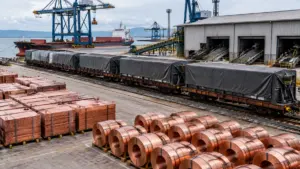
By mid-2026, the rehabilitation of the Angolan Benguela line is nearing its first major capacity milestone. While the full Zambian extension isn't expected to be fully operational until 2029, the incremental improvements are already shifting volumes. Western DRC mines are now routinely bypassing the eastern bottleneck, moving high-grade copper cathodes directly to the Atlantic. This shift is critical as copper demand for AI and data centers continues to hit record highs, requiring a supply chain that can react to price signals in weeks, not months.

Geopolitics on the Rails: G7 vs. China
The Lobito Corridor is the flagship project of the G7’s Partnership for Global Infrastructure and Investment (PGI). With over $4 billion in U.S. backing and significant EU involvement, it is a rare, tangible example of Western infrastructure "hard power" in Africa.
The goal is clear: diversify the supply chain. Currently, China owns or has stakes in roughly 80% of DRC copper mines and 15 of its 19 cobalt mines. For the U.S. and EU, the Lobito rail is a strategic hedge. Even if China "owns the dirt," the West now aims to "own the road."
However, Beijing isn't standing still. In response to the Lobito push, 2024 and 2025 saw a flurry of activity around the TAZARA railway, with China securing concessions to modernize the link between the Copperbelt and the Indian Ocean. In 2026, we are witnessing a literal race of the rails. The competition has turned the DRC and Zambia into the most sought-after logistical real estate on the planet, giving African governments unprecedented leverage to negotiate better terms for their mineral wealth.

Mining M&A Deals 2026: The Infrastructure Premium
The existence of the Lobito Corridor is directly influencing mining M&A deals 2026. In previous cycles, a high-quality copper deposit in a landlocked region like northwestern Zambia carried a heavy "logistics discount." Investors had to price in the risk of their product being stuck at a border for three weeks.
In 2026, that discount is evaporating. We are seeing a surge in "infrastructure-adjacent" acquisitions. Mid-tier miners and majors alike are looking at projects within 50 kilometers of the LAR line with fresh eyes. The corridor acts as a de-risking mechanism, making smaller or lower-grade deposits economically viable because the cost-to-market has plummeted.
Current market intelligence suggests that several major copper-gold JVs in the region are being restructured specifically to align with the LAR’s loading terminals. When an asset has a guaranteed, fast-track route to the Atlantic, its Net Present Value (NPV) shifts significantly to the right. This is one reason why critical minerals remain a strategic priority for global portfolios this year.
Market Snapshot: Copper & Cobalt Logistics (June 2026)
| Metric | Lobito Route (LAR) | Eastern/Southern Routes |
|---|---|---|
| Transport Time (Avg) | 12 – 17 Days | 40 – 55 Days |
| Port Congestion Index | Low (Expanding) | High (Traditional) |
| Strategic Backing | U.S. / EU (PGI) | China (Belt & Road) |
| 2026 Capacity Share | 15% (Growing) | 85% (Stable) |
| Primary Commodities | Copper, Cobalt, Manganese | Copper, Gold, Agriculture |
Redrawing the Supply Chain: What’s Next?
As we look toward the second half of 2026, the "Corridor Competition" will likely intensify. The Lobito project is proving that Western capital can indeed build large-scale infrastructure in Africa, provided the strategic incentive is high enough.
For the copper supply chain 2026, this means more optionality. If a strike hits the port of Durban or a political shift affects Dar es Salaam, the LAR provides a vital pressure valve. It also creates a "green" corridor opportunity; with planned solar and wind projects along the line, the rail aims to become a low-carbon transport solution, a key selling point for OEMs in Europe and North America looking to lower their Scope 3 emissions.

The Lobito Corridor isn't just a railway; it’s a statement of intent. It tells the world that the Copperbelt is no longer a "captured" market. By 2026, the tracks are laid, the trains are moving, and the global copper map has officially been redrawn.
Shareable Social Media Snippet (LinkedIn/X)
? The "Great Game" of copper has shifted from the mine to the tracks. The 1,300km Lobito Corridor is cutting export times from 45 days to 15, directly challenging traditional supply chain dominance. As #MiningM&A deals in 2026 focus on logistics-ready assets, how is your portfolio accounting for the "Infrastructure Premium"? #Copper #MiningNews #LobitoCorridor #CriticalMinerals #SkillingsMining