2026 Lithium Power Map : Early Access Open ($59) | Get the latest sector data and secure your copy here: https://skillings.short.gy/LithiumPreSale


By Penny Langford
The global uranium sector entered 2026 under a spotlight rarely seen since the pre-Fukushima era. As nations scramble to secure carbon-free baseload power and tech giants hunt for energy to fuel massive data centers, the uranium market has transitioned from a niche commodity story into a core pillar of global energy security. Spot prices, which breached the psychological $100 per pound barrier in January 2026, signal a fundamental shift in the supply-demand balance that has been building for over a decade.
For operators, investors, and policymakers, understanding the nuances of this market is no longer optional. The intersection of geopolitical tension, under-investment in new mines, and a sudden surge in nuclear utility contracting has created a high-stakes environment.
More Read

Here are the 10 essential things you need to know about the current uranium market outlook.

1. The Breach of the $100 Barrier
In the opening weeks of 2026, spot uranium (U₃O₈) prices surged past $100 per pound, marking a significant milestone. This 25% increase within a single month was not merely a speculative spike but a reaction to tangible supply constraints and the realization that the “easy” secondary supply from inventories has largely vanished. This price level acts as a catalyst for the industry, potentially unlocking marginal projects that were previously deemed uneconomical at $60 or $70 per pound. However, the lead times for these projects remain a significant hurdle.
2. Demand Driven by AI and Data Centers
While traditional grid stability remains the foundation of nuclear demand, the emergence of the “AI energy crunch” has accelerated the bull case. Major tech firms are increasingly looking toward nuclear power: and specifically Small Modular Reactors (SMRs): to provide the 24/7 power required for massive AI training clusters. We are seeing a trend where Big Tech may fund the next uranium bull market, as companies like Microsoft and Amazon seek to de-risk their energy pipelines by backing developers like NexGen Energy.
More Read

3. The 50% Replacement Rate Crisis
The most critical data point for the 2026 outlook is the massive gap between current production and long-term requirements. The industry requires approximately 185 million pounds of uranium annually to sustain the existing global reactor fleet. However, recent production levels have hovered at roughly 50% of this replacement rate. This deficit has been covered by drawing down inventories for years, but those stockpiles have reached critically low levels, forcing utilities back into long-term contracting at higher prices.
4. Extreme Market Concentration
The uranium supply chain remains one of the most concentrated in the mining world. Two entities: Kazatomprom in Kazakhstan and Cameco in Canada: accounted for roughly 86% of the total output among major producers in 2025. This concentration creates significant systemic risk; any regulatory change in Astana or operational disruption in Saskatchewan has immediate global pricing implications. Kazatomprom alone is expected to generate over $3.3 billion in uranium revenue this year, highlighting the weight these two giants carry in the global market.

5. Kazakhstan’s Expansion and ISR Technology
As the world’s leading producer, Kazakhstan’s moves are paramount. Kazatomprom has signaled a plan to boost output by roughly 9% in 2026, aiming for up to 75.4 million pounds of U₃O₈. Much of this growth is coming from the South Tortkuduk site, which utilizes In-Situ Recovery (ISR) technology. ISR is increasingly favored in the 2026 market due to its lower environmental footprint compared to traditional open-pit mining, aligning with modern ESG compliance standards.
| Major Producer | 2025 Est. Production (M lbs) | Market Dominance |
|---|---|---|
| Kazatomprom | 29.1 | ~40-45% |
| Cameco | 21.0 | ~18-22% |
| Orano | 11.5 | ~10-12% |
| Uzatom | 9.0 | ~8-10% |
6. The U.S. Domestic Uranium Renaissance
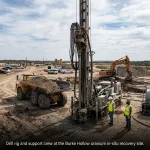
To counter the reliance on Central Asian supply, the United States has aggressively pushed for domestic production. A major milestone in this effort was UEC’s commencement of production at Burke Hollow, the first new U.S. ISR uranium mine in over a decade. This project, along with others in the Wyoming and Texas basins, is part of a broader strategic initiative supported by the Department of Energy to ensure fuel security for the aging U.S. reactor fleet.
7. Accelerating Capital Expenditure (Capex)
The industry is currently in the midst of a massive investment cycle. Aggregate uranium capital expenditure is rising from $704 million in 2024 to a projected $969 million in 2025, with expectations to peak at $1.6 billion in 2027. This capital is flowing into mine restarts, brownfield expansions, and the development of the “next generation” of high-grade deposits in the Athabasca Basin. Investors are using specific valuation metrics to identify which junior explorers have the highest probability of reaching production before the 2028 supply crunch.

8. Geopolitical Policy as a Price Floor
The legislative environment has turned decisively pro-uranium. Beyond the U.S. Section 232 measures, which protect domestic producers, we are seeing new strategic mineral pacts. For instance, the U.S. strategic minerals pact involving tantalum and other critical metals illustrates a broader western strategy to “friend-shore” supply chains. For uranium, this means utilities are often willing to pay a premium for “Western-origin” material to avoid the risk of sanctions or export bans from non-aligned regions.
9. The Utility Contracting Gap
For years, nuclear utilities benefited from a “carry trade” where they could buy cheap spot material rather than signing long-term contracts. That era has ended. Many utilities now face significant coverage gaps for the 2027-2030 period. As these companies return to the negotiating table, they are finding a “seller’s market.” This shift is driving a resurgence in M&A activity, such as the Uranium Royalty merger, as firms look to consolidate future production rights.
10. Long-Term Price Forecasts (2026-2033)
Analysts widely expect uranium prices to remain elevated for the foreseeable future. Average realized prices across major producers are forecast to rise from roughly $60 per pound in 2023 to nearly $99 per pound by 2033. While the market may see short-term volatility as new supply from restarts (like those in Namibia and Australia) hits the market, the underlying structural deficit is expected to persist until at least 2028, when the next major wave of greenfield projects is scheduled to come online.

Summary for Decision Makers
The 2026 uranium market is characterized by a “scarcity mindset” among buyers. The combination of triple-digit spot prices, aggressive utility contracting, and a massive capital expenditure cycle suggests that the sector is in the early-to-mid stages of a multi-year bull run. However, the concentration of supply in Kazakhstan and the long lead times for Western projects remain the primary risks to global energy stability.
2026 Lithium Power Map : Early Access Open ($59) | Get the latest sector data and secure your copy here: https://skillings.short.gy/LithiumPreSale