As of April 2026, the global energy landscape is witnessing a structural shift that few analysts predicted a decade ago. The intersection of generative artificial intelligence (AI) and baseload power requirements has triggered what industry veterans are calling the “Uranium Renaissance.” While solar and wind remain critical components of the decarbonization puzzle, the sheer scale of the energy demand generated by hyperscale data centers has forced Silicon Valley to look toward the nuclear sector for a reliable, carbon-free solution.

The narrative has shifted from theoretical discussion to operational reality. In late 2025 and early 2026, tech giants: including Microsoft, Google, and Amazon: have moved beyond carbon credits and into direct power purchase agreements (PPAs) and equity investments in nuclear technology. This surge in interest is providing the financial floor necessary to restart mothballed reactors and fast-track the development of Small Modular Reactors (SMRs).
The Data Center Power Crisis: Numbers that Move Markets
The urgency behind this transition is grounded in the extraordinary energy consumption growth of the AI era. According to recent industry projections, data centers are expected to consume approximately 945 TWh by 2030. To put this in perspective, this exceeds the combined current electricity usage of Germany and France.
AI-specific workloads are the primary driver, potentially accounting for over 20% of total electricity demand growth through 2030. In the United States alone, energy demand from data centers is projected to triple by 2028, capturing up to 12% of total domestic electricity consumption. For Big Tech firms committed to “Net Zero” targets, the math no longer supports a reliance on intermittent renewables alone. AI requires constant, high-density power: something only nuclear energy can provide at scale without carbon emissions.
The Big Tech Pivot: From Software to SMRs
Silicon Valley’s leadership has become the loudest advocate for nuclear expansion. OpenAI CEO Sam Altman has identified nuclear fission and fusion as the “only viable pathway” to meet AI power demand forecasts that continue to exceed initial projections. This sentiment is echoed across the board:
More Read

- Google: Under the leadership of Lucia Tian, Head of Clean Energy, Google is pioneering partnerships in next-generation nuclear and advanced geothermal projects. The company is also utilizing AI to optimize grid stability, ensuring that new nuclear capacity can be integrated seamlessly.
- Microsoft: Beyond their well-documented interest in fusion, Microsoft has played a pivotal role in the digital transformation of the mining sector. Their collaboration with Codelco (as detailed in our analysis of Codelco and Microsoft’s AI partnership) illustrates the company’s “digital-to-physical” strategy, where software optimizes the extraction of the very minerals needed to power their servers.
- Amazon: Through its Climate Pledge Fund, Amazon has increased its exposure to SMR developers, recognizing that the “plug-and-play” nature of modular reactors is perfectly suited for the regional clusters where data centers are built.

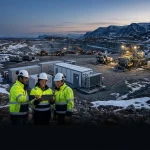
Modular processing facilities are mirroring the scalable design of new SMR technologies.

Why SMRs are the 2026 Game Changer
Small Modular Reactors (SMRs) represent the most significant technological shift in the nuclear sector since the mid-20th century. Unlike traditional gigawatt-scale reactors, which take decades to permit and billions to build, SMRs offer a decentralized approach.
- Scalability: SMRs can be manufactured in a factory setting and shipped to the site, significantly reducing construction risk and capital expenditure.
- Proximity to Demand: Their smaller footprint and enhanced safety features allow them to be placed closer to data center hubs, reducing the need for massive new transmission infrastructure: a major bottleneck in the 2026 energy transition.
- Reliability: SMRs provide the 99.9% uptime required for high-performance computing (HPC) clusters, which cannot afford the volatility of weather-dependent energy sources.
The 2026 outlook for SMRs is increasingly bullish. As the Skillings Power List recently highlighted, the companies providing the raw materials for these reactors are seeing unprecedented capital inflows.
More Read

The Uranium Supply Chain: A Looming Bottleneck?
The “Renaissance” is not without its challenges. The primary concern for operators and investors alike is the uranium supply chain. Years of underinvestment in new mine capacity have created a tight market, which is now being squeezed by both traditional utilities and the new “Tech-Nuclear” alliance.
| Market Snapshot: Uranium & Nuclear Energy (April 2026) | Data Point |
|---|---|
| Projected Data Center Power Demand (2030) | 945 TWh |
| Estimated Uranium Supply Deficit (2026) | 15.5 Million lbs U3O8 |
| New SMR Projects Under Construction (Global) | 22 |
| Average Uranium Spot Price (Q1 2026) | $112/lb |
| AI Contribution to US Power Growth | 22% |
Current mine production in traditional hubs like Kazakhstan, Canada, and Australia is being supplemented by a renewed push for domestic mining in the United States and Europe. The U.S. funding bills of early 2026 have prioritized projects that can move to the production phase within a three-year window, reflecting the geopolitical necessity of secure fuel supplies.

Visualizing the global uranium flow from mine to modular reactor to data center hub.
Geopolitics and Policy: The $50B Strategy
The uranium market is no longer just an energy story; it is a national security story. The EU’s strategic move to include nuclear energy in its Critical Minerals Reserve Plan has unlocked billions in financing for junior miners and processing facilities. This policy shift is intended to reduce reliance on Russian enriched uranium, which remained a thorn in the side of Western energy security throughout 2025.
In the United States, the Department of Energy (DOE) has accelerated its HALEU (High-Assay Low-Enriched Uranium) program. HALEU is the specialized fuel required for many SMR designs, and the establishment of a domestic supply chain is critical for Big Tech’s nuclear ambitions to materialize.

Policy shifts in 2026 have streamlined permitting for critical mineral projects across North America.
Conclusion: The 2026 Energy Outlook
The Uranium Renaissance is the result of an unavoidable collision between the digital future and the physical limitations of the power grid. As Big Tech companies transform into energy companies, the demand for uranium and nuclear technology will likely remain a dominant theme for the remainder of the decade.
For mining operators, the message is clear: the market for nuclear fuel is no longer cyclical; it is structural. For investors, the focus shifts to companies that can navigate the permitting landscape and bring new supply online to feed the AI-energy nexus.
The integration of SMRs into the global power mix represents a historic shift in how we power progress. As we move deeper into 2026, the success of the AI revolution will depend less on the number of GPUs in a data center and more on the stability of the uranium supply chain that powers them.
Skillings Mining Intelligence: Daily Market Brief
- Market Spotlight: Uranium spot prices hold steady above $110 as tech-led demand begins to impact long-term contracting cycles.
- M&A Alert: Rumors of a major hyperscaler taking a direct equity stake in a Canadian uranium producer are driving junior miner valuations.
- Policy Watch: New SMR permitting rules in the UK and US are expected to reduce project timelines by 18 months.
Stay ahead of the 2026 energy transition.
View our latest Deep-Dive Analysis on Critical Minerals

Partner with Skillings to reach the decision-makers fueling the Uranium Renaissance.