The 2026 mining cycle isn’t a recovery. It’s a structural scramble.

Most analysts spent the last two years waiting for prices to “normalize.” They missed the point. We aren’t returning to a baseline; we are witnessing the complete rewiring of global commodity flows. The players on this list aren’t just digging holes: they are securing the tactical high ground in a decade defined by scarcity.
If you’re looking for a comfortable consensus, look elsewhere. These are the 10 movers and shakers defining the industry this week.
1. Ucore Rare Metals: The Pentagon’s Favorite Midstreamer
Ucore Rare Metals has officially moved from a “maybe” to a “must-have.” Currently sitting at the top of the 2026 OTCQX Best 50, their Strategic Metals Complex (SMC) in Louisiana isn’t just a refinery; it’s a geopolitical statement.
With Department of Defense backing and a secured feedstock deal for Greenland’s Tanbreez rare earths, Ucore is doing what many junior miners fail to do: actually building the midstream. They aren’t just promising magnets; they are creating the infrastructure to process them outside of the Chinese orbit. That’s a massive distinction in 2026.
More Read

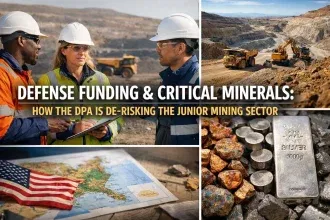
Strategic alignment: Defense funding is now the primary de-risking tool for critical mineral projects.

2. The Copper Supply Gap: The Structural Ghost
Copper is the mover that doesn’t have a ticker, yet it dictates every board meeting from Vancouver to Perth. The numbers are brutal. Existing supply is projected to meet only about 70% of global demand by 2035.
This isn’t a rounding error. It’s a crisis.
More Read

Every major project currently being fast-tracked is essentially a drop in an ocean of demand driven by the copper processing requirements of the AI and EV revolutions. We are looking at a 2026 market where “getting the ore out” is less important than “having the ore in the first place.” The structural deficit is the most powerful force in the room.
3. Rio2: The Mid-Tier Execution Machine
Rio2 is putting on a masterclass in acquisition and timing. Their US$241 million buyout of Peru’s Condestable copper-gold mine was completed in December, and the payoff is already visible.
They are forecasting 27,000 metric tons of copper equivalent annually. But the real story is the Fenix gold project in Chile. First gold is scheduled for March 2026. That’s this month. While others are stuck in the permitting purgatory of the Andes, Rio2 is actually pouring metal. Execution over exploration. Every single time.
4. Lundin Mining & The Vicuña District: The New Frontier
Lundin Mining’s $215 million stake increase in the Vicuña District is a bet on a generational asset. Located on the border of Chile and Argentina, this isn’t just one mine: it’s an entire district including Josemaria, Filo del Sol, and Los Helados.
The scale here is staggering. In an era where “tier-one” assets are disappearing, Lundin is consolidating control over what might be the last great copper-gold cluster of the century. They are playing a long game that most shareholders don’t have the stomach for, but the 2026 cycle rewards the patient.

The Vicuña District represents the scale of exploration required to fill the looming copper deficit.
5. Uranium’s “Silent Squeeze”: The 2026 Energy Pivot
Uranium has moved from the fringe to the center of the clean energy narrative. As China’s critical minerals export controls tighten the screws on other sectors, the nuclear supply chain is becoming the ultimate hedge.
We aren’t just talking about spot price hikes. We are talking about long-term contract resets that are forcing utilities to scramble for domestic supply. The movers here aren’t just the producers; they are the explorers who have spent a decade in the dark and are suddenly finding the lights are back on.
6. Graphite One: Alaska’s Magnet Play
Graphite One is the wildcard that just turned into a trump card. Their Graphite Creek deposit in Alaska recently confirmed the presence of all five principal permanent magnet rare earths.
This is huge.
Positioning itself eighth on the recent industry rankings, Graphite One is capitalizing on the US government’s obsession with domestic supply chains. If you want to build an EV in America, you need Graphite One. It’s that simple. They are proof that geology still matters, even in a tech-obsessed world.

Next-gen processing facilities are modular, efficient, and increasingly built close to the source.
7. Heliostar Metals: The Production Ramp-Up
Heliostar Metals is making a jump that most juniors only dream of. They are targeting production growth from 30,000 ounces to 300,000 ounces annually by the end of the decade.
That’s a 10x multiplier.
In a market that is increasingly cynical about “growth projections,” Heliostar is delivering on-the-ground results. Their focus on high-grade assets and lean operations is a blueprint for the 2026 cycle. They aren’t trying to be everything to everyone; they are just trying to be the most efficient gold producer in the room.
8. G Mining Ventures: The Guyana License Win
G Mining just secured a 20-year mining license for its Oko West gold project. This follows final environmental permit approval: a hurdle that has killed many a promising project in South America.
Guyana is quickly becoming the darling of the mining world, and G Mining is the poster child for how to navigate the regional politics. They are showing that Ghana’s bauxite boom or the complexities of Oyu Tolgoi aren’t the only models for frontier mining. Clear permitting and strong local partnerships are the new gold standard.

Labor and licensing: The two biggest hurdles for projects in the 2026 mining cycle.
9. C3 Metals: The High-Altitude Discovery
C3 Metals and their Khaleesi Discovery in the Andean belt are proving that there are still monsters left to find. Geologists are currently assessing drill cores that point toward a major copper-gold porphyry system.
It’s high-altitude. It’s rugged. It’s expensive.
But it’s also exactly what the majors are looking for. As big miners run out of reserves, they are looking at companies like C3 to provide the next generation of supply. This is exploration at its most fundamental: and most rewarding.

Assessing the future: Geologists examine core samples at a frontier Andean drill site.
10. The Department of Energy (DOE): The New VC
You can’t talk about the 2026 mining cycle without talking about the US Department of Energy. They have essentially become the most influential Venture Capitalist in the sector.
From USA Rare Earth consolidating control of Round Top to the countless grants for lithium processing, the DOE is picking winners. The “shakers” this week aren’t just CEOs; they are the bureaucrats in DC holding the checkbook. If you aren’t on their radar, you aren’t in the game.
The 2026 Verdict
The mining industry has always been cyclical, but this cycle is different. We are no longer just digging up rocks to sell to the highest bidder. We are digging up the foundational components of a new global economy.
The movers on this list understand that the old rules: relying solely on Chinese processing, ignoring the midstream, or neglecting ESG: are gone. In 2026, the winners are those who can navigate the intersection of geology, geopolitics, and government funding.
Those two clocks: the speed of technology and the slowness of geology: do not sync. And that’s exactly where the opportunity lies. There’s not enough to go around. Not even close.