Mining news this week is being shaped by a common question across commodities: which projects are moving from strategic narrative to measurable execution?

For operators, investors and policymakers, the most useful catalysts are not broad themes alone. They are construction milestones, scheduled plant restarts, drilling programs, regulatory decisions and technical studies that can change how a project is valued or how quickly new supply might reach the market.
This edition of the Weekly Power List tracks five companies and projects with clearly reported near-term catalysts across the AI-energy nexus, copper, uranium and SMR-related supply, lithium and frontier exploration. It is an informational watchlist, not a buy, sell or hold recommendation.
Five mining catalysts to watch
| Name / ticker | Commodity or theme | Jurisdiction | Catalyst | Timing | Key risk |
|---|---|---|---|---|---|
| Max Power Mining : CSE: MAXX | Natural hydrogen and AI energy | Saskatchewan, Canada | Follow-up drilling and evaluation of a proposed hydrogen-powered AI infrastructure model | Second half of 2026; timing subject to company plans | Commercial deliverability, financing and non-binding transaction risk |
| Freeport-McMoRan : NYSE: FCX | Copper | Indonesia | Planned restart of the Manyar smelter as Grasberg concentrate shipments recover | September 2026 target | Operational recovery, smelter execution and permitting |
| NexGen Energy : TSX/NYSE: NXE | Uranium and nuclear fuel | Saskatchewan, Canada | Continued Rook I site preparation, earthworks and shaft preparation | Through 2026 | Construction cost, future operating licence and execution |
| Lithium Americas : NYSE: LAC | Lithium and critical minerals | Nevada, United States | Continued Phase 1 construction and installation of major process infrastructure at Thacker Pass | 2026 construction program; late-2027 mechanical completion target | Cost overruns, ramp-up, lithium prices and project execution |
| Frontier Nuclear and Minerals : Nasdaq: FNUC | Uranium frontier exploration | Wyoming, United States | Approximately 120-hole Pine Ridge drill program targeting a maiden resource | July–December 2026; possible extension into January 2027 | Exploration results, permitting, metallurgy and resource definition |
1. Max Power Mining: testing the AI-energy connection

The AI-energy nexus is creating a new class of mining news in which the value proposition is not limited to a mined commodity. Max Power Mining’s Lawson Complex in Saskatchewan is being advanced as a potential natural hydrogen system that could eventually support distributed power generation and cooling for AI and high-performance computing infrastructure.
Max Power has reported hydrogen concentrations of up to 286,000 parts per million in its initial Lawson work and has described the system as Canada’s first confirmed subsurface natural hydrogen discovery. The company has also reported a three-dimensional seismic program intended to improve its understanding of the system’s geometry and continuity.

The immediate catalyst is technical validation. Max Power is preparing an expanded follow-up drilling program to test the commercial potential of the Lawson system. The company also signed a memorandum of understanding with TerraVolt Energy, EcoTech Building Solutions and Carbon Neutral Growth Fund to evaluate a model combining natural hydrogen, modular power systems, building infrastructure and produced brine waters for AI data centres.
That agreement is explicitly exploratory. It does not guarantee a definitive commercial contract or construction project. Its importance lies in the way it links a resource-development program to a specific end-use market: power-intensive computing.
The next material signals will be drilling results, evidence of sustained flow and clarity on how any hydrogen could be processed, transported or converted into electricity. The main risk is that geological confirmation does not automatically establish commercial deliverability. The project must still address infrastructure, financing, regulation, hydrogen-handling technology and customer commitments.
Read the reported Lawson AI infrastructure memorandum and Skillings’ broader analysis of autonomous mining technology and energy demand.
2. Freeport-McMoRan: the Manyar restart and Grasberg recovery

Freeport-McMoRan enters the week with a copper catalyst tied to one of the industry’s most closely watched operating recoveries.
PT Freeport Indonesia CEO Tony Wenas told reporters that the Manyar smelter in East Java was expected to resume production in September as concentrate shipments from the Grasberg mine gradually recover. The update was reported by Reuters and published by Mining Weekly.
The restart matters because Grasberg’s recovery has implications beyond a single mine. Mining activity at the Indonesian operation was halted after a fatal mud-flow incident, and the return to normal production is expected to be gradual. Freeport has said the mine could approach full capacity by the end of 2027.
Since mining restarted, PT Smelting in Gresik has been the priority recipient of Grasberg concentrate. Combined copper cathode production from Manyar and PT Smelting was estimated at nearly 400,000 tonnes in 2026, according to the reported company guidance.
For the market, the September restart is a defined operational checkpoint. A successful restart could improve the flow of material through Indonesia’s integrated mine-and-smelter system. Delays, technical problems or lower-than-expected feed could extend tightness in the copper market.
The catalyst should therefore be read in both directions. A restart would support the recovery narrative, but it could also release additional refined copper into a market already responding to supply disruptions and elevated physical premiums.
Key indicators include the actual restart date, ramp-up rates, concentrate availability and any change to Freeport’s consolidated production outlook. The key risks remain operating reliability, the pace of Grasberg’s mine recovery and the possibility that smelter performance lags mine output.
See the reported Manyar restart update and Skillings’ coverage of copper prices and physical tightness.
3. NexGen Energy: Rook I moves into construction

NexGen Energy’s Rook I project has moved beyond a permitting story and into visible site development in Saskatchewan’s Athabasca Basin.
The Canadian Nuclear Safety Commission issued NexGen a licence to prepare the site and construct the uranium mine and mill on March 4, 2026. The licence authorizes site preparation and construction, but not operation. A future operating licence would require a separate application and regulatory decision.
NexGen’s project materials state that construction has started and that shaft preparation is underway. The company’s 2026 site program includes earthworks, shaft and mill pads, a diffuser road, temporary water treatment and additional construction infrastructure.
The project is designed as a high-grade underground uranium operation with permitted production of up to 30 million pounds of uranium oxide annually. NexGen reports measured resources of 209.6 million pounds of U₃O₈ at 4.35%, alongside indicated and inferred resources.
The near-term catalyst is execution: whether early works remain on schedule, whether detailed engineering and procurement continue without material disruption, and whether the company can translate its licence into a controlled four-year construction program.
Rook I is relevant to both uranium markets and the wider SMR and nuclear-power conversation because utilities and governments are seeking additional long-term fuel supply. However, a construction licence is not a production permit. The project still faces capital, infrastructure, environmental-monitoring, workforce and future operating-licence risks.
The CNSC facility page provides the regulatory distinction between construction and operation. NexGen’s Rook I project overview details the project design and current development stage.
4. Lithium Americas: Thacker Pass remains a construction story

Lithium Americas’ Thacker Pass remains one of the most important proposed domestic lithium developments in North America, but its next catalyst is execution rather than near-term production.
Phase 1 is designed to produce 40,000 tonnes per year of battery-quality lithium carbonate. Lithium Americas has consistently targeted mechanical completion of the Phase 1 processing plant for late 2027, followed by full ramp-up through 2028.
The company’s 2026 construction program includes major civil, structural and process work. Reported milestones include the delivery of pipe-rack modules, installation of crystallizers and counter-current decantation tanks, steel erection and progress on the lithium carbonate building. The project has also been receiving long-lead equipment and construction materials.
Phase 1 has an estimated capacity to increase current U.S. lithium production substantially, while its financing structure includes support from the U.S. Department of Energy and General Motors. That government and industrial backing makes construction progress relevant to the broader debate over domestic critical-mineral supply chains.
The watch points for the coming period are the pace of equipment installation, high-voltage infrastructure, capital spending and any update to the late-2027 mechanical-completion target. The primary risks are cost escalation, construction delays, commissioning performance, lithium-market conditions and the ability to ramp the process plant consistently.
Lithium Americas’ Thacker Pass overview contains the company’s project description and development targets. Skillings has also tracked the wider lithium supply and market-balance outlook.
5. Frontier Nuclear: Pine Ridge drilling targets a maiden resource
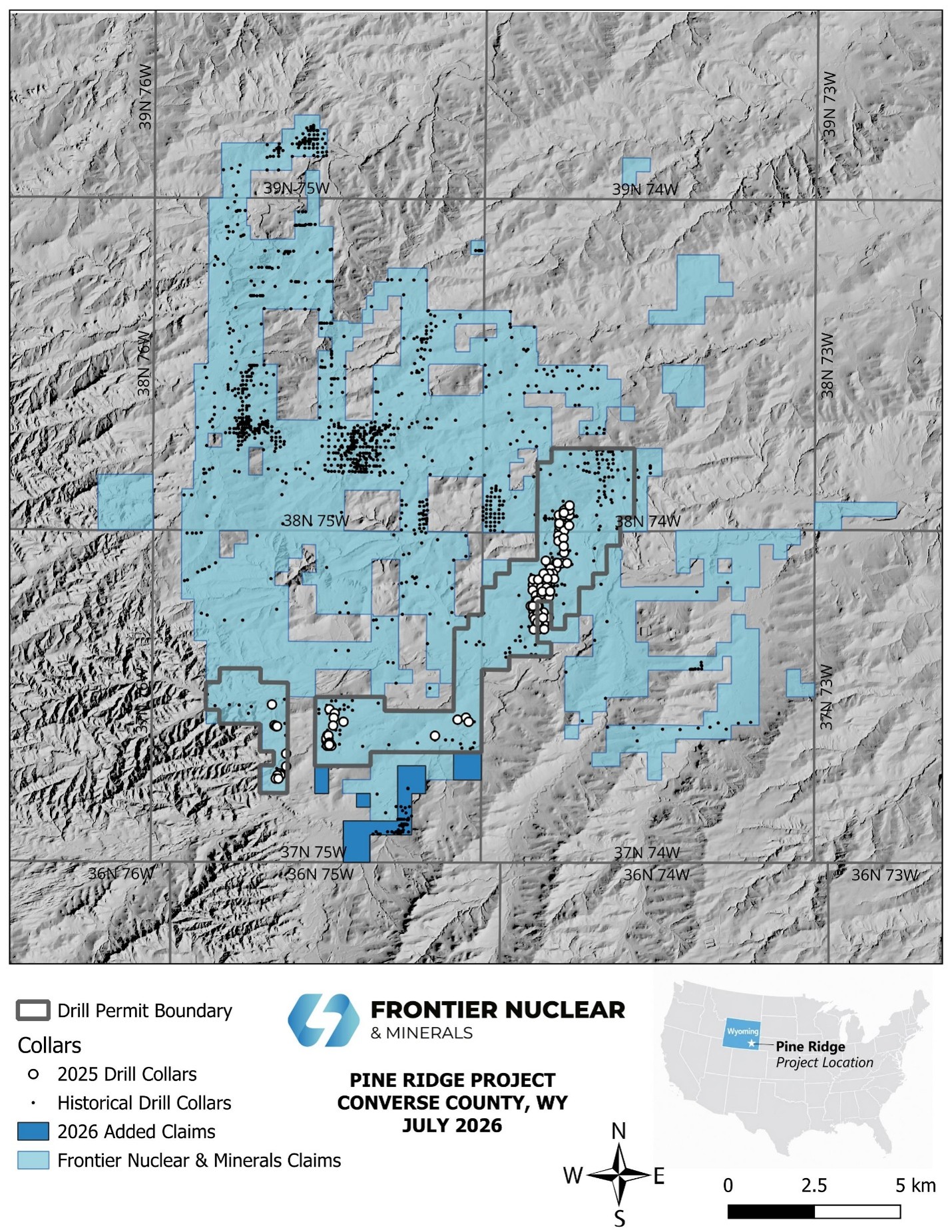
Frontier Nuclear and Minerals offers the list’s clearest frontier-exploration catalyst.
The company began a 2026 drill program at its 100%-owned Pine Ridge uranium project in Wyoming’s Powder River Basin in July. The program is expected to comprise approximately 120 holes totaling 36,000 metres, using one rig from July through December, with a possible extension into January 2027.
The objective is to define sandstone-hosted roll-front uranium deposits and prepare a maiden mineral resource estimate by early 2027. That target builds on Frontier’s 2025 program, which identified widespread mineralization, continuity across several areas and at least 25 mineralized roll fronts within multiple sandstone packages.
Pine Ridge covers approximately 39,390 acres and is located near Cameco’s Smith Ranch processing facility. Frontier says the project benefits from more than 1,300 historical drill holes, in addition to the 2025 drilling campaign.
The immediate catalyst is the flow of exploration results: assays, confirmation of mineralized trends, thickness and continuity, and evidence that the project can support an eventual in-situ recovery development concept.
As with all early-stage exploration, the stated drilling target is not a resource estimate. The main risks include disappointing grades or continuity, metallurgy, permitting, groundwater management, financing and the possibility that a maiden resource is delayed.
Read Frontier Nuclear’s announcement on the Pine Ridge drill program.
Why these mining catalysts matter
These five names represent different points on the mining-development spectrum.
Max Power is testing whether a subsurface energy resource can connect with the physical requirements of AI infrastructure. Freeport is managing an operating recovery with direct implications for copper supply. NexGen is converting a licensed uranium project into construction activity. Lithium Americas is demonstrating whether a strategically supported battery-materials project can maintain schedule and cost discipline. Frontier Nuclear is still at the exploration stage, where drilling must establish the resource base needed for later technical and permitting work.
The common thread is measurable progress. In a market crowded with forecasts and proposed transactions, the most consequential mining news will likely come from companies that can show new tonnes, reliable infrastructure, regulatory advancement or verified technical results.
Shareable LinkedIn/X snippet
Five mining catalysts to watch: Max Power’s natural-hydrogen and AI-energy model, Freeport’s Manyar smelter restart, NexGen’s Rook I construction, Lithium Americas’ Thacker Pass buildout and Frontier Nuclear’s Pine Ridge drilling. A neutral watchlist for operators, investors and policymakers tracking supply-chain execution.