By Charles Pitts

Autonomous mining technology 2026 has officially transitioned from cautious pilot programs and isolated capital expenditures into the default operational baseline for tier-one and tier-two producers alike. What was once viewed as an ambitious engineering experiment confined to remote Australian iron ore basins is now a sprawling, multi-vendor industrial ecosystem.
With fleet deployments surging past historical thresholds, mining companies are no longer asking whether driverless haulage works. Instead, capital allocators are evaluating how rapidly mixed-fleet interoperability, battery-electric automation, and underground spatial intelligence can be scaled across global operations to compress unit costs and eliminate fatal safety hazards.
The 1,000-Truck Milestone: Komatsu’s FrontRunner and Surface Dominance
The scale of this transition was underscored when Komatsu commissioned its 1,000th autonomous ultra-class haul truck running the FrontRunner Autonomous Haulage System (AHS). Achieving this milestone makes Komatsu the first original equipment manufacturer (OEM) to reach four-digit deployments in ultra-class surface haulage.
The milestone unit: a Komatsu 930E-5AT electric drive truck with a 290-metric-ton payload capacity: was deployed at Barrick’s Nevada Gold Mines complex in the United States. Komatsu’s flagship 930E series alone accounts for more than half of the company’s total autonomous fleet. Since the commercial debut of FrontRunner in 2008 at Rio Tinto’s Pilbara operations, Komatsu-equipped autonomous fleets have collectively moved over 11.5 billion metric tons of material globally.
More Read

Crucially, the economic case for autonomy is increasingly matched by an unblemished safety record. Across more than a decade and a half of continuous commercial operation, FrontRunner deployments have reported zero system-related injuries. By removing operators from high-fatigue haulage circuits, mining majors have virtually eliminated collision risks associated with blind spots, shift fatigue, and extreme weather conditions.


Retrofitting and OEM-Agnostic Fleet Transformation
While OEMs like Komatsu and Caterpillar have traditionally anchored their autonomy solutions to proprietary hardware ecosystems, the broader market demands flexibility. Mining companies operating heterogeneous fleets cannot simply scrap existing machinery to adopt a single manufacturer’s autonomous stack.
More Read

This commercial reality has catalyzed partnerships focused on OEM-agnostic retrofitting. Hitachi Construction Machinery and autonomy developer Pronto have advanced collaborative frameworks to retrofit legacy haul trucks with vision-centric, hardware-light autonomous systems. By deploying advanced sensor suites: combining high-resolution cameras, edge-computing processors, and supplementary radar: retrofit solutions allow mid-tier producers and mature operations to convert conventional diesel-electric fleets into autonomous units without greenfield capital outlays.
This retrofitting trend democratizes access to hands-free operations. Smaller miners facing declining ore grades and rising labor costs can now phase in autonomy truck-by-truck, significantly lowering the barrier to entry that previously restricted driverless technology to multi-billion-dollar greenfield projects.

Cabless Electrification and New Entrants
Autonomy is also converging rapidly with zero-emission propulsion. The traditional paradigm of building massive operator cabs atop 300-ton haul trucks is being challenged by purpose-built, cabless battery-electric vehicles designed from the ground up for unattended operation.
A prime example is SANY’s SKT145Ei, a cabless, battery-electric autonomous haul truck engineered specifically for high-capacity open-pit applications. Without the weight, space, and climate-control requirements of a human operator cabin, the SKT145Ei optimizes payload distribution, reduces vehicle tare weight, and maximizes energy efficiency.
Simultaneously, technology providers such as China’s CiDi are expanding their footprint into international markets. By pairing heavy-duty electric trucks with robust V2X (vehicle-to-everything) communication networks and localized 3D mapping software, these new market entrants are challenging traditional OEM dominance in bulk commodity basins across Asia, Africa, and Latin America.
Underground Autonomy and Spatial Intelligence
While surface haulage commands the highest visibility due to the sheer size of ultra-class trucks, underground mining is undergoing an equally profound automation shift. Confined, high-risk, and geologically complex, underground environments are ideal proving grounds for advanced robotic perception.
Sandvik’s AutoMine suite: featuring AutoMine Aura for underground loaders (LHDs), trucks, and drills: has set the benchmark for subterranean automation. By utilizing sophisticated 3D laser perception, inertial navigation, and real-time path planning, modern underground machines navigate narrow, winding declines without relying on surface GPS infrastructure.
+---------------------------------------------------------------------------------+
|               SURFACE VS. UNDERGROUND AUTONOMY ARCHITECTURES                    |
+--------------------------+------------------------------------------------------+
| Metric / Parameter       | Surface Haulage (e.g., Komatsu 930E)                 |
+--------------------------+------------------------------------------------------+
| Primary Guidance         | High-Precision Differential GPS / Centimetric GNSS   |
+--------------------------+------------------------------------------------------+
| Environmental Challenge  | Dust, Extreme Weather, Open Pit Topography           |
+--------------------------+------------------------------------------------------+
| Core Business Driver     | High-Volume Payload, Fuel Efficiency, Tire Life      |
+--------------------------+------------------------------------------------------+
| Underground Counterpart  | Sandvik AutoMine / 3D Laser Inertial Mapping         |
+--------------------------+------------------------------------------------------+
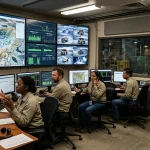
Operators stationed in surface control rooms can oversee multi-level underground stopes where autonomous LHDs muck ore continuously through shift changes and blasting intervals. This eliminates the traditional downtime required for smoke clearance and ground control inspections, boosting underground equipment utilization rates by 25% to 40% across early adopter sites.

Operator-Led Orchestration: Vale, LoopX, and the ISO 23725 Standard
As autonomous fleets expand, major mining houses are moving beyond single-vendor dependencies. Rather than relying entirely on OEM-controlled software stacks, producers like Vale are pioneering operator-centric R&D partnerships: such as their work with advanced AI orchestration platforms like LoopX.
These enterprise-level orchestration layers unify disparate equipment brands: integrating Komatsu surface trucks, Sandvik underground loaders, and Caterpillar shovels into a single, cohesive dispatch and optimization network.
To ensure these mixed-fleet ecosystems operate safely and seamlessly, the formalization of global standards has become paramount. The advancement of ISO 23725 provides the regulatory and technical baseline for interoperability among autonomous mining systems. By establishing standardized communication protocols, functional safety requirements, and emergency intervention frameworks, ISO 23725 reduces integration friction and reassures mining regulators and insurers as fleets cross the multi-thousand unit threshold globally.

Strategic Outlook
The milestone of 1,000 autonomous trucks deployed by a single manufacturer marks the end of mining’s probationary phase with automation. Autonomy is no longer an optional differentiator for elite operations; it is the fundamental architecture upon which future mineral supply chains will be built.
For mining executives and engineering managers, the strategic imperative for the remainder of the decade is clear. Capital allocation must pivot toward modular, OEM-agnostic architectures that embrace battery-electric propulsion, retrofitting capabilities, and interoperability standards. As global demand for copper, lithium, nickel, and iron ore intensifies, the miners who successfully scale hands-free operations will capture decisive cost advantages while securing social licenses through uncompromised operational safety.