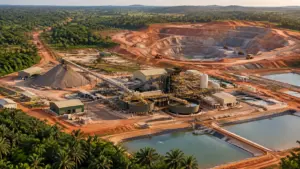
The traditional mining model is broken. For decades, the industry has relied on a linear relationship: if you want more ore, you need more bodies, more shifts, and more massive capital expenditure on legacy hardware. But 2026 has brought a brutal reality check to the surface. As labor costs spiral and ore grades decline, the “brute force” method of extraction is no longer economically viable.

Enter the Centennial copper mine in Utah.
What was once a dormant asset underperforming at 2,500 tons of copper cathode annually is now the poster child for the “AI-native” mine. Mariana Minerals didn’t just buy a mine; they bought a testing ground for a thesis that many in the industry were too timid to test: that autonomous systems are not an “efficiency layer” but the core production methodology. The results are already hammering the old guard’s expectations.
The 20x Multiplier: Brutal Math, Not Magic
Mariana Minerals’ $85 million Series A funding to revive Centennial wasn’t spent on a larger cafeteria or more housing for workers. It was poured into a fleet of autonomous haul trucks, drill rigs, and AI-driven operational software. The goal is audacious: 50,000 tons of copper annually by 2030.
That is a 20-fold production increase.
More Read

This isn’t a rounding error. This is a total restructuring of the ROI equation. In a traditional setup, scaling production by 2,000% would require a small army of operators. At Centennial, the production multiplier is achieved through 24/7 continuous operations. Machines don’t have shift changes. They don’t have fatigue cycles. They don’t need to stop for lunch or safety briefings in the same way human crews do.


The strategic calculus here isn’t subtle: by removing the constraints of human biological rhythms, Mariana is effectively “unlocking” hours of production that were previously lost to the ether. When you calculate the ROI of an $85 million investment against a 20x output increase, the payback period shrinks from decades to years.
More Read
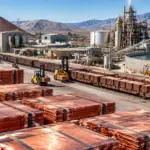
Remote Operations Centers: The New Front Line
The most visible shift at Centennial isn’t happening in the pit: it’s happening in the Remote Operations Centers (ROCs). The workforce hasn’t been eliminated; it has been redistributed. A conventional mine of this scale would require hundreds of personnel on-site. Centennial is shifting that weight toward systems engineers, maintenance technicians, and remote monitors.
This is a trend we are seeing globally. Whether it’s the mining job market in Africa or the high-altitude sites in the Andes, the demand for “boots on the ground” is being replaced by a demand for “eyes on the screen.”
Utah is becoming a hub for these remote centers. The reason is simple: infrastructure. To run an autonomous fleet, you need low-latency connectivity and a talent pool that understands both geology and Java. By centering operations in Utah, Mariana can tap into a tech-savvy workforce that would never have considered a career in traditional “dirt” mining.
The Copper-AI Nexus: Why This Matters Now
There is a deep irony at play in 2026. The very technology driving the need for autonomous mines: Artificial Intelligence: is the primary driver of the copper demand that makes these mines profitable. Every new data center and every GPU cluster being deployed by Big Tech is a copper sink.
As we’ve noted in our analysis of the AI-energy nexus, the demand for critical minerals is hitting a fever pitch. Copper is the nervous system of the modern world. Without it, the “shiny AI revolution” grinds to a halt.
Mariana Minerals is effectively closing the loop. They are using AI-driven autonomous systems to extract the copper needed to build the next generation of AI. It’s a self-reinforcing cycle that de-risks the investment. When the end-user (Big Tech) is desperate for supply, the operator who can guarantee consistent, high-volume output through autonomy wins the contract.

Comparative Economics: Autonomy vs. Legacy
To understand the Centennial revival, you have to look at the competitive landscape. While Mariana is going all-in on tech, others are struggling with the whipsaw of iron ore prices and the complexities of green steel pivots.
Here is how the ROI breakdown typically shakes out for a tech-first revival:
- Capital Intensity: High upfront cost ($85M for Centennial), but significantly lower OpEx over the life of the mine.
- Safety Abatement: Autonomous operations drastically reduce Insurance premiums and LTI (Lost Time Injury) costs.
- Utilization Rates: Machines operate at 90%+ utilization, compared to the 60-70% typical of human-operated shifts.
- Precision: AI-driven drilling reduces “dilution”: the accidental extraction of waste rock: which increases the effective grade of the ore sent to the mill.
For junior miners and mid-tiers, this model provides a blueprint for reopening assets that were previously deemed “uneconomic.” If you can’t afford a 500-person camp and the associated logistics, you better find a way to run that site with 50 people and 100 robots.
Strategic Shifts in the Southwest
Centennial isn’t an isolated incident. The American Southwest is seeing a resurgence of interest in “defunct” assets. BHP and Faraday Copper are looking at Arizona restarts; Blue Moon Metals recently acquired a germanium and gallium site in Utah. Even Rio Tinto, fresh off its massive Arcadium Lithium acquisition, is providing loans to central Utah copper operations.
The common thread? They are all looking for ways to bypass the labor shortage. The “skills gap” in mining isn’t just a talking point; it’s a structural threat to the industry. By betting on autonomy, Mariana Minerals isn’t just being “innovative”: they are being pragmatic. They are future-proofing against a world where there aren’t enough traditional miners to go around.

The 2030 Horizon: Dependencies and Risks
Of course, the path to 50,000 tons isn’t without its grim realities. The 2030 target requires sustained performance over a four-year scaling window. That is an eternity in the tech world and a heartbeat in the mining world.
The biggest risk? Reliability.
If the autonomous software glitches or the Remote Operations Center loses connectivity, the entire mine stops. There is no “manual override” when your equipment is miles away and controlled by an algorithm. Furthermore, the industry is still grappling with how to maintain these high-tech fleets. A mechanic who can fix a 1990s Cat truck is not the same person who can troubleshoot a LiDAR sensor array.
Mariana’s success depends on their ability to build a hybrid maintenance culture: one that treats a software bug with the same urgency as a blown hydraulic hose.
The Bottom Line
The Centennial Mine revival is more than just a local success story; it’s a stress test for the future of the industry. It proves that venture capital is finally seeing mining not as a “dumb” commodity business, but as a high-stakes tech play.
For operators, the lesson is clear: Autonomy is no longer a luxury for the Tier 1 majors like Rio Tinto or BHP. It is the entry price for anyone looking to bring “marginal” assets back to life in a high-cost, high-demand environment.
2026 marks the inflection point. The mines that survive the next decade won’t be the ones with the most workers. They’ll be the ones with the best code.