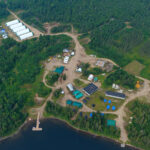
An open-pit tungsten operation in Galicia, Spain. Image: Skillings Mining Intelligence.

By Penny Langford
Eurobattery Minerals said metallurgical testwork at its San Juan tungsten project in Galicia, Spain, produced a concentrate grading 63.1% WO₃, a result the company described as commercial grade.
The result matters because the project is being developed against a highly concentrated global supply chain. China remains the dominant tungsten producer, processor and consumer, while the United States has not mined tungsten commercially since 2015, according to the U.S. Geological Survey’s 2026 Mineral Commodity Summary.
For San Juan, however, the 63.1% result is not a production guarantee. It is a laboratory-scale processing milestone that must still be translated into consistent mine feed, plant availability, permitting compliance, financing and contracted sales.

What Eurobattery Minerals reported
The testwork was conducted by SLR Consulting in the United Kingdom between April and July 2026, in consultation with Minepro Solutions, according to Eurobattery Minerals’ announcement.

The company said the programme used a gravity-based circuit consisting of hydrocyclone desliming, spiral concentration, scavenging and cleaning. It reported that the circuit achieved:
| Metric | Reported San Juan result | Why it matters |
|---|---|---|
| Concentrate grade | 63.1% WO₃ | Indicates a high-grade tungsten trioxide concentrate |
| Tungsten recovery | 49.9% of tungsten in feed | Shows the portion of contained tungsten recovered in the tested circuit |
| Concentrate mass | 0.7% of original feed | Indicates substantial upgrading from ore to concentrate |
| Scheelite liberation | 92% free or liberated | Supports gravity concentration in the tested sample |
| Bond crushing index | 6.67 kWh/t | Classified by the company as “very easy” crushing |
| Abrasion index | 0.12 | Classified as slightly abrasive |
| Thickener unit area | 0.07 m²/t/day | Compatible with conventional thickening equipment, according to the company |
Eurobattery Minerals said the circuit used no flotation, chemical separation reagents or leaching. The equipment: including hydrocyclones, spirals, shaking tables and a thickener: is commercially available, the company said.

The distinction between the headline grade and the recovery rate is important. A 63.1% WO₃ concentrate demonstrates product quality in the cleaning stage, but it does not mean that 63.1% of the tungsten in the ore was recovered. Eurobattery Minerals reported recovery of 49.9% of the tungsten contained in the feed.
The company also cautioned that the results came from laboratory testing on a bulk sample and are not directly comparable with continuous industrial plant performance. It said the final recovery range will be determined during plant enrichment and operation.
Why tungsten matters to the supply chain
Tungsten, also known as wolfram, combines high melting point, hardness, density and wear resistance. Eurobattery Minerals identifies the metal as important to cutting tools, mining equipment, high-performance alloys, aerospace, electronics and defense applications in its San Juan project overview.
The USGS said about 60% of U.S. tungsten consumption was used in cemented carbide parts for cutting and wear-resistant applications, including construction, metalworking, mining and oil and gas drilling. Other uses include specialty steels, electrical components, welding products and tungsten chemicals.
That demand profile gives tungsten an industrial role that extends beyond the energy transition. Cutting tools and wear parts influence the productivity of other mining and manufacturing sectors, while tungsten alloys and specialty products are used in aerospace and defense supply chains.
The material is also strategically exposed. The USGS reported that China produced approximately 67,000 tonnes of tungsten in 2024, out of global mine production of about 82,000 tonnes. Spain produced approximately 3,400 tonnes, according to the same source.
The USGS also reported that China remained the world’s leading producer, importer and consumer of tungsten concentrates in 2025. It said China introduced export controls on selected tungsten products in February 2025, while prices rose sharply during the year.
For buyers in Europe and North America, that concentration creates a supply-chain question at several stages: not only at the mine.
Concentrate is only the first link
Tungsten ore must be mined, concentrated and then converted into intermediate and finished products. The downstream chain can include ammonium paratungstate, tungsten oxides, tungsten powder, tungsten carbide and cemented carbide tools.
That means a new mine outside China can improve geographic diversity without automatically creating a fully independent supply chain. Buyers still need conversion capacity, technical specifications, logistics, financing and long-term offtake arrangements.

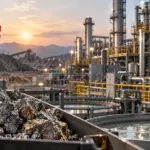
Hydrocyclones, spirals and shaking tables are central to the gravity-based flowsheet tested for San Juan.
The San Juan testwork is relevant because Eurobattery Minerals said the project’s flowsheet avoids flotation and chemical separation reagents. As an operational inference, a simpler gravity circuit could reduce reagent procurement, chemical handling and certain water-treatment requirements compared with a flowsheet that depends on flotation or leaching. It does not, by itself, establish lower overall operating costs or a smaller environmental footprint at commercial scale.
Those outcomes would depend on plant design, water recycling, power use, tailings management, maintenance, labor, reagent-free recovery performance and the quality of the final concentrate.
Project stage remains the central risk
Eurobattery Minerals has moved San Juan into engineering and development, but the project remains pre-production. The company’s project page lists development activities including construction and commissioning, while recent company updates have targeted commercial production in 2027.
Several risks remain between the laboratory result and a saleable, consistently produced concentrate.
1. Sample representativity
The reported testwork was based on a bulk sample. The company’s own caveat means the result may not capture all geological variability across the deposit.
Changes in scheelite grain size, liberation, dilution, slimes content or host-rock characteristics could affect recovery and concentrate quality as mining advances. A plant designed around a narrow sample range may require operational changes if the orebody behaves differently across benches or mining phases.
2. Scale-up and plant control
Gravity equipment is commercially available, but commercial performance depends on circuit configuration and control. Hydrocyclone classification, spiral feed density, table operation, water balance and thickener performance must remain stable as throughput changes.
Eurobattery Minerals has said the next steps include detailed engineering, plant construction and commissioning. Those steps must demonstrate that the laboratory flowsheet can operate continuously, not only under controlled test conditions.
3. Recovery versus grade
The 63.1% WO₃ grade is a strong product result, but higher grade can sometimes involve additional cleaning or the rejection of material that contains recoverable tungsten. The project must balance concentrate quality with recovery, throughput and operating cost.
For potential buyers, the final specification will also depend on impurities, moisture, particle size, packaging, delivery terms and penalties. Those commercial details were not established by the reported laboratory result.
4. Permitting and execution
A successful processing test does not resolve mining permits, environmental conditions, water approvals, construction contracts, grid access, road logistics or community engagement.
The company has said San Juan is located near A Gudiña in Ourense, Galicia. Its project materials describe an existing tungsten district and longer-term resource potential, but also state that further exploration is needed to confirm the broader geological opportunity.
This is consistent with a wider shift in project evaluation. As discussed in Skillings’ analysis of critical minerals policy and project economics, permits and execution timelines increasingly influence whether a technically viable deposit can attract capital.
What the result means for 2026 decision-makers

Laboratory testwork must be followed by representative sampling and continuous plant validation.
The San Juan result improves the project’s technical case in three ways.
First, it indicates that the tested ore can produce a high-grade WO₃ concentrate through gravity concentration. Second, the reported liberation data support the use of conventional equipment in the tested sample. Third, the result gives engineers a more defined basis for plant design than an exploration-stage assay alone.
The result does not yet establish project economics. A full assessment would require mine scheduling, capital costs, operating costs, recovery across representative ore domains, concentrate pricing, transport, taxes, closure liabilities and funding requirements.
For the broader European supply chain, San Juan illustrates the value of projects that can produce an intermediate product close to industrial markets. But the strategic benefit will depend on whether production is reliable and whether downstream processors are prepared to accept and convert the concentrate.

Mining supply-chain resilience depends on transport, processing and customers as well as resource quality.
A practical monitoring framework
Operators, investors and policymakers should track five milestones as San Juan advances:
- Representative metallurgical testing: Whether additional samples confirm the 63.1% WO₃ result and the reported recovery range.
- Pilot or continuous testing: Whether the gravity circuit maintains grade and recovery over sustained operating periods.
- Final plant design: Throughput, water balance, thickener sizing, tailings handling and expansion assumptions.
- Permitting and construction: Approval status, equipment procurement, commissioning schedule and cost changes.
- Commercial arrangements: Concentrate specifications, offtake terms, transport routes and access to downstream conversion.
The main conclusion is measured but significant: Eurobattery Minerals’ San Juan project has reported a high-grade tungsten concentrate from a simple gravity-based flowsheet, strengthening its technical case at a time when tungsten supply remains concentrated and geopolitically exposed.
The next test is not whether the laboratory can produce 63.1% WO₃. It is whether the project can reproduce that quality, at acceptable recovery and cost, through a permitted and continuously operating commercial plant.
Social snippets
LinkedIn:
Eurobattery Minerals says its San Juan tungsten project in Galicia produced a 63.1% WO₃ concentrate through gravity-only processing. Our analysis examines the result, the 49.9% reported recovery, China’s supply-chain dominance and the project risks between laboratory testwork and commercial production.
X:
San Juan tungsten testwork produced a reported 63.1% WO₃ concentrate using gravity processing. The key questions now are recovery, scale-up, permitting, plant execution and downstream supply-chain access.