By Charles Pitts

China’s lithium carbonate market has settled into a narrow range as seasonal purchasing from battery and cathode producers meets a steady recovery in domestic output and higher imports.
Battery-grade lithium carbonate was assessed around 140,000–145,750 yuan ($19,700–$20,500) per tonne in mid-September, according to market assessments compiled by industry data providers. The range is below levels seen at the start of the month and reflects a market that has not been able to convert peak-season buying into a sustained rally.
The immediate question for producers, converters and downstream buyers is whether the traditional September stocking cycle will tighten the market again, or whether returning capacity and imported feedstock will cap prices through the second half of the year.
Mysteel and Shanghai Metals Market, or SMM, offer a broadly similar reading of the market’s competing forces: demand is improving, particularly from lithium iron phosphate (LFP) batteries and energy storage, but supply is also recovering. The result is a market that is consolidating rather than breaking decisively higher or lower.
Price support has weakened from early-month levels
Mysteel assessed battery-grade lithium carbonate at 158,750 yuan per tonne in its Sept. 1 evening session, while its analysis of the second half of 2026 pointed to a possible move toward 170,000 yuan as inventories declined and downstream buyers prepared for peak-season demand.

Subsequent market assessments have been lower. Trading and industry data cited by market trackers placed prices near 142,250–143,000 yuan per tonne, while another assessment put the level at 145,750 yuan. Differences reflect variations in grade, delivery terms, location and the timing of transactions, but the direction is clear: spot prices have moved away from the upper end of the early-September range.
The decline does not necessarily signal a collapse in demand. Instead, it indicates that buyers have remained selective. Cathode producers and battery manufacturers have continued to replenish material when prices softened, but have generally avoided chasing the market higher.

That pattern has created a floor under prices while limiting the potential for a sharp rebound.
China lithium carbonate market snapshot
Indicator Current market signal Battery-grade carbonate 140,000–145,750 yuan/tonne Mysteel assessment at start of September 158,750 yuan/tonne September domestic production plan cited by Mysteel About 116,800 tonnes September net imports forecast by SMM About 29,300 tonnes Main demand swing factor LFP batteries and energy storage
Peak-season buying is real but cautious
September is traditionally one of the stronger purchasing periods for China’s battery supply chain. New electric vehicle models, year-end delivery schedules and energy-storage installations can all encourage producers to secure lithium units before demand rises further.
Mysteel’s survey of major battery producers indicated that China’s lithium-ion battery production schedules for September were expected to reach a year-to-date high. The survey estimated total production at about 332 gigawatt-hours, with energy-storage cells accounting for approximately 130 GWh, or 39% of the total.
However, Mysteel also cautioned that some of the increase may reflect front-loaded orders and tax-related timing rather than a durable acceleration in end-market consumption. LFP cathode production was rising more slowly than overall cell output, suggesting that some inventory movement was occurring at different points along the supply chain.
SMM has reached a similar conclusion. Its September analysis described demand as resilient but price-sensitive, with buyers showing stronger interest below approximately 150,000 yuan per tonne. The agency expects LFP cathode output to exceed 610,000 tonnes in September, supported by both electric vehicles and stationary storage.
That matters because LFP now represents the dominant source of lithium carbonate demand in China. SMM estimates that LFP cathode production consumes more than 80% of the country’s lithium carbonate demand, making its production schedules a key indicator of the market balance.

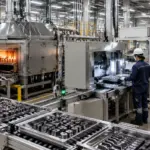
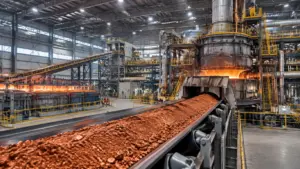
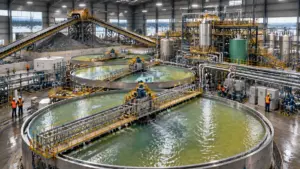
Industrial processing equipment illustrates the conversion capacity connecting lithium feedstock with battery-grade carbonate.
Energy storage is becoming the marginal demand driver
Electric vehicles remain the foundation of lithium demand, but energy storage is increasingly influencing short-term purchasing decisions.
SMM expects China’s storage-cell output to reach approximately 94.47 GWh in September. Grid-scale, generation-side and commercial and industrial projects are supporting demand, while larger-format cells are moving from qualification into commercial deliveries.
The storage market has also provided a buffer against periods of softer passenger-vehicle demand. Utility-scale projects are often planned over longer time horizons than automotive procurement, giving cell manufacturers greater visibility and supporting production even when vehicle sales fluctuate.
SMM’s forecasts show lithium carbonate demand for LFP cathode production rising from about 139,100 tonnes in August to 146,900 tonnes in September, 154,000 tonnes in October and approximately 158,600 tonnes in November.
Those figures help explain why prices have not fallen more sharply despite rising supply. Demand is not uniformly strong across the market, but the storage segment is absorbing a significant volume of LFP material.

Large-scale brine operations remain an important source of global lithium supply.
Domestic restarts and imports add pressure
China’s lithium carbonate supply is recovering after maintenance, temporary suspensions and operating disruptions across hard-rock, lepidolite and salt-lake operations.
SMM estimates that domestic carbonate output reached approximately 116,400 tonnes in August, up 7% from July, and expects production to rise further as suspended capacity returns. September domestic output could reach about 128,500 tonnes under SMM’s estimate, although individual operating rates remain sensitive to margins and raw-material availability.
Imports are adding another source of material. China imported approximately 26,800 tonnes of lithium carbonate in July, up 30% month on month and 93% year on year, according to SMM. September net imports are projected at roughly 29,300 tonnes.
The combination of higher domestic output and imports is increasing the amount of material available to converters. It also changes the market’s risk profile: even if demand remains firm, a larger supply pipeline makes it more difficult for buyers to create a sustained shortage through stockpiling.
The timing of further feedstock arrivals will be important. Mysteel expects spodumene concentrate from Australia and Zimbabwe, along with salt-lake material from South America, to arrive more rapidly from late November. That could create additional downward pressure if downstream stocking has already been completed and battery production slows seasonally.
Jianxiawo remains a key swing factor
The operating status of CATL’s Jianxiawo lithium mine in Jiangxi remains central to supply expectations.
The mine has become a market focus because any restart or expansion would add domestic lithium units at a time when producers are already bringing capacity back online. At the same time, uncertainty around regulatory approvals and the timing of a full return has limited the market’s willingness to assume that all potential supply will arrive immediately.
Benchmark Mineral Intelligence has linked early-September price support to uncertainty surrounding the mine and regulatory developments. Industry coverage has also suggested that a full resumption could add a significant volume of lithium supply during the second half of the year.
For buyers, Jianxiawo represents a potential source of future relief. For sellers, the lack of clarity over its operating schedule provides some support by preventing the market from fully pricing in the additional tonnes.
The mine is therefore less important as a single supply point than as an indicator of how quickly China’s higher-cost domestic production can return. If Jianxiawo and other suspended operations restart smoothly, the market’s balance could loosen. If regulatory or operational constraints persist, imports and existing output may not be sufficient to meet the strongest demand scenarios.
H2 balance depends on demand realization
SMM expects supply to continue rising through the final quarter, but it also forecasts that demand will remain ahead of available material under its current assumptions.
Its estimates put total lithium carbonate demand at approximately 184,900 tonnes in October, 189,500 tonnes in November and 182,300 tonnes in December. Against projected supply, that would imply deficits of about 20,100 tonnes, 21,500 tonnes and 12,300 tonnes, respectively.
Mysteel is more cautious about the durability of the current demand impulse. Its analysis said September could represent the peak of the seasonal production cycle, with fourth-quarter momentum depending on whether large-scale storage-cell pricing improves and overseas orders remain firm.
The difference between the two outlooks is not a disagreement over whether supply is growing. Both agencies expect more supply. The key variable is whether energy-storage and LFP demand will grow quickly enough to absorb it.
That is why prices have consolidated rather than moved in a clear direction. Downstream buyers are providing support near lower price levels, while domestic restarts and imports are limiting upside.
For the rest of the year, operators and investors will be watching three indicators closely: the pace of Jianxiawo’s return, the volume and timing of overseas feedstock arrivals, and whether energy-storage demand remains strong after the peak-season stocking cycle ends.
Until those variables become clearer, China’s lithium carbonate market is likely to remain volatile but rangebound, with seasonal buying meeting a supply base that is gradually becoming more flexible.
Sources: Mysteel’s H2 2026 China lithium market analysis, SMM’s H2 2026 lithium carbonate outlook, Mysteel lithium carbonate price assessments, and Benchmark Mineral Intelligence lithium prices.