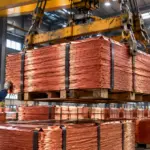
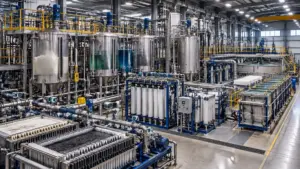
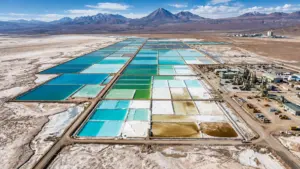
Rare earth separation and refining equipment at an industrial processing facility.

The critical minerals supply chain is becoming less constrained by geology than by chemistry. New mines are advancing across the United States, Australia, Brazil and Africa, but the ability to separate, refine and convert their output into battery-grade, magnet-grade or industrial materials remains concentrated in a small number of countries.
That imbalance is central to the 2026 outlook. The International Energy Agency says the top three refining countries accounted for an average 86% of refined output across six key energy minerals : copper, lithium, nickel, cobalt, graphite and rare earths : in 2024, up from about 82% in 2020. By comparison, the top three mining countries accounted for 77% of production.
The distinction matters for operators, investors and policymakers. A new mine can add tonnes to global resources, but those tonnes do not become secure supply until they can be processed, qualified and delivered to manufacturers.
The supply chain’s narrowest point sits beyond the mine
China remains the dominant refiner for 19 of 20 energy-related minerals tracked in the IEA’s analysis, with an average share of about 70%. Indonesia has become the key refining hub for nickel, while China maintains a leading position in cobalt, graphite, lithium processing and rare earth separation.

For rare earths, the concentration is even more pronounced. China accounts for more than 90% of global rare earth separation and refining capacity and roughly 94% of sintered permanent magnet production, according to IEA-linked industry assessments.

That gives processing countries influence that mine owners do not necessarily possess. Ore from a Brazilian, Australian or U.S. project may still require Chinese-linked chemical expertise, equipment, reagents, technical specifications or downstream customers before it can enter an advanced manufacturing supply chain.
Skillings previously examined this structural imbalance in Critical Minerals Refining Is 86% Concentrated. The central conclusion remains relevant in 2026: diversification in mining has moved faster than diversification in refining.


An integrated mining and processing operation illustrates the infrastructure required to connect mine supply with midstream capacity.
China’s export controls add pressure to an existing dependency
Prospective Chinese export-control pressure is not limited to the possibility of an outright embargo. Licensing delays, end-use reviews, technology restrictions and selective enforcement can create disruption without stopping every shipment.
China introduced export controls on several medium and heavy rare earths in 2025, including dysprosium, terbium, yttrium and related compounds and materials. Broader measures affecting additional rare earths, foreign-made products containing Chinese-origin materials and technologies used in separation, refining and magnet manufacturing have also become a planning concern for Western manufacturers.
The practical risk is that companies may have access to ore but lack predictable access to the processing steps needed to convert it into usable products.
That is why the prospective expiration or reactivation of broader measures has become a planning milestone for manufacturers and project developers. Skillings’ analysis of the November export-control test for the West outlines three potential outcomes: a managed extension, selective reactivation or a broad snapback affecting materials, technology and foreign-made products.
The most exposed materials are likely to be heavy rare earths used in high-performance permanent magnets. Dysprosium and terbium improve magnet performance at high temperatures, making them important in electric vehicles, wind turbines, aerospace systems, industrial motors and defense equipment.
A linkable snapshot of the midstream gap
| Indicator | Latest reported measure | Why it matters |
|---|---|---|
| Top three refining countries’ share across six key energy minerals | 86% in 2024 | Processing remains more concentrated than mining |
| Comparable share in 2020 | 82% | Refining concentration has increased rather than declined |
| Top three mining countries’ share in 2024 | 77% | Mine supply is geographically broader than refining |
| China’s average position across 19 of 20 energy-related minerals | About 70% of refining | China remains the leading midstream supplier across most minerals |
| China’s share of rare earth separation and refining | More than 90% | Alternative mine supply can remain dependent on Chinese processing |
| China’s share of sintered permanent magnet production | About 94% | The downstream bottleneck extends beyond chemical refining |
| Expected average share of top three refined-material suppliers by 2035 | About 82% | Announced projects imply only limited near-term diversification |
| Typical capital-cost premium for projects in more diversified regions | About 50% | Supply security can be more expensive than lowest-cost supply |
Sources: IEA Global Critical Minerals Outlook, Skillings analysis. Figures refer to different mineral groups and should not be treated as directly interchangeable.
The data points to a difficult investment equation. Refining projects outside established hubs can improve resilience, but they often face higher construction costs, smaller initial markets, stricter environmental requirements and more expensive power and chemical inputs.
USA Rare Earth targets the mine-to-magnet gap
The acquisition of Brazil’s Serra Verde Group by USA Rare Earth is one of the clearest attempts to address the problem through vertical integration.
Under the agreement announced in April, USA Rare Earth agreed to acquire Serra Verde, owner of the Pela Ema rare earth project in Goiás, Brazil, for $300 million in cash and 126.849 million newly issued shares. The transaction implied an equity value of approximately $2.8 billion based on USA Rare Earth’s share price at the time.
The combination was completed in September, according to USA Rare Earth. Pela Ema produces the four magnetic rare earths needed for neodymium-iron-boron magnets: neodymium, praseodymium, dysprosium and terbium.
The financing architecture is as important as the acquisition itself. Serra Verde secured a $565 million financing package from the U.S. International Development Finance Corporation. A separate special-purpose vehicle was capitalized at $1.55 billion to purchase 100% of Phase 1 production under a 15-year offtake agreement.
That structure combines mine supply, processing, long-term purchasing commitments and government-backed capital. It is designed to reduce the commercial risk that often prevents Western refineries from reaching scale: uncertainty over who will buy the output and whether the project can compete with lower-cost Chinese supply.
USA Rare Earth is also developing U.S. magnet manufacturing capacity. The model therefore extends from Brazilian production and processing to U.S.-aligned downstream conversion rather than stopping at the mine gate.

Workers inspect process equipment in a critical minerals facility.
U.S. financing is moving toward midstream capacity
U.S. policy has increasingly recognized that mining incentives alone will not close the supply-chain gap. Federal support is being directed toward separation plants, magnet manufacturing, recycling, strategic offtake agreements and project finance.
That shift is visible in the structure of the Serra Verde financing and in support for other rare earth projects. It also reflects a broader concern: mine development timelines can be long, but midstream projects face their own technical and commercial barriers.
A refinery needs more than feedstock. It requires qualified chemical processes, reliable power, waste-management systems, skilled operators, product specifications and customers willing to accept material from a new supplier. Each stage can delay commissioning or limit utilization.
For investors, this makes project quality more difficult to assess. An announced resource, a permitted mine, a pilot separation plant and a commercially qualified refinery are not equivalent milestones.
The same principle applies to recycling. Recovered rare earths can reduce demand for primary supply over time, but recyclers must secure consistent magnet scrap, achieve high recovery rates and qualify their output with manufacturers. Recycling capacity can complement mining and refining; it cannot remove the need for primary supply in the near term.
Three scenarios for the 2026 critical minerals supply chain
| Scenario | Supply-chain outcome | Likely market effect | Key indicators |
|---|---|---|---|
| Bull case: managed diversification | Chinese licensing remains workable while U.S., allied and Brazilian projects advance on schedule | Premiums for non-Chinese material narrow as new refining and magnet capacity qualifies | Construction milestones, customer qualification, stable license approvals and new offtake agreements |
| Base case: selective pressure | Controls remain targeted, but licensing and technology reviews lengthen delivery times | A two-tier market develops, with higher premiums for heavy rare earths and defense-grade supply | Dysprosium and terbium premiums, contract duration, shipment lead times and equipment approvals |
| Bear case: broad snapback | Broader export controls return with aggressive enforcement across materials, technology and foreign-made products | Inventory drawdowns, production delays, redesigns and accelerated government intervention | License denials, shipment refusals, extraterritorial enforcement and magnet shortages |
The base case is the most operationally plausible. A fully disruptive embargo would impose costs on Chinese manufacturers as well as foreign buyers, while a complete relaxation would weaken Beijing’s leverage. Selective licensing pressure allows China to preserve commercial trade while retaining influence over strategic end users and technologies.
What decision-makers should monitor
Mining companies should assess projects by the full value chain rather than by mine output alone. The relevant questions include:
- Who will separate and refine the material?
- Is the process commercially proven at the proposed scale?
- Can the project operate without Chinese equipment, reagents or technical services?
- Are customers committed to purchasing the output?
- Does the financing structure protect the project during low-price periods?
- Can the product meet specifications for magnets, batteries or industrial applications?
For manufacturers, supply-chain mapping should extend beyond the immediate supplier to the separation plant, chemical converter and technology provider. Chinese-origin material may remain relevant even when final assembly occurs in a third country.
For policymakers, the priority is to connect permitting, finance and demand support. A mine without a refinery is incomplete supply security. A refinery without customers is an underutilized asset. A magnet plant without qualified feedstock remains exposed to upstream disruption.
The central 2026 conclusion is straightforward: critical minerals security will be determined less by how many new deposits are identified than by how quickly midstream capacity can be built, financed and qualified.
The race is no longer simply to extract copper, lithium, nickel or rare earths. It is to control the processing steps that turn those materials into products the energy, industrial and defense sectors can use.
Social snippets
Critical minerals supply chains are becoming more geographically diverse at the mine : but not at the refinery. The top three refining countries accounted for 86% of refined output across six key energy minerals in 2024, while China remains the dominant refiner for 19 of 20 minerals tracked by the IEA. USA Rare Earth’s Serra Verde acquisition shows how U.S.-aligned financing is shifting toward mine-to-magnet integration. The remaining challenge is scale, qualification and cost.
X
The critical minerals bottleneck is increasingly midstream. Refining remains more concentrated than mining, China dominates rare earth separation and magnet production, and new Western projects face higher costs and long qualification timelines. USA Rare Earth’s Serra Verde deal shows the strategic shift toward mine-to-magnet supply chains.