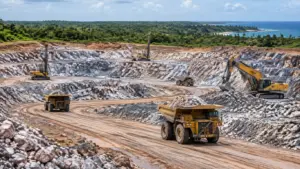
An underground gold mine in Quebec's Abitibi region. Image: Skillings Mining Intelligence

Cartier Resources has lowered the upfront cost of its Cadillac gold project in Quebec while extending the proposed mine life to 16.2 years, according to an updated preliminary economic assessment released Thursday.
The Agnico Eagle-backed company said the project’s initial capital requirement has fallen to C$275.8 million, from C$341 million in the previous 2023 study. The updated plan also increases the proposed mine life from 9.7 years to 16.2 years, with average annual production of about 100,000 ounces of gold.
The study evaluates Cadillac at a base-case gold price of US$3,600 per ounce. It also includes a sensitivity at US$4,300 per ounce, close to the approximately US$4,310 gold-price environment cited by the company and market participants in 2026.
At the base case, Cartier reported an after-tax net present value, discounted at 5%, of C$1.001 billion and an after-tax internal rate of return of 26.6%. At US$4,300 per ounce, after-tax NPV rises to approximately C$1.565 billion, while the after-tax IRR increases to 37.3%.
A larger project with lower upfront capital
The Cadillac Project is located near Val-d’Or in Quebec’s Abitibi gold belt and covers a 15-kilometre stretch of the Larder Lake–Cadillac Fault Zone. Cartier owns the project through a land package that includes the historic Chimo Mine and the East Cadillac property.

The updated PEA replaces the earlier study on what was then called the Chimo Mine Project. Cartier said the new assessment incorporates its updated mineral resource estimate, 2026 metallurgical testwork and a different gold-price environment.
The proposed operation would be entirely underground and use conventional longitudinal longhole stoping. Mining would be carried out through ramp access, with load-haul-dump machines moving ore to the surface by truck. The mine plan reaches a peak mining rate of 4,300 tonnes per day.

The PEA contemplates mining approximately 23.1 million tonnes of mineralized material grading 2.28 grams of gold per tonne. That material contains about 1.698 million ounces of gold, of which the study estimates 1.610 million ounces would be recovered at a metallurgical recovery rate of 95%.
The project’s processing strategy is staged. Cartier plans to use third-party toll milling at 3,000 tonnes per day during the first year. A 3,000-tonne-per-day plant would then operate on site from years two through four, followed by an expansion to 4,300 tonnes per day from year five onward.

The Cadillac Project sits near Val-d’Or, a major mining centre in Quebec’s Abitibi region.
Capital discipline remains central to the case
The reduction in initial capital is one of the most significant changes from the 2023 PEA.
The earlier study outlined a 4,500-tonne-per-day underground operation with a 9.7-year mine life and average annual production of 116,900 ounces. It used a gold price of US$1,750 per ounce, estimated initial capital at C$341 million and reported an after-tax NPV of C$388 million.
The updated study presents a different development strategy. Rather than building the project at its eventual full processing rate from the outset, Cartier has structured the plan around toll milling, a smaller initial plant and a later expansion.
That sequence helps reduce the capital required before production begins. However, it also means the project remains exposed to execution risk around third-party milling capacity, underground development and the timing of the expansion.
Cartier estimates total initial capital at C$275.8 million, including infrastructure, electrical and communications systems, underground development, processing facilities, indirect costs and contingency. Growth capital is estimated at C$277.1 million, largely associated with the processing expansion.
Sustaining capital is estimated at C$1.102 billion over the life of the mine, with closure capital of C$40 million. Total capital costs across the project are therefore approximately C$1.655 billion.
| Cadillac Project metric | Updated PEA |
|---|---|
| Initial capital | C$275.8 million |
| Growth capital | C$277.1 million |
| Sustaining capital | C$1.102 billion |
| Closure capital | C$40 million |
| Total capital costs | C$1.655 billion |
| Mine life | 16.2 years |
| Average annual gold production | 100,000 oz |
| Total recovered gold | 1.610 million oz |
| Peak mining rate | 4,300 tonnes per day |
| Metallurgical recovery | 95% |
| AISC | US$2,137/oz |
The capital profile also illustrates the distinction between a low initial build cost and the full cost of operating the mine over time. The C$275.8 million initial figure is important for financing and construction decisions, but it does not represent the project’s total capital commitment.
Gold-price sensitivity increases the margin for development
Cartier’s base-case assumptions are already materially higher than those used in the 2023 assessment. The updated study uses US$3,600 per ounce gold and a Canadian-to-U.S. dollar exchange rate of 1.38.
At that base case, the project produces an after-tax payback period of 4.3 years. The study estimates life-of-mine after-tax free cash flow at C$2.772 billion.
The sensitivity table shows how strongly the project’s economics respond to gold prices:
| Gold price | After-tax NPV5% | After-tax IRR | Payback |
|---|---|---|---|
| US$3,000/oz | C$497.2 million | 16.4% | 6.2 years |
| US$3,600/oz base case | C$1.001 billion | 26.6% | 4.3 years |
| US$4,200/oz | C$1.486 billion | 35.9% | 2.8 years |
| US$4,800/oz | C$1.962 billion | 44.9% | 2.2 years |
At the US$4,300-per-ounce scenario highlighted by Cartier, the after-tax NPV reaches approximately C$1.565 billion. That represents an NPV-to-initial-capital ratio of roughly 3.6 times.
The project’s estimated all-in sustaining cost of US$2,137 per ounce is notably higher than the US$755 per ounce reported in the previous PEA. The difference reflects changes in the mine plan, project scale, capital treatment, sustaining requirements and operating assumptions. It also means the project’s economic resilience will depend on the relationship between gold prices and the cost base as development advances.
Mining operating costs account for the largest share of the estimated operating expense. Cartier forecasts total life-of-mine operating costs of C$3.148 billion, equivalent to approximately C$136.40 per tonne processed.

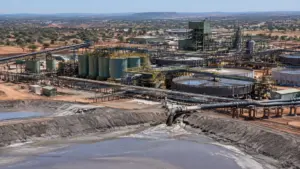
The proposed development would combine underground mining with staged processing infrastructure.
Resource growth remains outside the PEA
Cartier’s updated mineral resource estimate includes 767,800 ounces of measured and indicated gold resources and approximately 2.417 million ounces of inferred resources across the Cadillac property.
The company said about 35,000 metres of drilling completed during 2025 and 2026 have not yet been incorporated into the current economic model. Cartier also pointed to new discoveries in the Contact and Hope sectors and exploration potential along the Cadillac Fault.
Those targets could provide future resource growth, but they are not included in the current PEA. As a result, the updated economic assessment should be viewed as a development case based on the defined mineralized material rather than a full valuation of the district’s exploration potential.
The distinction is important under Canada’s National Instrument 43-101 disclosure rules. A PEA is preliminary in nature and may include inferred mineral resources, which are considered too geologically speculative to have the economic considerations applied to them that would enable them to be categorized as mineral reserves.
Cartier said the updated technical report supporting the PEA will be filed on SEDAR+ and on the company’s website within 45 days of the announcement.
Permitting and execution are the next tests
The PEA includes preliminary work on environmental, permitting and social considerations. Cartier said Stantec completed a review of the project’s physical, biological and social setting in 2026. The company has also started geochemical characterization of waste rock, ore and tailings to support water and materials management planning.
The proposed infrastructure includes underground portals, waste-rock and overburden facilities, tailings management, water systems, power infrastructure, offices and maintenance facilities.
Cartier’s Cadillac Project overview describes the property’s access to roads, regional infrastructure and nearby milling capacity. Its previous PEA page provides the company’s earlier technical study for comparison, while the updated PEA announcement contains the current economic tables and assumptions.
For investors and potential project partners, the immediate question is whether Cartier can preserve the updated capital profile as the project moves from a preliminary assessment toward more advanced engineering and permitting. The low initial capital requirement improves development flexibility, but the large sustaining and growth commitments underline the importance of construction sequencing, operating performance and access to toll-milling capacity.
The updated Cadillac study gives Cartier a longer production profile and stronger economics at current gold prices. Its next challenge will be converting that preliminary case into a financeable, permitted and technically defined underground operation.

Gold-bearing quartz mineralization is characteristic of the hard-rock geology targeted by underground operations in the Abitibi belt.
Source: Cartier Resources updated PEA announcement and project disclosures; Mining.com reporting. The PEA is preliminary and does not establish mineral reserves.