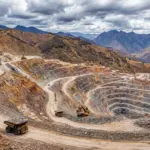
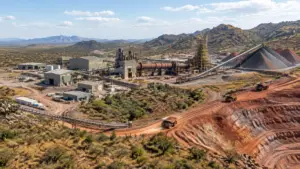
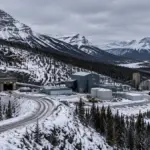
An open-pit mining complex in Nevada’s arid Great Basin region.

By Penny Langford
Barrick Mining Corp. and Newmont Corp. have agreed to expand their Nevada Gold Mines joint venture to include Barrick’s Fourmile project and Newmont’s Fiberline and Mike developments, adding a major exploration asset and two development projects to the world’s largest gold-mining partnership.
Under the agreement announced Aug. 10, Newmont will pay Barrick $1.95 billion in cash after Fourmile is contributed to Nevada Gold Mines. The ownership structure will remain unchanged, with Barrick holding 61.5% and continuing as operator, while Newmont retains 38.5%.
The deal also resolves outstanding disputes between the companies over the joint venture and includes revised governance provisions. Newmont has separately consented to Barrick’s planned initial public offering of its North American gold assets, removing a potential obstacle to that transaction.
The agreement is subject to the contribution of the three projects under a Second Amended and Restated LLC Agreement. The companies said the assets are expected to be contributed simultaneously as soon as reasonably practicable.

Fourmile brings a growing resource base
Fourmile is located next to Barrick’s Goldrush development in northern Nevada. Barrick has described the project as a high-grade discovery and reported that its estimated resources had grown to approximately 15.6 million ounces in early 2026.
The project had originally been excluded from the Nevada Gold Mines joint venture created in 2019. Fiberline and Mike, both owned by Newmont, were also left outside the initial structure pending further development and feasibility work.
Bringing the three assets into the same operating platform changes the scope of the joint venture’s longer-term project pipeline. Fourmile’s location beside Goldrush could allow the companies to evaluate infrastructure, mine planning and processing options across a more continuous district, although the agreement does not establish a production schedule for the project.
Newmont will receive a 38.5% economic interest in Fourmile through its existing stake in Nevada Gold Mines. Barrick will retain the majority interest and operatorship while receiving the cash payment from Newmont.
| Key term | Detail |
|---|---|
| Barrick ownership | 61.5% |
| Newmont ownership | 38.5% |
| Operator | Barrick |
| Barrick contribution | Fourmile project |
| Newmont contributions | Fiberline and Mike projects |
| Cash payment | $1.95 billion from Newmont to Barrick |
| Agreement status | Assets to be contributed as soon as reasonably practicable |
| Other outcome | Outstanding NGM disputes resolved |
Terms based on company disclosures and the joint venture agreement described in the parties’ announcements.
Nevada remains central to U.S. gold supply
The expansion reinforces Nevada’s importance to the U.S. gold industry. According to the U.S. Geological Survey’s 2026 Mineral Commodity Summaries, U.S. gold mine production was estimated at 160 metric tons in 2025, with Nevada accounting for approximately 64% of the national total.
That equates to roughly 102 metric tons of Nevada production, calculated from the USGS state share. The agency also estimated the 2025 value of U.S. mine production at $17 billion, while the average gold price rose sharply during the year.
Nevada Gold Mines is the largest operating concentration within that production base. Industry data cited by Mining.com.au put the joint venture’s 2025 output at approximately 2.595 million ounces, or about 80.7 metric tons.
Production comparisons should be treated carefully because company reporting and USGS statistics use different bases. Nevada Gold Mines reports attributable production through the partners, while USGS figures cover statewide mine output. Still, the scale of the joint venture helps explain why changes to its asset base matter for U.S. gold supply and the companies’ long-term production strategies.
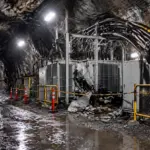
Newmont’s Nevada Gold Mines operations page describes the existing venture as a network of 10 underground mines, 12 open-pit mines, two autoclave facilities, two roasting facilities, four oxide mills, a flotation plant and five heap-leach facilities. The assets include the Cortez, Carlin, Turquoise Ridge, Phoenix and Long Canyon operations.
The integration of additional deposits into that network could give the partners more flexibility in sequencing development and using established processing infrastructure. Any such benefits will depend on technical studies, permitting, capital allocation and the economic characteristics of each project.
A strategic reset for both companies
For Barrick, the transaction monetizes part of Fourmile’s value while preserving majority control through Nevada Gold Mines. The company will continue to operate the expanded complex and participate in future development through its 61.5% interest.
The agreement also supports Barrick’s effort to reorganize its North American gold assets. Newmont’s consent to the proposed North American gold asset IPO addresses restrictions associated with the joint venture structure, according to the companies’ disclosures.
For Newmont, the deal provides exposure to Fourmile while allowing the company to consolidate Fiberline and Mike within an operating platform it already owns. The structure avoids creating a separate standalone development vehicle for each project and gives Newmont continued participation in Nevada without changing its minority position in the joint venture.
The $1.95 billion payment is the central financial feature for Newmont. The company is effectively paying to gain a stake in Fourmile and to place the three previously excluded projects under a modernized joint venture framework. Barrick’s deemed contribution for joint venture accounting purposes was reported at approximately $3.11 billion, compared with Newmont’s $1.95 billion contribution.
The companies did not provide a new annual production forecast for the expanded asset base. That distinction is important: the agreement increases the resource and development pipeline, but it does not immediately translate into additional gold output.
What happens next
The next step is the formal contribution of Fourmile, Fiberline and Mike to Nevada Gold Mines. Newmont’s cash payment is due within 30 days after the contribution of Fourmile, according to the terms summarized in the company disclosures.
The parties will then need to advance technical and development work on the newly included assets. For Fourmile, key questions will include how the resource can be developed alongside Goldrush, what infrastructure requirements will emerge and how the project could fit into the broader Carlin Trend production schedule.
Fiberline and Mike will also require further evaluation before their production potential can be assessed. The agreement brings them into the joint venture, but does not by itself establish reserves, construction decisions or first production dates.
The companies’ ability to coordinate across the expanded portfolio will therefore be as important as the size of the resource base. Nevada Gold Mines already operates a complex mix of open-pit and underground mines, mills, roasters, autoclaves and leach facilities. Adding projects may create logistical and processing options, but it may also increase the demands on capital planning, permitting and governance.

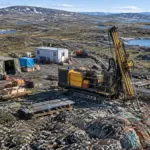
Exploration and technical work will determine how Fourmile, Fiberline and Mike advance within the expanded portfolio.
Production growth will depend on execution
The agreement comes as gold producers face a combination of strong prices, aging mines, rising development costs and pressure to replace depleted reserves. Nevada offers an established mining jurisdiction and extensive existing infrastructure, but new production still depends on permitting, engineering, workforce availability and cost control.
The USGS data show that Nevada’s share of U.S. gold production remains substantial, even as national mine output has declined from 187 metric tons in 2021 to an estimated 160 metric tons in 2025. The addition of Fourmile, Fiberline and Mike strengthens the pipeline around the country’s most important gold-producing region, but the timing of any production increase remains uncertain.
For investors and operators, the immediate significance of the agreement is structural rather than operational. Barrick and Newmont have aligned ownership of several previously separate projects, settled their disputes and preserved the existing 61.5%-38.5% split.
The longer-term test will be whether the expanded Nevada Gold Mines platform can convert Fourmile’s growing resource, together with Fiberline and Mike, into additional production without undermining capital discipline or the performance of the existing operations.
Sources: Barrick and Newmont agreement; Newmont Nevada Gold Mines operations; USGS Gold Mineral Commodity Summaries; Barrick Fourmile project.