Updated PEA models a 22-year operation, 10.7 million ounces of annual silver-equivalent production in its first seven years and a 29.3% after-tax IRR at long-term consensus prices.

Honey Badger Silver has released an updated preliminary economic assessment for its Prairie Creek project in Canada’s Northwest Territories, lifting the mine’s after-tax net present value to about C$1.2 billion from the previous estimate.
The company said the study, released Thursday, reflects stronger metal prices, an expanded resource base and a revised mine plan for the asset, which Honey Badger now calls the PC Silver Mine. The updated economics arrive as silver trades near US$63.80 an ounce, renewing investor attention on North American silver-zinc projects that were previously constrained by lower commodity-price assumptions.
At the long-term consensus price case, the PEA estimates an after-tax NPV at an 8% discount rate of C$1.165 billion, rounded by the company to C$1.2 billion. The study also outlines after-tax life-of-mine free cash flow of C$3.2 billion, an internal rate of return of 29.3% and a payback period of 3.1 years.
All figures are in Canadian dollars unless otherwise stated.

Silver prices reshape Prairie Creek economics
The PEA uses a long-term consensus case of US$50 an ounce for silver, alongside zinc at US$1.50 a pound, lead at US$0.90 a pound and copper at US$5 a pound.

That assumption is materially below the spot-price case included in the study. Using metal prices as of Aug. 31, including silver at US$66.41 an ounce, the project generates an after-tax NPV8% of C$1.836 billion, after-tax free cash flow of C$4.678 billion and an after-tax IRR of 38.2%.
| PEA case | Silver price | After-tax NPV8% | After-tax IRR | Payback |
|---|---|---|---|---|
| Long-term consensus | US$50.00/oz | C$1.165B | 29.3% | 3.1 years |
| Spot pricing | US$66.41/oz | C$1.836B | 38.2% | 2.4 years |
| Last-12-month high | US$121.67/oz | C$3.240B | 54.8% | 1.6 years |
Source: Honey Badger Silver updated PEA.
The company’s last-12-month high case is not a forecast. It applies the highest prices for silver, zinc, lead and copper, together with the lowest foreign-exchange rate, recorded during the preceding 12 months. It illustrates the project’s sensitivity to commodity prices rather than establishing a base-case expectation.
The PEA’s cost profile is supported by the project’s polymetallic production. Honey Badger estimates an all-in sustaining cost, net of by-product credits, of negative US$22 per silver ounce under the long-term consensus case and negative US$36 an ounce under the spot case.
That measure reflects revenue from zinc, lead and copper, which reduces the effective cost assigned to silver production. It also means the project’s economics depend on several commodity markets rather than silver alone.
A long-life underground operation
The updated study outlines a 22-year underground mine producing approximately 2,400 tonnes per day. Run-of-mine material would pass through dense-media separation before milling at an average rate of about 1,500 tonnes per day.
During the first seven years, the operation is expected to produce an average of:
- 3.7 million ounces of silver per year
- 157 million pounds of zinc per year
- 118 million pounds of lead per year
- 2.2 million pounds of copper per year
That equates to approximately 10.7 million ounces of silver-equivalent annually.
Over the full mine life, the PEA forecasts average annual payable production of about 2.5 million ounces of silver, 117 million pounds of zinc, 95 million pounds of lead and 1.3 million pounds of copper. The company calculates average life-of-mine production at approximately 7.9 million ounces of silver-equivalent per year under the long-term consensus pricing framework.

Underground development is planned around existing workings and new access ramps.
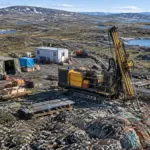
Honey Badger said the project is more advanced than a typical development-stage asset. The site includes a historic mill, an airstrip and approximately five kilometres of underground workings. The company also said key permits and agreements with Indigenous governments are in place, although further engineering, financing and regulatory work remains necessary before a construction decision.
The mine plan is based primarily on mineralization in the Main Quartz Vein, supported by stockwork and stratabound massive sulphide zones. Processing would produce lead and zinc concentrates, with silver and copper payables reporting primarily to the lead concentrate.
Resource growth supports the mine plan
The PEA uses an updated mineral resource estimate containing 11.63 million tonnes of measured and indicated resources grading 424 grams per tonne of silver-equivalent. It also includes 8.47 million tonnes of inferred resources grading 492 grams per tonne of silver-equivalent.
The resource estimate includes silver, zinc, lead, copper and antimony mineralization. Honey Badger said the current PEA does not assign economic value to several potential critical-mineral credits, including germanium, tungsten and antimony. It also excludes the potential impact of recently announced Canadian tax incentives.

Mineralized core represents the polymetallic geology underpinning the updated resource estimate.
The company plans to advance the project toward a feasibility study, which it is targeting for completion in the second quarter of 2027. Honey Badger said future work will focus on capital optimization, processing, development sequencing, a possible staged restart and the potential contribution of critical minerals.
The capital requirement remains substantial. The PEA estimates C$667 million in pre-commercial production capital, including approximately C$205 million for a 170-kilometre all-season road. Life-of-mine capital, including sustaining capital and closure costs, is estimated at approximately C$1.15 billion.
The access road is a central part of the development plan. Year-round access would support supplies, concentrate shipments and mine logistics, while potentially reducing inventory requirements and improving operational reliability. The project has also been awarded more than C$20 million in non-dilutive support from Canada’s National Trade Corridors Fund, according to the company.
2026 silver outlook remains divided
The Prairie Creek update comes as the silver market faces a combination of structural support and sharp price volatility.
The Silver Institute expects the global silver market to remain in deficit for a sixth consecutive year. Its 2026 outlook forecasts total supply of about 1.05 billion ounces, up 1.5%, against a deficit of approximately 67 million ounces. Mine production is expected to rise 1% to 820 million ounces, while physical investment is forecast to increase 20% to 227 million ounces.
Industrial demand is less certain. The Silver Institute expects industrial fabrication to fall 2% to roughly 650 million ounces, mainly because solar manufacturers are reducing silver use per panel and substituting other materials. Demand from data centres, artificial intelligence infrastructure and automotive applications is expected to offset part of that decline.
Forecasts for the silver price therefore remain widely dispersed.
| Outlook source | 2026 silver view |
|---|---|
| J.P. Morgan Global Research | US$70/oz annual average; US$63/oz in fourth quarter |
| Silver Institute | Deficit of about 67 Moz, with continued physical-market tightness |
| Market context for Prairie Creek | Spot silver near US$63.80/oz |
J.P. Morgan’s published outlook takes a more cautious view than the bullish scenarios embedded in Honey Badger’s PEA. It cites softer photovoltaic demand, silver thrifting and the possibility of higher interest rates as downside risks.
For Prairie Creek, the contrast is important. The project’s long-term consensus case uses US$50 silver, while its spot case uses US$66.41. At prices around US$63.80, the project would sit between those two disclosed assumptions, although the company has not published a separate NPV at exactly that price.
Key risks remain before a production decision
The updated economics are preliminary and include inferred mineral resources. Honey Badger has not estimated mineral reserves for Prairie Creek, and the company cautioned that there is no certainty the PEA will be realized.
The project must still address financing, detailed engineering, road construction, operating costs, permitting and logistics in a remote northern environment. Silver, zinc, lead and copper prices could also move materially from the assumptions used in the study.
Honey Badger’s next milestone will be the feasibility study. Investors and operators will be watching whether the company can convert the PEA’s strong price sensitivity into a financeable construction plan, particularly for the all-season road and the mine’s processing infrastructure.
For now, the updated assessment places Prairie Creek among the more significant undeveloped silver-focused projects in North America. Its economics are supported not only by silver prices, but also by the scale of its zinc, lead and copper credits and the infrastructure already present at the site.
Sources: Honey Badger Silver PEA release; Honey Badger Silver PC Silver Mine; J.P. Morgan silver outlook; Silver Institute 2026 market outlook.