By Sonny Rollins

The next milestone in autonomous mining is not another driverless truck demonstration. It is the disappearance of the boundary between fleet classes.
Epiroc’s extension of autonomous truck control from underground workings to surface haul roads, combined with Komatsu’s commissioning of its 1,000th ultra-class autonomous haul truck, shows how the sector is moving toward mine-wide operating systems. At the same time, EACON says its autonomy platform is deployed on more than 3,500 trucks, including more than 1,500 battery-electric units.
The shift matters because autonomy is moving from a large-mine privilege to a potential mid-tier default. The commercial question is no longer whether a truck can follow a route without a driver. It is whether an operator can connect haulage, tipping, charging, communications, drilling and mine planning into one production system.
Citable insight: Autonomous mining is moving from driverless equipment to production control, and the economic advantage will increasingly belong to mines that integrate fleets, energy and data rather than automate isolated machines.
From fleet milestones to mine-wide integration
Industry trade reporting and OEM disclosures indicate that global autonomous haul truck fleets have surpassed 10,000 units. The figure should be treated as a deployment estimate rather than a single audited market series, because manufacturers count different truck classes, retrofit projects and operating stages.

Even with that qualification, the direction is clear. Autonomous haulage has passed the demonstration threshold.

Komatsu’s official announcement confirmed that its FrontRunner Autonomous Haulage System had commissioned 1,000 ultra-class trucks. The milestone truck, a 930E-5AT electric-drive unit with an approximately 290-metric-tonne payload, was deployed at Barrick’s Nevada Gold Mines.
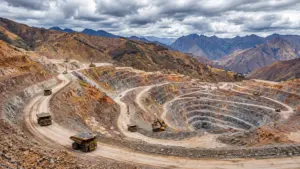
Australia remains the largest adoption base for large-scale open-pit autonomous fleets, supported by long haul roads, high-volume iron ore operations and centralized operating models. China, meanwhile, is scaling battery-electric autonomy fastest, particularly in coal and large open-pit operations where fleet standardization and digital infrastructure can be deployed together.
The result is a market with two overlapping paths:
- Large surface fleets are extending autonomous haulage across established open-pit operations.
- Electrified and underground fleets are being designed around common control, energy and communications architectures from the outset.
The deployment base is broadening
EACON’s reported deployment figures illustrate the speed of adoption outside the traditional ultra-class fleet model. The company says its autonomous system is deployed on more than 3,500 trucks, including over 1,500 battery-electric vehicles. That means battery-electric trucks account for roughly 43% of the company’s reported autonomous fleet.
The figure includes a mix of new-build and retrofit deployments, and the company’s own reporting is the primary source. Nevertheless, it points to an important commercial development: autonomy is no longer tied exclusively to the largest diesel-electric haul trucks.
EACON’s model is particularly relevant to mid-tier operators because retrofit autonomy can reduce the need to replace an entire fleet. The economic case depends on truck condition, site geometry, sensor integration and communications infrastructure, but the ability to upgrade existing equipment changes the entry point for smaller producers.
Epiroc is addressing a different barrier: the boundary between underground and surface operations. Trade coverage of the company’s Deep Automation extension describes autonomous trucks using 3D LiDAR-based localization, mapping and obstacle detection to move from underground routes through portals and onto surface areas.
The capability has been demonstrated rather than universally commercialized. Its significance is nevertheless strategic. A truck that must stop at the portal for a manual handover carries the limitations of two separate operating systems. A truck that can retain its control architecture across both environments can be scheduled as part of one haul cycle.
That is particularly relevant for underground copper, nickel and gold mines where ore movement increasingly involves long ramps, surface stockpiles and centralized processing facilities.

Control-room teams are shifting from in-cab operation toward fleet supervision, exception handling and production coordination.
The mine becomes the product
The most important investment may not be the truck. It may be the network and software environment that allows trucks to work together.
At the Yimin open-pit coal mine in Inner Mongolia, XCMG and its partners have deployed 100 cabless battery-electric haul trucks. Huawei describes the operation as using a private 5G-Advanced network and a vehicle-cloud-network architecture. Reporting on the project identifies automated battery swapping, cloud-based dispatch and high-definition video connectivity as parts of the system.
Hyva and XCMG have also worked on digital tipping technology for the fleet. The company’s Digital Tipping Solutions architecture replaces some manual hydraulic controls with software-managed tipping functions. That makes the dump cycle part of the autonomy stack rather than a separate mechanical action.
The implications extend beyond traffic control. A mine-wide network must coordinate:
- Truck dispatch and route allocation
- Loading and dumping sequences
- Battery charging or swapping
- Road access and mixed-fleet interactions
- Maintenance alerts and remote intervention
- Drill-and-blast data
- Ore routing and processing constraints
Private 5G is attractive because it can provide high bandwidth and low latency across a defined industrial area. But network availability is only one requirement. Autonomous fleets also need resilient positioning, cybersecurity, redundancy and procedures for degraded communications.
For operators, the practical lesson is that autonomy capex cannot be evaluated as a truck purchase alone. It is an operating-model investment involving roads, control rooms, data architecture and workforce design.
The economics: utilization first, charging second
Autonomous haulage can remove direct in-cab seat-hours, but it does not eliminate the need for labor. Operators are redeployed into control rooms, maintenance, dispatch, data management and system support.
At 70% equipment utilization, a truck operating continuously would represent approximately 6,100 direct in-cab equipment-hours per year. At 80% utilization, that rises to about 7,000 hours. These are seat-hours displaced, not jobs automatically removed. The final workforce impact depends on supervision ratios, shift design, intervention frequency and local labor agreements.
The operational value comes from several combined effects:
- More consistent cycle times. Autonomous trucks can maintain repeatable speeds, braking profiles and following distances.
- Higher payload availability. Remote diagnostics and predictive maintenance can reduce avoidable downtime, although sensor and software failures introduce new maintenance requirements.
- Lower fuel consumption. Smoother acceleration and reduced idling can reduce fuel use per tonne moved.
- Potentially lower tyre wear. Predictable driving and improved road discipline may reduce aggressive cornering and braking.
- Reduced exposure to hazardous areas. People can be removed from active haul roads, dumping zones and selected underground work areas.
Battery-electric fleets add a different constraint: charging logistics.
A diesel truck can be refueled during a planned stop. An electric truck requires a charging or battery-swapping strategy that must match production cycles. Charging stations, grid capacity, battery temperature management, spare packs and queueing can become the new bottleneck.
At Yimin, battery swapping helps separate energy replenishment from the haul cycle. Other mines may use fixed charging, dynamic trolley systems or a combination of approaches. None is universally optimal. The answer depends on haul distance, gradients, climate, power availability and fleet intensity.

Open-pit autonomy is moving from isolated truck control toward coordinated fleet production.
Autonomous mining deployment tracker
| OEM or operator | Reported autonomous units | Powertrain or system | Operating environment | Strategic significance |
|---|---|---|---|---|
| Komatsu FrontRunner | 1,000 ultra-class trucks commissioned | Electric-drive haul trucks | Large surface mines | Demonstrates production-scale autonomy across commodities and regions |
| EACON | 3,500+ trucks, including 1,500+ battery-electric | Battery-electric, hybrid and other platforms | Primarily surface operations | Shows retrofit and mixed-OEM pathways into autonomy |
| XCMG and Huaneng Yimin | 100 trucks | Cabless battery-electric | Open-pit coal mine | Combines autonomy, battery swapping, private 5G and cloud dispatch |
| Epiroc Deep Automation | Capability extension; commercial scale varies by site | Underground and battery-electric truck platforms | Underground-to-surface routes | Tests the removal of the portal handover between fleet classes |
| Australian open-pit operators | Largest regional adoption base | Predominantly large electric-drive fleets | Surface haulage | Provides the most mature operating data for high-volume autonomy |
Sources: OEM announcements, company materials and trade reporting. Figures are reported deployment or commissioning numbers and are not directly comparable across providers.
Base, bull and bear cases
The following framework is an operating scenario model, not a market forecast. It shows how adoption and integration could affect unit costs over a mine investment cycle.
| Scenario | Adoption assumption | Energy and network conditions | Indicative haulage cost implication | Main risk |
|---|---|---|---|---|
| Base | 25%–40% of eligible haul cycles automated | Selective electrification; private wireless on main routes | 10%–18% lower cost per tonne after stabilization | Retrofit complexity and workforce transition |
| Bull | 50%–70% of eligible haul cycles automated | Integrated 5G, battery swapping or charging, mine-plan control | 20%–30% lower cost per tonne | Requires interoperability and reliable power infrastructure |
| Bear | Below 20% of eligible haul cycles automated | Network gaps, limited grid capacity and mixed manual fleets | 0%–8% lower cost per tonne | Downtime, safety segregation and stranded capex |
The main difference between the cases is not the advertised capability of an individual machine. It is the percentage of the mine that can operate predictably under one control architecture.
What executives should watch
Four issues will determine whether autonomy becomes a mid-tier default.
Interoperability: Mines with mixed Komatsu, Caterpillar, Epiroc, Sandvik or regional equipment will need data and traffic systems that can work across OEM boundaries. Vendor-specific platforms can accelerate deployment but may increase long-term lock-in.
Retrofit versus new-build: Retrofitting offers a lower entry cost, while new-build fleets can optimize vehicle design, sensors and battery systems from the beginning. The right choice will depend on remaining fleet life and mine longevity.
Workforce transition: Removing drivers from cabs does not remove the need for experienced workers. Mines will need control-room supervisors, autonomy technicians, network specialists and maintenance personnel capable of managing exceptions.
Competing capital priorities: Autonomy and decarbonization may reinforce each other, but they can also compete for capital. A mine may need to fund haulage automation, charging infrastructure, grid upgrades, ventilation changes and processing improvements at the same time.
The industry’s next phase will be measured less by the number of autonomous trucks delivered than by the number of mines that can coordinate trucks, drills, energy and processing without creating new bottlenecks.
For operators, the strategic test is straightforward: can autonomy improve the whole production chain, or only one vehicle class? For investors and analysts, the more useful indicators will be utilization, cost per tonne, intervention rates, charging uptime and the pace of workforce redeployment.
The mines that answer those questions successfully will help determine whether autonomous technology remains concentrated among the largest producers or becomes the operating standard for the next generation of copper, lithium, nickel, gold and critical-minerals assets.
Social snippets
LinkedIn:
Autonomous mining has moved beyond the driverless-truck demonstration. The next phase is integration: underground and surface fleets operating under common control, battery-electric trucks managed through private 5G, and digital tipping and charging systems tied to mine planning. Our analysis examines what that means for costs, labor, interoperability and mid-tier operators.
X:
Autonomous mining’s 2026 story is integration, not just more driverless trucks. Komatsu has passed 1,000 ultra-class units, EACON reports 3,500+ autonomous trucks, and Epiroc is extending control from underground to surface. The next bottleneck may be charging, networks and interoperability.