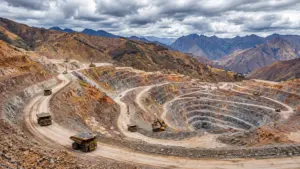
An all-season road under development in a remote Canadian Shield landscape, illustrating the infrastructure challenge facing northern mineral projects.

By Salini Krishnan
Canada has attracted nearly C$500 billion (about US$358 billion) in investment commitments, according to the federal government. But the headline figure conceals a more difficult question for the country’s critical-minerals strategy: how much of that capital is attached to a permitted mine, a processing plant or infrastructure that can move a project to construction?
The answer is far less clear.
The commitments announced through Canada’s Investment Summit include bank financing, pension and insurance capital, investment funds, infrastructure plans and large corporate projects. They demonstrate strong interest in Canada, but most are not commitments to individual mines. That distinction exposes the scale gap between capital available in principle and mineral capacity that can actually be built.
For operators and investors, the bottleneck is no longer simply geological potential. It is the conversion of deposits into permitted, financed and connected industrial assets.

The headline commitment is not mine capacity
The federal government said the Investment Summit generated nearly C$500 billion in new investment commitments. The breakdown included almost C$325 billion in proposed bank financing, nearly C$100 billion from pension funds, insurers and institutional investors, and more than C$14 billion from investment funds.
A further C$52.5 billion Bell Canada investment in Saskatchewan’s artificial-intelligence infrastructure was included in the broader national investment narrative.
Mining and metals were the largest category in the summit prospectus, with 63 projects among 167 projects across eight sectors. Yet inclusion in a prospectus does not mean that a mine has cleared its environmental assessment, secured all permits, reached a final investment decision or arranged construction finance.
The federal government has tried to narrow that gap through the Major Projects Office, the Canada Growth Fund and the Critical Minerals Sovereign Fund. It also committed approximately C$140 million through the Canada Growth Fund to Generation Mining’s Marathon copper-palladium project in Ontario, described as one of Canada’s only fully permitted, shovel-ready critical-minerals projects.
That example is important precisely because it is unusual. A large pool of capital can support a mine only when the project has passed through the approval process and is sufficiently advanced for investors to underwrite construction and operations.
Capital commitments versus permitted mine capacity
| Capital or project signal | Reported value | Link to permitted mine capacity | What it shows |
|---|---|---|---|
| Canada Investment Summit commitments | Nearly C$500 billion | No aggregate mine capacity disclosed | A broad mobilization of capital, not a mine-construction pipeline |
| Bank financing commitments | Nearly C$325 billion | No project-by-project allocation disclosed | Financing availability remains conditional on bankable assets |
| Pension, insurance and institutional capital | Nearly C$100 billion | No permitted capacity attached to the aggregate figure | Long-term capital is interested, but requires investable projects |
| Investment funds | More than C$14 billion | No permitted mine capacity disclosed | Funds may support companies, infrastructure or strategic sectors beyond mining |
| Marathon copper-palladium project | About C$140 million in federal support | Fully permitted and shovel-ready; production capacity was not stated in the summit release | A specific project has crossed the permitting threshold |
| Advanced Canadian gold projects | Nearly US$11 billion in potential annual value across 15 projects | Projects have mine plans and reserves, but remain outside construction | Permitting delays can immobilize significant existing resource value |
| Major Projects Office portfolio | About C$500 billion associated with 27 initiatives | No consolidated mine capacity disclosed | Project coordination is improving, but output remains a future claim |
Sources: Prime Minister’s Office; Export Development Canada; Major Projects Office. The absence of an aggregate capacity figure reflects public disclosure limits, not a conclusion that projects lack resources.
The table highlights the central issue: Canada can count dollars more easily than it can count permitted tonnes.
Permitting is a value-chain constraint
Export Development Canada has described Canada’s geological endowment as a strategic advantage, but it has also identified two practical constraints: permitting timelines and limited domestic processing.
In its analysis of the critical-minerals strategy, EDC said Canada has minerals including lithium, nickel, cobalt, copper and rare earth elements, but that “permitting timelines remain a challenge.” The agency also said the country’s domestic processing footprint remains small and that the economics of building midstream capacity are complex.
That creates a two-stage scale gap.
First, projects must obtain approvals for mines, roads, power systems and processing facilities. Second, developers must determine whether Canadian refining and separation capacity can compete with established facilities in other jurisdictions. Without the second step, Canada risks exporting concentrates while importing higher-value refined products and components.
The issue is visible beyond critical minerals. One analysis identified 15 advanced-stage Canadian gold projects with published mine plans and reserves but no construction decision. Their potential annual production value was estimated at nearly US$11 billion, based on current gold prices. Gold is not classified as a critical mineral, but the permitting queue shows how regulatory delays can affect projects with completed technical work and substantial capital requirements.
Canada’s average mine-development timeline has also been estimated at roughly 20 years, compared with about 14 years in Australia. That difference matters for copper, nickel and lithium projects competing for capital against assets in jurisdictions with shorter development cycles.
The federal response includes a “One Project, One Review” approach, a Mine Permit Navigator and a target of about two years for mining approvals. Those tools may improve coordination, but they do not remove environmental assessment, Indigenous consultation, provincial requirements or the need to secure social licence.
Infrastructure determines whether northern deposits are bankable
The proposed Arctic Economic and Security Corridor illustrates the relationship between permitting and infrastructure.
The project would create an approximately 400-kilometre all-season road through the Slave Geological Province to the Nunavut border, where it would connect with the Grays Bay Road. Together, the two projects are intended to provide a year-round route from Yellowknife toward a deepwater Arctic port.
The corridor is being advanced by the Tłı̨chǫ Government, Yellowknives Dene First Nation and the Government of the Northwest Territories. The Major Projects Office describes the project as a potential export link for mineral development, including copper, gold and zinc, as well as a dual-use economic and security corridor.

An all-season road would reduce reliance on seasonal access and improve the logistics of mineral development in the North.
The corridor’s commercial value depends on more than the road itself. Northern mines require power, telecommunications, air access, fuel logistics, skilled labour and port capacity. A road that reaches a mineral district but not a viable export route will not close the project’s financing gap.
The proposed Taltson hydro expansion is intended to address part of the energy constraint. The project would add approximately 60 megawatts of hydro capacity and serve 11 communities and industrial users. In combination with the road and port proposals, it represents an attempt to build a connected northern system rather than fund isolated projects.
That integrated approach could improve the economics of future copper, gold and critical-minerals projects. It also introduces additional approval interfaces. Roads, transmission lines, hydro facilities and mines may each involve separate reviews, consultation processes and financing milestones.
State-backed capital is becoming more targeted
Canada’s challenge is clearer when compared with the structure supporting USA Rare Earth’s acquisition of Serra Verde in Brazil.
The transaction is backed by a separate US$1.55 billion government-supported special-purpose vehicle designed to acquire 100% of Serra Verde’s Phase 1 production for 15 years. The structure includes a US$750 million government commitment, a credit facility of up to US$500 million and a US$300 million forward-purchase commitment for rare-earth products.
That is not the same as a general investment pledge. It is linked to a defined asset, a specified production stream and a long-term offtake arrangement. The structure gives lenders and investors greater visibility into demand, pricing and strategic alignment.

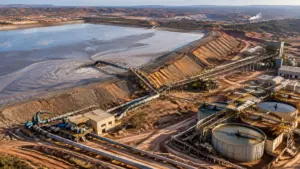
Processing infrastructure is increasingly central to how governments structure support for strategic mineral projects.
Brazil’s new Law No. 15,506 adds another layer to the comparison. The law establishes a national policy and council for critical and strategic minerals and creates a screening and ratification mechanism for certain transactions.
Foreign ownership is not prohibited, but transactions involving changes of control, significant foreign participation, mining-right transfers or some international supply agreements may face review. The government can approve a transaction, impose conditions or refuse ratification where it considers national sovereignty, economic security or the public interest to be at stake.
For Canadian developers, the lesson is not that one model is superior. It is that state-backed capital is becoming more specific. Governments are increasingly tying support to a mine, processing plant, offtake contract or strategic supply chain rather than announcing broad pools of capital without an identified output stream.
Tariffs increase the cost of delay
The permitting gap is also becoming a geopolitical issue.
After the United States imposed 50% tariffs on a broad range of Canadian goods, Canada responded with tariffs designed to match the value of the U.S. measures. The dispute raises the cost of relying on cross-border supply chains and strengthens the case for domestic production, processing and infrastructure.
But tariffs do not automatically make a Canadian mine economic. They can create stronger incentives for supply-chain diversification while leaving developers exposed to approval delays, construction inflation, power constraints and uncertain offtake terms.
The strategic value of a Canadian copper, nickel or rare-earth project may be clear to policymakers. The commercial case still depends on whether the project can deliver permitted production within a timeframe that customers and financiers can accept.
Base, bull and bear scenarios
| Scenario | Permitting and infrastructure outcome | Market implication |
|---|---|---|
| Base case | The Major Projects Office improves coordination, but major mines continue to move through multi-year consultation, environmental and financing processes. Processing capacity expands selectively. | Canada advances a limited number of copper, gold, lithium and rare-earth projects, while concentrates continue to leave the country for downstream processing. |
| Bull case | “One Project, One Review” produces predictable timelines, Indigenous-led infrastructure partnerships mature, and the AESC, Taltson expansion and Grays Bay link secure coordinated financing. | Permitted capacity grows faster, domestic processing attracts allied capital and Canada becomes a more credible supplier of refined critical minerals. |
| Bear case | Capital commitments remain largely non-specific, permitting delays persist and infrastructure projects face cost escalation or fragmented approvals. | Developers defer final investment decisions, Canada loses processing value abroad and strategic supply-chain goals remain ahead of physical output. |
The base case is the most likely because infrastructure and permitting reforms rarely move at the same speed as investment announcements. The bull case requires coordination across federal and provincial governments, Indigenous governments, utilities, ports and private developers. The bear case would emerge if Canada counts mobilized capital as delivered investment without measuring permitted tonnes, construction starts and operating capacity.
For decision-makers, the most useful metric is therefore not the size of the summit headline. It is the number of projects that progress from resource definition to approval, final investment decision, construction and production.
Canada has capital, deposits and strategic demand. Its $500 billion scale gap is the distance between those advantages and the permitted mine capacity needed to turn them into supply.
Distribution snippets
LinkedIn:
Canada has attracted nearly C$500 billion in investment commitments, but the headline figure is not the same as permitted mine capacity. Our analysis examines the gap between broad capital mobilization and buildable copper, lithium, gold and rare-earth projects, and why infrastructure, processing and permitting will determine whether Canada’s critical-minerals strategy delivers physical supply.
X:
Canada’s nearly C$500B investment headline masks a harder problem: most of the capital is not tied to a permitted mine. We examine the permitting, processing and infrastructure gap facing Canadian critical minerals, from the Arctic corridor to the Taltson hydro expansion.