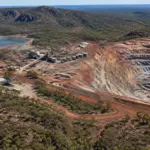
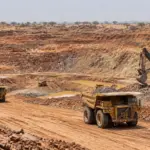
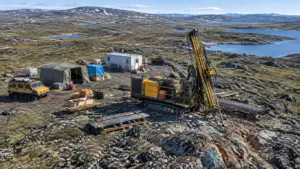
Reverse-circulation drilling at a remote East Yilgarn exploration target.

RareX Ltd. has identified a 74-metre zone of anomalous copper sulphide mineralisation beneath a large gallium anomaly at the Niobe prospect in Western Australia, adding a new dimension to the company’s emerging critical minerals strategy.
The result came from hole KRC012 at the Khaleesi Project, within the Khaleesi Alkaline Intrusive Complex in the East Yilgarn region. Portable X-ray fluorescence readings reached 5,724 parts per million copper, equivalent to 0.57%, with numerous readings above 1,500 ppm.
Copper was elevated across much of the 77–151-metre downhole interval. The results are preliminary, with laboratory assays expected in four to six weeks.
The discovery comes as copper prices remain close to record levels and global mine output is expected to decline in 2026 for the first time since 2017. It also gives RareX a copper component alongside the gallium, niobium and rare earth potential already identified at Khaleesi.

Copper result expands the Niobe target
RareX’s KRC012 hole intersected 74 metres of anomalous copper sulphide mineralisation, according to coverage by Mining.com.au.

| Metric | Result |
|---|---|
| Drill hole | KRC012 |
| Copper interval | 77–151 metres downhole |
| Mineralised zone | 74 metres |
| Peak pXRF copper reading | 5,724 ppm, or 0.57% |
| Other readings | Numerous results above 1,500 ppm |
| Assay timing | Expected in four to six weeks |
| Drill campaign | 3,500 metres across five priority targets |
The company has cautioned that pXRF readings are not a substitute for laboratory assays. They can indicate the distribution and tenor of mineralisation during exploration, but final grades, mineralogy, recoveries and metallurgical characteristics must be confirmed through laboratory testing.
RareX Managing Director and CEO James Durrant described the copper result as an “exciting new discovery” that adds another dimension to the Khaleesi Alkaline Intrusive Complex.

“The pXRF results are preliminary and we are awaiting laboratory assays, however the scale and consistency of the copper anomalism across KRC012 warrants follow-up,” Durrant said, according to the report.
He added that alteration vectors suggested the hotter part of the system may still be untested.
That interpretation is important for the next stage of exploration. In intrusive systems, changes in alteration and mineral zoning can help geologists vector toward the centre or higher-temperature portion of a mineralised body. At Niobe, RareX is now integrating the copper data with existing geophysical and geochemical information.
Niobe sits beneath a large gallium anomaly
Niobe is the largest and most advanced target within the Khaleesi Project. Surface work has outlined a gallium anomaly measuring approximately 5 kilometres by 3 kilometres, with coincident magnetic and gravity features.
Those geophysical signatures have helped define a deeper target beneath the surface anomaly. The current drilling program is testing whether the surface gallium enrichment is connected to a broader alkaline intrusive system containing rare earths, niobium, copper and other critical minerals.
RareX began a 3,500-metre maiden reverse-circulation campaign at Khaleesi in September, targeting five priority areas. The program was designed to test the Niobe gallium and carbonatite targets, along with the Rim, Nb and Mag prospects.
The campaign represents the first systematic test of RareX’s geological model at Khaleesi. The company has used historical drilling, modern magnetic and gravity surveys, and reinterpretation of earlier exploration data to refine its targets.
Mining.com.au reported the commencement of the maiden campaign earlier this month.
Historical work by AngloGold Ashanti, IGO and Fortescue largely focused on the region’s younger cover and often stopped after reaching basement. As a result, much of the underlying intrusive complex was not tested for the combination of gallium, niobium, rare earths and base metals now being targeted by RareX.

Rock-chip and drill-sample analysis will be required to confirm the copper mineralisation indicated by pXRF readings.
Why the copper-gallium combination matters
Copper and gallium occupy different parts of the critical minerals supply chain, but both have strategic importance.
Copper is essential to electrical networks, renewable power infrastructure, electric vehicles, industrial equipment and data centres. The International Energy Agency has warned that the current project pipeline could leave the copper market facing a supply deficit of up to 30% by 2035.
In its analysis of the copper market, the IEA noted that average global copper mine grades have fallen 40% since 1991. It also highlighted the long lead times for new mines, rising capital intensity and the limited number of major discoveries in recent decades.
Near-term supply conditions have added to the pressure. Copper is trading around US$14,400 per tonne, or approximately US$6.84 per pound on Comex, while outages at Grasberg in Indonesia and Kamoa-Kakula in the Democratic Republic of Congo have removed roughly 600,000 tonnes from expected 2026 production.
Against that backdrop, a copper discovery can provide a potential economic anchor for a project pursuing less established commodities. The same dynamic is visible at BHP’s Olympic Dam, where copper cash flow supports the evaluation of rare earth potential. Thor Energy is also advancing its Alford projects around copper recovery, while New Frontier Minerals is using anticipated cash flow from its NWQ Copper Project to support broader critical minerals work.
Gallium, meanwhile, is important to semiconductor, defence, satellite, solar and advanced electronics applications. China controls almost all global gallium production, leaving buyers outside China exposed to export restrictions, limited supply and significant regional price differences.
Gallium has been quoted at roughly US$400 per kilogram for Chinese material, while some European sources have reported prices in the thousands of dollars per kilogram. The gap does not represent a single transparent global spot market, but it illustrates the premium that can emerge where non-Chinese supply is scarce.
Niobium is similarly concentrated. Three mines account for most global production, while ferroniobium has been quoted at about US$40–70 per kilogram and niobium pentoxide at approximately US$45–60 per kilogram.
For RareX, the relevance of the KRC012 result is therefore not simply the presence of copper. It is the possibility that copper sulphide mineralisation may form part of a larger, multi-commodity system beneath a known gallium target.
Assays will determine the next step
The most important near-term catalyst for Khaleesi will be the laboratory assay results from KRC012 and the remaining holes in the maiden program.
Those assays should help establish:
- Whether the pXRF copper readings translate into consistent laboratory grades.
- The mineralogical form of the copper and associated sulphides.
- Whether copper is linked to the gallium, niobium or rare earth zones.
- The width and continuity of mineralisation outside the initial hole.
- Whether alteration patterns support follow-up drilling toward a higher-temperature core.
- The potential for recoverable by-products through future metallurgical work.
Until assays and additional drilling are completed, the KRC012 result remains an exploration indication rather than a mineral resource or economic discovery.
The result also needs to be considered within RareX’s broader portfolio. At the Cummins Range Project in Western Australia, the company is continuing metallurgy work on magnet-grade rare earths, battery-grade phosphate, gallium and scandium. RareX is also part of a consortium with Iluka Resources focused on the Mrima Hill rare earths project in Kenya and holds investments in Kincora Copper, Cosmos Exploration and Canada Rare Earth.

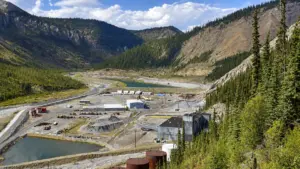
The Niobe prospect combines a broad surface gallium anomaly with magnetic and gravity features.
A new test for the Khaleesi model
The KRC012 result gives RareX a new geological question to answer at Khaleesi: whether the project is defined by separate, isolated mineral occurrences or by a connected polymetallic intrusive system.
The scale of the Niobe gallium anomaly, the coincident geophysical features and the newly reported copper sulphide interval provide a basis for further testing. However, the project remains at an early exploration stage, and the quality of the next evidence will matter more than the headline pXRF reading.
Laboratory assays, mineralogical studies and follow-up drilling will determine whether the copper zone has sufficient grade, thickness and continuity to influence the project’s development model.
For now, RareX has confirmed that copper is present within the Niobe target and that the Khaleesi system may be more geologically complex than previously understood. In a market seeking new copper supply while also looking for alternatives to concentrated gallium, niobium and rare earth supply chains, that combination is likely to keep the project under close watch.
Source: Mining.com.au coverage of RareX’s copper result; RareX Khaleesi drilling update; International Energy Agency copper market analysis.