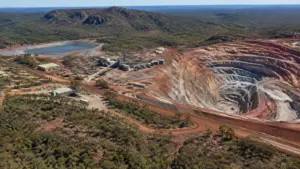
The Cobre Panamá copper operation in Panama remains central to First Quantum’s financial and strategic outlook.

By Penny Langford
First Quantum Minerals’ three-year agreement with Jiangxi Copper has kept the Chinese copper producer’s stake in the Canadian miner near 18.5%, limiting further accumulation and placing restrictions on any large disposal of shares through July 2027 and beyond.
The shareholder rights agreement, signed on July 23, 2024, gives Jiangxi a significant position in First Quantum but stops short of control. Its terms offer a useful case study for mining M&A deals 2026, as Canadian authorities apply closer scrutiny to foreign investment in copper and other critical-minerals supply chains.
The agreement was disclosed in First Quantum’s second-quarter 2024 results. A separate first-quarter 2025 filing disclosed an additional $500 million copper prepayment arrangement with Jiangxi, deepening the commercial relationship between the two companies.

What the Jiangxi agreement does
Jiangxi Copper is First Quantum’s second-largest shareholder, with a holding of approximately 18.5% following earlier share purchases. The agreement formalizes the relationship without allowing Jiangxi to move freely toward a controlling position.

| Agreement feature | Term disclosed by First Quantum |
|---|---|
| Agreement date | July 23, 2024 |
| Scheduled end date | July 23, 2027, unless Jiangxi’s holding falls below 10% earlier |
| Additional standstill | Six months after termination, subject to exceptions |
| Further share purchases | Restricted without First Quantum’s consent |
| Large share disposals | A block of 5% or more requires consent and related conditions |
| Buyer restriction | Jiangxi cannot sell to a buyer that would own more than 9.9% |
| Board rights | One nominee may be put forward for consideration by the board’s governance committee |
| Voting support | Jiangxi agreed not to oppose most board-recommended matters, with specified exceptions |
The standstill is the central provision. Subject to exceptions, Jiangxi cannot acquire additional First Quantum shares during the agreement or during the six-month period following termination without the company’s consent.
The arrangement also gives First Quantum the right to designate one or more purchasers if Jiangxi proposes to sell a block representing 5% or more of the company. Jiangxi cannot sell such shares to a buyer that would hold more than 9.9% of First Quantum after the transaction.

The board provision is narrower than a guaranteed seat. Jiangxi can nominate one person for consideration by First Quantum’s Nominating and Governance Committee, which then makes a recommendation to the board regarding appointment or election.
Jiangxi also agreed not to vote against director nominees proposed by management or the reappointment of auditors. It agreed not to oppose other board-recommended matters, subject to exceptions covering issues such as a takeover of First Quantum, the sale of a controlling interest in a material asset or an issuance that would give another person more than 10% of the shares.
The SRA can also end early by mutual written agreement. Its structure therefore creates a defined period of shareholder stability rather than a permanent limit on Jiangxi’s ownership.
Why the agreement matters under Canadian policy
The agreement is not itself an approval under Canada’s Investment Canada Act. Nor does an 18.5% minority holding automatically amount to control of First Quantum.
The significance lies in the policy environment surrounding critical minerals and foreign state-linked capital.
Canada’s policy regarding foreign investments from state-owned enterprises in critical minerals says investments by foreign state-owned enterprises, or private investors considered subject to significant foreign-government influence, can face enhanced review across the critical-minerals value chain.
The policy applies to investments in Canadian entities or assets involved in exploration, development, production, processing and refining. It covers direct and indirect investments, controlling and non-controlling interests, and investments regardless of value.
Canada says the participation of a foreign SOE or foreign-influenced investor in a critical-minerals investment will support a finding that there may be reasonable grounds to believe the transaction could be injurious to national security. The framework does not constitute an automatic ban, but it raises the review risk and increases the importance of governance, supply-chain access and strategic influence.
The Investment Canada Act has separate net-benefit and national-security review tracks. The net-benefit review generally applies to acquisitions of control above applicable financial thresholds. National-security review is broader. Under Canada’s national-security review guidelines, minority investments and transactions of any value may be examined where relevant security concerns exist.
That distinction matters for First Quantum. The current Jiangxi arrangement limits the path toward control, but it does not remove the possibility that a future increase in ownership, board influence, supply-chain rights or a formal takeover bid could attract regulatory attention.
The Canadian government can consider the strategic value of the mineral assets, the potential influence of the foreign investor, the effect on alternative supply sources and broader geopolitical circumstances. In some cases, the government can impose conditions, block a proposed transaction or require divestiture after an investment has been implemented.
Cobre Panamá remains a separate operating risk
The Jiangxi agreement did not transfer ownership of Cobre Panamá or change the mine’s operating status.
First Quantum halted production at the Panamanian copper mine in November 2023 after legal and political disputes. In its 2024 filing, the company said Cobre Panamá remained in a phase of Preservation and Safe Management, with production guidance suspended. Its first-quarter 2025 filing said production remained halted while the company awaited official steps concerning the power plant and stored copper concentrate.
The commercial arrangements with Jiangxi nonetheless matter because Cobre Panamá’s suspension removed a major source of production and cash flow from First Quantum’s portfolio. The shareholder agreement helped define Jiangxi’s position at a time when First Quantum was managing high debt, preservation costs and uncertainty over the Panamanian asset.
The company’s 2024 filing reported approximately $17 million per month in Cobre Panamá preservation and safe-management costs during the second quarter. Its 2025 filing reported costs of about $13 million per month in the first quarter.
The standstill therefore provided governance certainty while First Quantum sought to stabilize its balance sheet and rely more heavily on its producing assets in Zambia.
Zambia is the commercial centre of the relationship

Zambian copper production is central to the prepayment and offtake arrangements with Jiangxi Copper.
The relationship with Jiangxi is not limited to equity ownership. It also includes copper financing and offtake arrangements linked to First Quantum’s Zambian operations.
The original arrangement provided a $500 million prepayment in exchange for deliveries of 50,000 tonnes of Zambian copper anode per year over three years, payable at market prices. In April 2025, First Quantum disclosed a supplemental $500 million prepayment for an additional 50,000 tonnes per year over a separate three-year period.
Across the applicable contract periods, the arrangements link up to 100,000 tonnes of annual Zambian copper-anode deliveries to Jiangxi. The prepayments reduce as deliveries are made, according to First Quantum’s filing.
The contracts give First Quantum near-term liquidity and provide Jiangxi with access to copper units from a major African producing region. They also show how strategic investment, commodity offtake and balance-sheet financing can become closely connected in modern mining transactions.
First Quantum’s principal Zambian copper operations include Kansanshi and Sentinel. The company has also been investing in the Kansanshi S3 expansion and related processing capacity. Its filings have highlighted power constraints in Zambia, including the need to source additional electricity from regional suppliers as production expands.
That makes the Jiangxi arrangements operationally relevant even though Jiangxi does not control the mines. The financing supports the producer’s liquidity, while the offtake gives the buyer a defined supply relationship in a market where copper is increasingly treated as a strategic input for electrification, grid investment and industrial technology.
Implications for other mining companies

Strategic shareholders and board rights are increasingly examined alongside ownership percentages.
Other mining companies with Chinese strategic shareholders are unlikely to be assessed solely on the size of the equity stake.
A negotiated private placement with board nomination rights, offtake commitments, access to technical information or influence over capital allocation may attract more scrutiny than a small passive holding acquired through ordinary market trading. The precise assessment will depend on the investor, the asset, the rights attached to the investment and the jurisdiction in which the relevant business operates.
The Canadian policy is especially important for companies with Canadian critical-minerals assets or operations. Copper, lithium, nickel, cobalt, graphite and rare earths are all connected to supply chains that governments increasingly regard as strategic.
The framework does not mean every Chinese-linked investment will be blocked. It does mean companies and investors should expect regulators to examine whether a transaction creates effective influence over production, processing, data, technology or future supply.
That may affect the structure of future mining M&A deals 2026. Transactions could use stronger standstill provisions, limits on board representation, restrictions on information access, independent governance requirements or clearly defined offtake terms. Canadian companies may also seek capital from a wider pool of strategic and institutional investors to reduce dependence on any single state-linked shareholder.
For existing shareholders, the First Quantum agreement also illustrates the importance of reviewing contractual rights rather than focusing only on ownership percentages. A stake below 20% can still carry meaningful influence when combined with board nomination rights, voting commitments and commercial supply agreements.
A model for constrained strategic ownership

Copper offtake and processing relationships are becoming central to critical-minerals deal structures.
First Quantum’s arrangement with Jiangxi represents a negotiated middle ground.
Jiangxi remains a major shareholder and commercial partner. First Quantum gains a defined shareholder relationship, financing support and copper offtake. At the same time, the standstill prevents rapid accumulation and places limits on the transfer of a large block to another influential shareholder.
The structure does not resolve the underlying uncertainty around Cobre Panamá, nor does it eliminate the strategic and regulatory questions associated with foreign ownership of critical-minerals companies. It does, however, demonstrate how mining companies and strategic investors can use contractual restrictions to manage those concerns.
The key question for future transactions will be whether regulators view an investment as genuinely passive or as part of a broader strategy to influence a critical mineral, its production assets or its supply chain.
In Canada’s 2026 policy environment, that distinction is becoming increasingly important.
Sources
- First Quantum Minerals reports second-quarter 2024 results
- First Quantum Minerals reports first-quarter 2025 results
- Reuters reporting on First Quantum and Jiangxi Copper
- Canada’s policy on foreign investments by state-owned enterprises in critical minerals
- Canada’s guidelines on national-security review of investments
- Skillings: Critical minerals permitting and Canada’s development gap
- Skillings: G20 critical-minerals supply-chain diversification
Distribution snippets
LinkedIn:
First Quantum Minerals’ standstill agreement with Jiangxi Copper keeps the Chinese strategic shareholder near an 18.5% stake while linking the two companies through up to $1 billion in copper prepayment arrangements. The structure shows how ownership limits, offtake and Canada’s critical-minerals screening regime are reshaping mining M&A deals in 2026.
X:
First Quantum’s agreement with Jiangxi Copper caps further accumulation, limits large share sales and links the companies through Zambian copper offtake. The deal also highlights Canada’s tougher scrutiny of Chinese strategic investment in critical minerals.