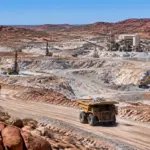
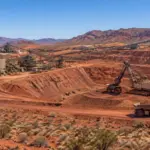
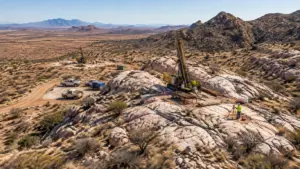
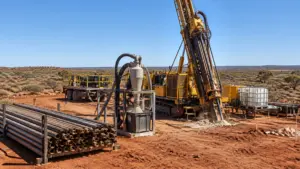
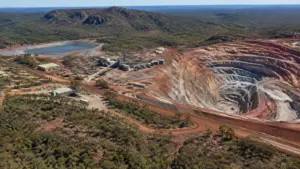
Aircore drilling in a remote Northern Territory exploration area.

By Penny Langford
Barkly Rare Earths has reported rare-earth mineralisation in all 28 holes from an initial drilling program across roughly 23 km at its Barkly project in Australia’s Northern Territory, extending evidence of magnet-rare-earth enrichment well beyond the company’s existing resource area.
The results, reported through ASX filings and subsequent industry reporting, included an intercept of 2 metres at 2,716 parts per million total rare earth oxides (TREO) from 11 metres, with 951 ppm magnet rare earth oxides (MREO).
The company also said MREO accounted for between 31% and 40% of TREO in 27 of the 28 fresh intercepts. That ratio is central to how the results may eventually be assessed because the commercial importance of a rare-earth deposit depends not only on its total rare-earth grade, but also on how much of that material comprises elements used in high-performance permanent magnets.

The drilling does not establish a mineable reserve or demonstrate project economics. It does, however, provide a broader geological data set as Barkly works toward resource expansion, metallurgical testing and a planned resource update.

Barkly results broaden the geological picture
The 28 holes were drilled across a wide area of the Barkly project, with mineralisation reported from shallow depths in some locations. The company’s existing Inferred Mineral Resource stands at 40 million tonnes grading about 2,100 ppm TREO, including approximately 710 ppm MREO.
That equates to an MREO share of roughly 34% of TREO, similar to the 31%-40% range reported across most of the new intercepts.

| Reported metric | Result | Why it matters |
|---|---|---|
| Drill holes with rare-earth mineralisation | 28 of 28 | Indicates continuity across the tested area, subject to further drilling |
| Approximate distance covered | 23 km | Extends the scale of the exploration footprint |
| Key intercept | 2 m at 2,716 ppm TREO from 11 m | Demonstrates shallow, locally higher-grade mineralisation |
| MREO in key intercept | 951 ppm | Equivalent to about 35% of the reported TREO |
| Higher-grade sub-interval | 0.5 m at 6,064 ppm TREO from 11.5 m | Shows local grade variability within the broader interval |
| MREO proportion in fresh intercepts | 31%-40% in 27 of 28 | Points to a relatively consistent magnet-rare-earth component |
| Existing Inferred Mineral Resource | 40 Mt at about 2,100 ppm TREO | Provides the current resource benchmark, not a reserve |
The company has described the mineralisation as shallow and stratabound. According to its technical disclosures, the rare earths are hosted in aluminium-phosphate-sulphate minerals within sedimentary units of the broader McArthur Basin and adjacent geological provinces.
The wide spacing of the reported drilling is important context. A 23 km exploration footprint is not the same as a continuous, economically mineable orebody. The next stage will be to establish geological continuity, thickness, grade distribution and density at a spacing suitable for a higher-confidence resource estimate.
Why MREO matters more than headline TREO alone
TREO measures the combined concentration of rare-earth oxides in a sample. It includes light and heavy rare earths, including lanthanum, cerium, neodymium, praseodymium, terbium and dysprosium, among others.
MREO is a subset comprising the magnet-related rare earth oxides:
- Neodymium oxide;
- Praseodymium oxide;
- Terbium oxide; and
- Dysprosium oxide.
These elements are used in permanent magnets for electric motors, wind turbines, industrial equipment, electronics and other advanced technologies. Terbium and dysprosium can also improve resistance to demagnetisation at higher operating temperatures.
In Barkly’s headline intercept, the reported MREO proportion can be calculated as:
951 ppm MREO ÷ 2,716 ppm TREO = approximately 35%
That is close to the average MREO proportion in the existing resource. The consistency matters because a deposit with a moderate TREO grade but a high magnet-rare-earth component may have a different processing and market profile from a deposit dominated by lower-value lanthanum and cerium.
A high MREO ratio is not, by itself, a measure of profitability. It still has to be converted into a recoverable product, separated to a specification accepted by customers and produced at a cost that can withstand volatile rare-earth prices.
The distinction is increasingly relevant to the critical minerals supply chain 2026 discussion. Governments and manufacturers are seeking non-Chinese sources of magnet materials, but the supply-chain gap is not only in mining. It also includes concentration, chemical cracking, separation, refining and magnet manufacturing.
Skillings has previously examined this issue in its reporting on rare-earth magnet manufacturing and critical minerals traceability.
Metallurgy offers an early signal, not a completed flowsheet
Barkly’s results are supported by early metallurgical work, but the company has disclosed limitations that are material to interpreting the outcome.
In an August ASX announcement, Barkly reported 99% MREO extraction into an acid-leach solution from a single 75.45-gram composite sample subjected to caustic conversion and hydrochloric acid leaching. Earlier testwork had achieved up to 74% MREO extraction under different conditions.
The test also showed that 92% of phosphorus reported to the caustic conversion solution, with no measurable rare earths in that stream. That may assist future impurity management. However, the acid-leach solution contained approximately 2.43 grams per litre of aluminium and 2.03 grams per litre of silicon, both of which could affect purification requirements.

Laboratory leach and conversion testwork is an early step in flowsheet development.
The 99% figure should not be read as 99% recovery of a saleable separated rare-earth product. It represents extraction of MREO into a solution during a small-scale sighter test. The announcement said the test used a non-representative composite, had no duplicate test of the same route and did not demonstrate downstream purification or final product recovery.
Further work will need to establish:
- Whether the result can be repeated across representative samples;
- How reagent consumption changes with ore type and grade;
- Whether aluminium, silicon, phosphorus and other impurities can be controlled;
- How much water and energy the process requires;
- Whether the leach solution can be purified economically; and
- Whether the final product meets the requirements of potential offtake customers.
These questions are particularly important as the drilling footprint expands. A single composite can indicate processing potential, but it cannot capture the mineralogical and chemical variability of material distributed across 23 km.
Policy support is growing, but funding still requires proof
Australia’s policy environment has become more supportive of rare-earth development. The federal government’s A$1.2 billion Critical Minerals Strategic Reserve is initially focused on antimony, gallium and rare earth elements. The reserve is intended to support supply security through mechanisms such as offtake arrangements, forward contracts and selective stockpiling.
The government also administers a A$5 billion Critical Minerals Facility through Export Finance Australia. The facility can support extraction, processing and related infrastructure, subject to due diligence and national-interest considerations.
Export Finance Australia identifies several factors relevant to project assessment, including:
- A demonstrated Australian benefit;
- Alignment with eligible critical minerals policy;
- A completed feasibility study;
- Buyer commitment or market support;
- Proven processing technology; and
- Financial, technical and commercial capability.
Australia and the United States have also established a streamlined pathway for eligible bilateral critical-minerals projects through Export Finance Australia and the U.S. Export-Import Bank.
Those programs improve the potential funding environment for Australian rare-earth projects, but they do not remove the technical milestones required before financing. Barkly’s drilling announcement is an exploration update rather than an offtake agreement, feasibility study or project-finance commitment.
A 10% refundable tax incentive for eligible critical-minerals processing and refining costs is also scheduled to apply from July 2027, adding another potential support mechanism for projects that reach downstream development.
Scale-up risks remain the central test
The drilling results strengthen Barkly’s geological case, but several risks remain before the project can be assessed on a development basis.
Resource confidence: Twenty-eight successful holes across a broad area can support further exploration, but additional drilling is required to define thickness, continuity and grade variability.
Metallurgical variability: The reported 99% extraction result came from one small composite. Larger and more representative samples must demonstrate repeatability.
Downstream separation: Extracting MREO into solution is only one step. Producing separated neodymium-praseodymium, terbium or dysprosium products requires additional purification and separation stages.
Infrastructure: The Barkly project covers a large, remote area in the Northern Territory. Power, water, road access, logistics and potential processing location will influence capital and operating costs.
Environmental and permitting requirements: Barkly has reported low uranium and thorium levels in the drilling results, which may be favourable. Those levels still need to be confirmed across a larger resource and integrated into waste, water and permitting studies.
Market exposure: A magnet-rich product may improve strategic relevance, but it also leaves the project exposed to changes in magnet demand, substitution, recycling, Chinese supply and pricing.

The scale of the exploration footprint will require systematic resource and geometallurgical work.
What comes next
Barkly has said its broader program includes approximately 10,000 metres of drilling, additional assays, geometallurgical studies and a potential Mineral Resource update. The next disclosures should help clarify whether the 23 km trend can support a larger resource with consistent MREO grades.
For the Australian critical minerals supply chain, the significance of the results will ultimately depend on more than the number of mineralised holes. The key tests will be whether Barkly can convert exploration continuity into a higher-confidence resource, maintain the magnet-rare-earth ratio through broader sampling and develop a repeatable flowsheet that produces a marketable product.
Until those steps are completed, the September drilling results represent an encouraging exploration signal rather than evidence of a mine-ready rare-earth operation.