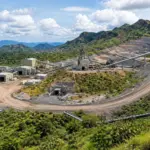
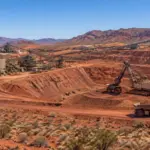
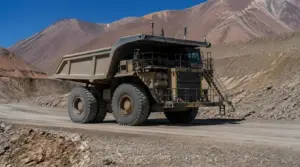
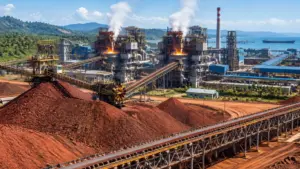
Lithium brine ponds and processing infrastructure in Argentina’s Andean mining corridor.

By Penny Langford
The United States plans to provide up to $7 billion in financing for Argentine mineral and energy projects over the next two years, according to a document reviewed by Reuters, in a move that links U.S. export credit more directly to the critical minerals supply chain 2026.
The proposed financing would be provided through the U.S. Export-Import Bank, or EXIM, and would help companies operating in Argentina obtain loans to purchase machinery, equipment and related goods from U.S. manufacturers.
The plan is part of a broader effort by Washington and Buenos Aires to develop mineral and energy projects while reducing exposure to supply chains dominated by Chinese processing and refining.
The reported package is not described as a direct grant to the Argentine government. Instead, it would use export-credit tools to support transactions involving U.S. suppliers, Argentine project developers and infrastructure or mining developments that meet EXIM requirements.

What the EXIM financing would do
EXIM typically supports overseas buyers of U.S. goods through direct loans, loan guarantees and export insurance. In this case, the structure would allow eligible companies in Argentina to finance the purchase of U.S.-made equipment for mining, processing, energy and associated infrastructure.
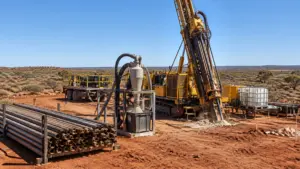
That could include drilling and extraction equipment, mineral-processing systems, electrical equipment, pipeline technology, transport infrastructure and digital or automated mining systems. The exact projects, loan amounts, interest rates and risk-sharing arrangements have not been publicly detailed.
| Reported or contextual measure | Relevance to the plan | Source |
|---|---|---|
| Up to $7 billion | Proposed EXIM financing capacity for Argentine mineral and energy projects | Reuters |
| About two years | Reported period for deploying the financing | Reuters |
| Lithium and copper | Core critical-mineral exposure identified in the U.S.-Argentina push | U.S. Commercial Service |
| Third-largest lithium reserves | Argentina’s position in the global lithium resource base | U.S. Commercial Service |
| Fourth-largest copper reserves | Argentina’s longer-term copper development potential | U.S. Commercial Service |
| $6 billion in mining exports in 2024 | Baseline for Argentina’s existing mining export sector | U.S. Commercial Service |
The financing mechanism matters because a mining project may have a strong geological resource but still fail to reach production without long-lead equipment, power, roads, water systems and export infrastructure.
For U.S. manufacturers, the arrangement could open access to a larger project pipeline. For Argentina, it could reduce the upfront cost of importing equipment while helping advance projects that have struggled to secure long-term capital.

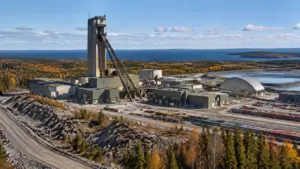
Lithium brine operations depend on processing capacity, water management and reliable transport infrastructure.
Argentina’s mineral and energy exposure
Argentina’s most immediate relevance to the critical minerals supply chain comes from lithium brines in the northwest, particularly across the high-altitude regions bordering Chile and Bolivia.
The country is already a significant lithium producer and exporter, while new projects and expansions are intended to increase output. Lithium production, however, is only one stage of the supply chain. The commercial value of the material also depends on chemical conversion, transport, battery-grade specifications and access to downstream customers.
Copper is the other major part of the opportunity. Argentina has a large pipeline of copper projects in the Andes, including projects that require roads, power generation, transmission capacity and export routes before construction can begin.
The U.S. Commercial Service identifies copper, lithium, gold and silver as important parts of Argentina’s mining sector and highlights opportunities in processing equipment, automation, water management and clean-energy integration.
The proposed EXIM support also extends beyond mining. Argentina’s Vaca Muerta shale formation has made the country an increasingly important energy supplier, creating demand for drilling equipment, pipelines, export terminals and related services. That gives the package a wider energy and industrial scope than a minerals-only financing program.
The challenge for policymakers will be ensuring that financing for energy and mining projects also supports the infrastructure needed to move materials from remote areas to processing plants, domestic manufacturers and export terminals.
A broader geopolitical contest
The U.S.-Argentina initiative follows a wider bilateral effort to strengthen cooperation on exploration, extraction, processing and investment in critical minerals.
The strategic objective is straightforward: expand the number of reliable supply sources for minerals used in batteries, power networks, defense systems and advanced manufacturing.
But the supply-chain problem is not limited to the location of mines. China retains a strong position in the processing and refining of several critical minerals, including lithium-related chemicals, graphite and rare earth materials. Industry and government studies have repeatedly identified processing as a major concentration point in the global supply chain.
That means a new mine in Argentina does not automatically produce a China-independent supply route.
Argentine lithium or copper may still be processed outside the country, depending on project economics, technology, ownership, offtake agreements and available infrastructure. Financing U.S. equipment can strengthen U.S. commercial participation without necessarily determining where the final chemical conversion or refining takes place.
This is why the policy mechanism will be measured not only by the number of mines supported, but also by whether it helps build processing and logistics capacity.
Skillings’ analysis of the G20 critical minerals framework reached a similar conclusion: diversification extends beyond extraction to include processing, infrastructure, recycling, technology transfer and value addition.

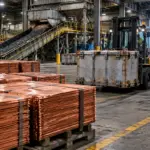
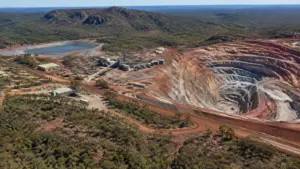
Copper development requires coordinated investment in extraction, processing, power and transport.
Implementation risks remain significant
The Reuters report did not identify a project-by-project allocation of the $7 billion. That leaves several important questions unresolved.
Credit and country risk
EXIM will need to assess the creditworthiness of borrowers, the strength of project contracts and the availability of guarantees or other forms of risk protection. Financing terms may differ between private mining companies, infrastructure developers and energy firms.
Argentina’s macroeconomic conditions, foreign-exchange availability and regulatory framework will also influence how projects are financed and how revenues are repatriated. The final structure will determine how much risk is carried by EXIM, commercial lenders, project sponsors and equipment suppliers.
Permitting and social license
Mining projects in Argentina must still navigate provincial permitting, environmental reviews, water-management requirements and community concerns. Lithium brine developments in particular face scrutiny over water use in arid regions.
U.S. export credit can help pay for equipment, but it cannot by itself resolve permitting delays, environmental disputes or local opposition.
Infrastructure bottlenecks
Many of Argentina’s most prospective mineral regions are remote and located at high altitude. Projects may require new roads, power lines, substations, pipelines, rail links or port capacity.
If infrastructure investment does not keep pace with mine construction, equipment financing could accelerate individual projects without solving the wider logistics constraints that limit exports.
Commodity and technology risk
Lithium projects face changing battery chemistries, shifting demand forecasts and price volatility. Copper developments typically require substantial capital and long construction timelines.
A financing commitment made over two years may support projects whose production begins much later. Sponsors and lenders will therefore need to account for changes in commodity prices, processing technology, operating costs and customer requirements.

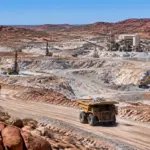
Large-scale mineral projects depend on coordinated investment in equipment, roads, power and processing.
What the plan means for China
The proposed package represents a challenge to China’s influence, but not an immediate replacement for Chinese processing capacity.
China’s position has been built over decades through investment in refining, chemical conversion, manufacturing, logistics and long-term commercial relationships. Developing alternative mines is faster than replicating those downstream capabilities.
For the United States and Argentina, the central test will be whether the financing supports a complete or more resilient chain:
- Resource development in lithium, copper and related minerals.
- Processing capacity closer to the source or within allied markets.
- Reliable power and transport connecting projects to customers.
- Commercial offtake agreements that provide a market for output.
- Traceability and standards that allow buyers to verify origin and processing.
If the financing mainly supports the purchase of U.S. equipment for mines that export partially processed material, it would still deepen commercial ties between Washington and Buenos Aires. However, its effect on China’s downstream position would be more limited.
If it helps create processing plants, power infrastructure and export routes that serve U.S.-aligned customers, the strategic impact would be broader.
For now, the $7 billion plan is best understood as a financing framework rather than a completed supply chain. Its importance will depend on which projects qualify, how risks are allocated and whether Argentina can convert geological potential into reliable, higher-value production.
Social snippet
The U.S. plans up to $7 billion in EXIM financing for Argentina’s mineral and energy projects, targeting lithium, copper and supply-chain diversification. The key test will be whether the capital reaches processing and infrastructure, not only extraction.