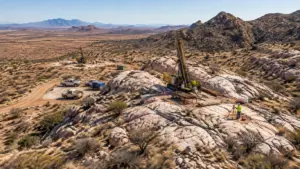
Representative documentary view of a shallow copper operation in central Tanzania.

Kenya-based Marula Mining is moving to take full ownership of the Kinusi copper mine in Tanzania’s Dodoma Region, adding a small but potentially near-term source of copper to a market facing tighter concentrate availability and widening disagreement over the scale of the expected 2026 deficit.
The Kinusi transaction would give Marula control of Takela Mining Tanzania, the company that owns and operates the project in Mpwapwa District. Marula currently holds a 75% commercial interest and has agreed to acquire the remaining ownership for total consideration of £2.5 million, according to the company’s transaction announcement published through Investegate.
The deal is structured around the project’s progress rather than a single upfront payment. Marula agreed to pay £500,000 on signing, £750,000 when Kinusi’s 10 primary mining licences are consolidated into one mining licence, and £1.25 million after commercial sales exceed 10,000 tonnes of product. Takela’s shareholders can elect to receive cash or Marula shares at 10 pence per share.
The sellers would also retain a 1.5% net smelter royalty on gross sales from Kinusi. Once the licences are consolidated, Tanzania is entitled to a 16% free-carried interest under the country’s Mining State Participation Regulations.

Kinusi asset: high grades reported, resource still unconfirmed
Kinusi comprises 10 primary mining licences covering shallow copper mineralisation at the Sasimo prospect and surrounding workings. Marula’s project information describes a mineralised corridor extending for more than 1 kilometre along strike and approximately 300 metres in width.

The company reports historical and recent high-grade results from exposed mineralisation. Samples from small-scale workings returned copper grades of 7.28%, 19.12% and 31.32%, while other assays from the Sasimo prospect included results between 6.54% and 15.48% copper. Marula has also reported samples from the No. 4 Open Pit averaging 21.54% copper, with individual results ranging from 20.21% to 22.64%.
Those figures should not be treated as an average mine grade. They represent selected or area-specific samples, and the company has not published a compliant average resource grade for the project.

Marula has outlined an initial exploration target of 10 million to 15 million tonnes of high-grade copper-gold mineralisation. The company has said the target could grow beyond 50 million tonnes after further drilling. That remains an exploration target, however, rather than a JORC- or NI 43-101-compliant mineral resource.
The distinction matters. A high-grade sample can demonstrate mineralisation, but it does not establish the volume, continuity, recovery rate or economic viability of a deposit. Those questions will require systematic drilling, resource modelling, metallurgical testing and operating data.

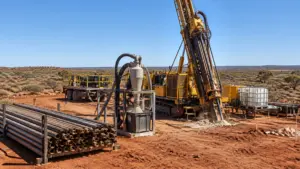
Representative copper ore and concentrate sampling scene.
Planned output is modest by global standards
Kinusi’s planned first processing phase is designed around gravity concentration, coarse jigging and fines dewatering. Marula says the circuit is intended to produce approximately 24,000 tonnes per year of high-grade copper concentrate.
A second phase would add fines heap leaching, solvent extraction and electrowinning, with an initial target of approximately 10,200 tonnes per year of copper cathode. The company has also described potential concentrate sales of between 1,000 and 2,000 tonnes per month as operations develop.
The production numbers are small compared with the world’s largest copper mines, which can produce hundreds of thousands of tonnes of contained copper annually. Their significance lies elsewhere: Kinusi is positioned as a shallow, potentially fast-starting operation that could generate saleable material without waiting for the long construction timelines associated with major underground mines or large-scale concentrators.
Marula has previously reported trial shipments and concentrate sales arrangements linked to Kinusi. Under the company’s disclosed sales structure, provisional payment could be based on 90% of estimated shipment value, with final settlement following independent weighing, grade analysis and confirmation that the concentrate met agreed specifications.
Funding combines staged payments and offtake-linked working capital
The acquisition structure limits the amount payable at completion but leaves Marula exposed to future funding requirements. The final £1.25 million payment is triggered by commercial sales exceeding 10,000 tonnes, aligning part of the purchase price with project performance.
Marula has also described a proposed offtake and funding arrangement with Traxys Europe. The structure would allow the buyer to purchase up to 2,500 tonnes per month of concentrate over a 12-month period, subject to product specifications and approvals.
The associated letter of credit could have a value of up to US$8 million. Up to 60% could be drawn as pre-shipment advances to support mobilisation and production costs. The advances would be with full recourse to Marula, and the company has said that no funds would be available until the letter of credit was issued and its conditions met.
That makes the facility a working-capital mechanism rather than a committed project-finance package. Its value to Kinusi depends on the mine’s ability to produce consistent tonnes, meet concentrate specifications and deliver on schedule.
The funding picture became more complex in September when Marula signed a binding option and transaction term sheet covering nine prospecting licences contiguous to Kinusi. The licences cover about 170 square kilometres. The proposed transaction would give Marula a 95% economic interest for total payments of US$2 million, consisting of US$800,000 upfront and US$1.2 million in deferred instalments.
The vendors would retain a 5% free-carried interest, which Marula could later acquire for US$500,000. Marula said it did not currently have sufficient cash resources to fund the completion payment and would need to secure additional funding.
Tanzania is pushing miners toward domestic value addition
Kinusi is advancing within a Tanzanian mining sector that is seeking greater control over processing, local procurement and mineral revenues.
The U.S. International Trade Administration’s Tanzania mining guide identifies copper, graphite, nickel, cobalt, lithium and rare earth elements among the country’s important critical-mineral opportunities. It also highlights local-content requirements, government equity participation and value-addition obligations as central features of the investment framework.
For copper developers, the policy direction increases the importance of processing plans. Tanzania permits copper exports under its mining and export rules, but projects must navigate licensing, assays, royalties, inspection requirements and local-content provisions. The government is also encouraging downstream activities such as mineral processing and smelting.
Graphite provides a sharper example of the direction of travel. Tanzania has tightened restrictions on the export of unprocessed graphite and is seeking domestic processing or sales to licensed local value-adders. The policy is designed to retain more economic value in the country and support battery-materials ambitions.
For Kinusi, the immediate commercial model is based on concentrate and potentially cathode production rather than a large-scale refinery. That may reduce initial capital requirements, but Marula will still need to demonstrate that its processing, export and procurement arrangements fit Tanzania’s evolving value-addition framework.

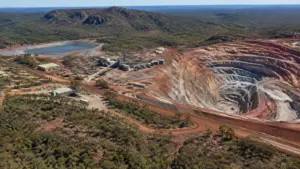
Representative view of mine infrastructure and haulage routes in central Tanzania.
What Kinusi means for the copper market
The project arrives as analysts debate how quickly the global copper market is moving from tightness into a structural deficit.
Forecasts summarized by the International Copper Study Group, banks and commodities analysts have placed the possible 2026 refined copper shortfall anywhere from roughly 150,000 tonnes to more than 600,000 tonnes. A Reuters-reported ICSG outlook has pointed to a deficit of about 150,000 tonnes, while UBS and ING have published materially larger estimates. Other analysts have argued that the market could remain broadly balanced.
| 2026 market view | Reported balance | Main rationale |
|---|---|---|
| ICSG outlook reported by Reuters | About 150,000-tonne deficit | Slower refined production growth |
| UBS estimate | About 407,000-tonne deficit | Mine disruptions and lower inventories |
| ING estimate | About 600,000-tonne deficit | Concentrate tightness and supply constraints |
| Goldman Sachs view | About 160,000-tonne surplus | More balanced supply and demand assumptions |
The range shows why any copper price forecast 2026 must be treated as a scenario rather than a single dependable number. The outcome will depend on mine recoveries, smelter availability, scrap supply, Chinese demand, inventories and the timing of new production.
Kinusi cannot close a global deficit on its own. Even if Marula reaches the planned 24,000 tonnes of annual concentrate capacity, the project would remain a fraction of global copper supply. Its relevance is operational and strategic: a shallow East African asset with reported high-grade zones may provide incremental units at a time when large new mines are difficult to permit, finance and build.
The next milestones will be more important than the headline exploration target. Investors, buyers and policymakers will be watching for licence consolidation, independent resource drilling, repeatable concentrate grades, reliable logistics, issuance of the proposed working-capital facility and evidence that the planned processing circuits can operate consistently.
For Tanzania, the transaction tests whether a smaller domestic project can move from high-grade surface indications to compliant production while meeting the country’s expectations on state participation and value addition. For the broader copper market, Kinusi is a reminder that supply growth will come not only from major mines, but also from a long list of smaller projects whose execution risks remain substantial.

Representative copper-bearing rock samples from a field exploration setting.
Sources and company information
- Marula Mining: Kinusi Copper Mine project information
- Marula Mining acquisition of Takela Mining Tanzania
- Marula Mining update on Kinusi
- Marula Mining copper concentrate sales at Kinusi
- Marula Mining option agreement for contiguous Tanzanian licences
- U.S. International Trade Administration: Tanzania mining sector
- Reuters: ICSG copper market deficit outlook