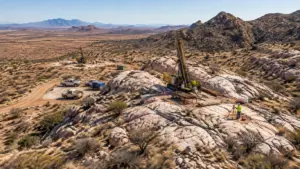
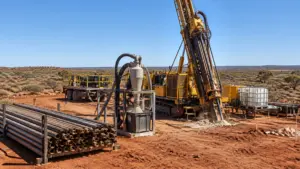
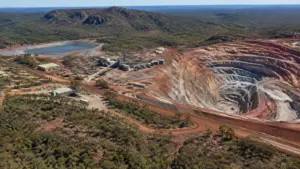
An industrial processing complex in Tennessee is at the center of Korea Zinc’s plan to expand U.S. refining capacity.

By Penny Langford
Korea Zinc’s $7.4 billion Project Crucible has cleared a major U.S. environmental review, advancing a Tennessee metals-processing complex intended to address a central weakness in the critical minerals supply chain 2026: the limited availability of domestic refining capacity.
The company plans to build the integrated smelting and refining facility in Clarksville, Tennessee, with U.S. government support and private-sector financing. The project is designed to process zinc, lead, copper, precious metals and a group of strategic minerals used in semiconductors, defense equipment, artificial intelligence infrastructure and advanced manufacturing.
Korea Zinc said the U.S. Department of Defense completed the project’s Final Environmental Assessment on Sept. 11 and issued a Finding of No Significant Impact, or FONSI. The decision removes a significant federal environmental hurdle, although additional federal, state and local permits remain outstanding.
The Korea Times has described Project Crucible as a response to the United States’ dependence on overseas processing, particularly in supply chains where China has developed a dominant position. Korea Zinc has said the facility will help create a more diversified minerals-processing network for the United States, South Korea and other allied economies.

A large refining project with a phased buildout
Project Crucible is planned as an integrated nonferrous smelter and refinery covering approximately 650,000 square meters. Korea Zinc intends to apply technology and operating experience from its Onsan smelter in South Korea, which the company describes as the world’s largest single-site nonferrous smelter.
The facility is expected to process about 1.1 million metric tons of raw materials annually and produce approximately 540,000 metric tons of finished products. Construction planning includes site preparation and foundation work, followed by equipment procurement and engineering, procurement and construction contractor selection.

Korea Zinc has targeted phased operations beginning in 2029, with full production expected around 2030.
The company’s stated product slate includes zinc, lead, copper, gold, silver and a range of critical and strategic metals. Semiconductor-grade sulfuric acid is also planned, linking the project to the U.S. semiconductor manufacturing buildout.
Project Crucible at a glance
| Category | Publicly reported detail |
|---|---|
| Location | Clarksville, Montgomery County, Tennessee |
| Total planned investment | Approximately $7.4 billion, including working capital and financing costs |
| Estimated capital expenditure | Approximately $6.6 billion |
| Planned processing input | About 1.1 million metric tons per year |
| Planned finished output | About 540,000 metric tons per year |
| Construction sequence | Site preparation and foundations, followed by full-scale construction |
| Initial operations target | Phased operations from 2029 |
| Core products | Zinc, lead, copper, gold, silver and strategic metals |
| Process chemicals | Sulfuric acid and semiconductor-grade sulfuric acid |
| Permitting status | Environmental assessment complete; broader permitting remains in progress |
| FAST-41 dashboard estimate | Environmental review and permitting completion targeted for Sept. 30, 2028 |
The scale is significant because the United States has lost or lacks sufficient domestic capacity to refine several metals, even where ore, concentrates or recyclable feedstocks may be available. The project therefore focuses on the middle of the supply chain, where material is converted into usable industrial products.
Zinc is central; nickel and rare earths require a distinction
Zinc is the anchor of Project Crucible. Korea Zinc is one of the world’s largest refined zinc producers, and the Tennessee project is being developed around an existing industrial site associated with zinc processing.
The official product descriptions also identify lead, copper, gold and silver, alongside antimony, gallium, germanium, indium, tellurium, cadmium, palladium and bismuth. U.S. government documents say 11 of the project’s planned nonferrous products are designated as critical minerals.
Nickel, however, does not appear in the detailed product lists published by Korea Zinc, the U.S. Department of Commerce or the FAST-41 permitting dashboard. That means the project should not currently be described as a confirmed nickel refinery. Nickel may form part of the broader strategic discussion around U.S. critical-minerals processing, but there is no disclosed nickel output target for the core Crucible facility.
The same distinction applies to rare earths. Korea Zinc has pursued separate U.S. plans to recover rare earth oxides from waste permanent magnets and other technology-related materials. Those activities are relevant to the company’s wider U.S. supply-chain strategy, but they are not the same as the core Tennessee smelter’s publicly disclosed list of metals.
This distinction matters for industrial customers and policymakers. Project Crucible is primarily a zinc-led, multi-metal refining project. Its strategic value comes from recovering several critical metals from complex feedstocks, rather than from being a conventional rare-earth separation plant or a nickel-processing facility.

The project is intended to combine base-metal refining with recovery of smaller-volume strategic metals.
Government backing combines grants, investment and permitting support
The project’s financing structure includes several forms of U.S. government support.
The Department of Commerce awarded $210 million in direct funding under the CHIPS and Science Act to Crucible Metals LLC, a Korea Zinc subsidiary. According to the National Institute of Standards and Technology, the award will support equipment used to produce critical and strategic minerals, as well as sulfuric acid and semiconductor-grade sulfuric acid.
The CHIPS award is linked to the project’s role in the semiconductor supply chain. Gallium, germanium, indium, tellurium and other materials are used in semiconductor, aerospace, defense and advanced electronics applications.
The Department of Defense’s Office of Strategic Capital has also announced conditional support for the project. Korea Zinc said approximately $2.15 billion would be arranged by the department with investors for the smelter, including a reported $1.4 billion conditional investment. These figures should be distinguished from the $210 million CHIPS award and from the project’s total $7.4 billion investment requirement.
The financing is intended to support a facility with $6.6 billion in capital expenditure. The higher $7.4 billion figure includes working capital and financing costs, according to Korea Zinc and U.S. government materials.
Project Crucible has also received FAST-41 coverage through the Federal Permitting Improvement Steering Council. FAST-41 is designed to coordinate complex federal permitting processes, publish project schedules and give agencies a common framework for tracking reviews.
The designation does not amount to a blanket construction approval. The federal permitting dashboard shows the project remains in progress, with four of 10 listed environmental review and permitting processes completed.
The environmental milestone is important, but not the final permit
The Final Environmental Assessment examined air quality, greenhouse gas emissions, water resources, utilities, biological and cultural resources, transportation, hazardous materials and socioeconomic effects.
The Department of Defense concluded that the project would not significantly affect the quality of the human environment and issued the FONSI. The assessment was coordinated with the U.S. Army Corps of Engineers, the U.S. Fish and Wildlife Service, the Tennessee State Historic Preservation Office, federally recognized tribes and the Tennessee Valley Authority.
The Federal Register notice also records unresolved mitigation obligations. The review found that construction would adversely affect three archaeological resources and one historic site. The department approved a phased approach to identify and mitigate those effects, including measures developed with state historic-preservation authorities.
The decision therefore advances the project without eliminating the execution work ahead. Water, construction, utility, transportation and operating permits must still be secured before the full facility can be built and commissioned.
Power and feedstock remain practical tests
Smelting and refining are power-intensive businesses. Korea Zinc has cited relatively low regional electricity costs as an advantage for the Tennessee site, while the environmental review indicates that the Tennessee Valley Authority will have a role in decisions involving connected power infrastructure.
That relationship will be important as Project Crucible moves from regulatory review to construction. The project’s economics will depend not only on electricity prices, but also on the timing and capacity of grid connections, substations and other supporting infrastructure.
Feedstock is another central risk. The FAST-41 dashboard says the facility is expected to receive materials primarily from the United States and North America, with deliveries arriving through multiple routes. Finished products are intended to move to U.S. customers by rail and truck.
That model could reduce exposure to long-distance shipping and overseas refining bottlenecks, but it also creates a requirement for reliable domestic and regional supplies of concentrates, secondary materials and metal-bearing scrap. The ability to handle complex feedstocks with variable impurity levels will be critical to maintaining recovery rates and product quality.
Korea Zinc’s experience at Onsan provides technical support, but transferring that operating model to Tennessee will involve commissioning, workforce development, equipment integration and supply-chain qualification. The company has said experienced personnel from South Korea will support the startup phase.

Project plans call for feedstock from U.S. and North American sources delivered through multiple transport routes.
What Project Crucible changes for the U.S. minerals chain
Project Crucible will not eliminate U.S. exposure to overseas mining or refining. It will, however, target a part of the value chain where supply disruptions can have an outsized effect.
For the United States, the project offers additional domestic capacity for zinc, copper, lead and smaller-volume critical metals. It also creates a potential source of semiconductor-grade sulfuric acid at a time when chipmakers are expanding U.S. manufacturing.
For Korea Zinc, the project establishes a North American production base and places its processing expertise inside a market where defense, semiconductor, data-center and industrial demand is expanding.
The strategic case rests on execution. The next milestones are likely to include remaining permits, power-infrastructure decisions, engineering and procurement awards, feedstock agreements and construction progress. The FAST-41 schedule currently extends environmental review and permitting into 2028, even as Korea Zinc targets phased operations from 2029.
That timetable leaves limited room for delays. Project Crucible has cleared an important regulatory checkpoint, but its contribution to the critical minerals supply chain 2026 will ultimately depend on whether the company can build the facility, secure feedstock and power, and achieve reliable multi-metal production at commercial scale.
Social snippet
LinkedIn/X: Korea Zinc’s $7.4 billion Project Crucible has cleared a major U.S. environmental review, advancing a Tennessee smelter designed to produce zinc, copper, lead and multiple critical metals. The project has CHIPS funding and defense support, but power, feedstock and remaining permits will determine whether it can meet its 2029 operating target.
Sources
- Korea Zinc: U.S. critical-minerals smelter and financing structure
- U.S. Department of Commerce/NIST: CHIPS incentives for Crucible Metals
- Federal Register: Project Crucible Final Environmental Assessment and FONSI
- FAST-41 Permitting Dashboard: Project Crucible
- The Korea Times: Korea Zinc’s Project Crucible and the U.S. minerals supply chain
- Skillings: Critical minerals permitting and the scale gap