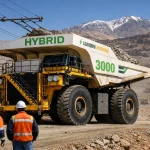
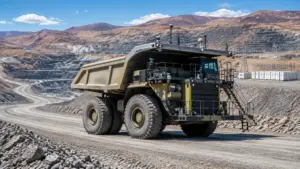
Here’s what nobody’s saying out loud: the era of incremental autonomous haulage pilots is over. Inner Mongolia Guangna Coal just signed a contract for 500 all-electric, autonomous mining trucks: not 10, not 50, but 500 units deployed across a single coal mining operation. The deal, finalized on February 9, 2026, represents the largest commercial-scale battery-electric autonomous haulage deployment globally.

This isn’t a technology demonstration. It’s a full fleet replacement.
The Deal Structure: Four Partners, One Integrated Stack
The procurement brings together four distinct technology providers, each handling a critical piece of the autonomous electric haulage puzzle.
Shaanxi Tonly Heavy Industry supplies the wide-body mining trucks themselves, purpose-built for short-haul, high-throughput pit configurations. CiDi provides the autonomous haulage system: vehicle-side perception, control algorithms, and vehicle-to-infrastructure (V2X) communication modules. CATL, the world’s dominant battery cell manufacturer, delivers high-capacity traction batteries with standardized cell chemistry and battery management system logic across the entire 500-truck fleet. Jiangsu Hengwang Digital Technology integrates haulage data into a unified smart-mine control and dispatch platform.

More Read

What makes this particularly significant: the vertically integrated technology stack creates vendor lock-in at massive scale. Once commissioned, displacing any one of these four partners becomes operationally and economically prohibitive. The entire fleet shares common charging infrastructure, software architecture, and maintenance protocols.

That’s not a bug. That’s the strategy.
The Numbers That Matter
China’s autonomous vehicle fleet in open-pit coal mines grew from 88 units in 2020 to more than 4,000 in 2025. That’s 45x growth in five years. The Guangna order alone adds another 12.5% to that installed base: from a single procurement contract.
More Read

For context: XCMG’s 100-truck autonomous fleet at Huaneng Yimin Mine, previously considered a landmark deployment, operates at 120% efficiency compared to traditional manned fleets and reduces CO₂ emissions by approximately 48,000 tonnes annually. Per facility. That’s not a rounding error.
Scale that precedent across Guangna’s 500-truck order, and you’re looking at potential annual CO₂ reductions exceeding 240,000 tonnes from haulage electrification alone: assuming proportional utilization and efficiency gains.
The infrastructure implications are equally stark. Deploying 500 battery-electric trucks requires centralized charging substations, power grid upgrades, and haul road redesign to optimize autonomous routing. This isn’t retrofitting existing operations. It’s reengineering pit logistics from the ground up.
Why Coal Mines Are Leading This Transition
Here’s the irony nobody wants to talk about: coal operations are becoming the proving ground for zero-emission mining technology. The reasons are brutally pragmatic.
Chinese coal mines operate under intense environmental scrutiny and local air quality mandates, particularly in Inner Mongolia where winter particulate pollution triggers regional production restrictions. Battery-electric autonomous trucks eliminate diesel particulate emissions at the source: no exhaust treatment, no NOx, no particulate matter.

Operationally, coal mines run predictable, repetitive haul cycles ideal for autonomous optimization. Short haul distances (typically under 5 km), high-frequency loads, and standardized pit configurations reduce the computational complexity of autonomous navigation. The vehicles aren’t navigating variable terrain; they’re executing optimized loops.
And here’s the kicker: China’s coal sector has the capital and the regulatory pressure to move fast. Government mandates for “green transformation and intelligent upgrading” in energy production create both the stick and the carrot. Coal producers modernize or lose operating licenses. The strategic calculus here isn’t subtle.
The Vendor Ecosystem Taking Shape
The four-party partnership model signals something important: no single OEM controls the full technology stack for large-scale autonomous electric haulage. This deal proves that complex integrations: truck manufacturer, autonomy provider, battery supplier, and digital platform operator: can be coordinated at commercial scale.
That matters because it fragments the market. Unlike diesel haul trucks where Caterpillar, Komatsu, and Hitachi dominate through vertically integrated platforms, the autonomous electric segment is forcing consortium-based procurement. CiDi doesn’t build trucks. Tonly doesn’t manufacture batteries. CATL doesn’t write dispatch software.
The result: modular technology stacks where mining operators can theoretically mix and match components. Emphasis on “theoretically”: because once you’ve standardized on CATL’s battery architecture and CiDi’s V2X protocols across 500 trucks, switching costs become astronomical.

But the fragmentation creates competitive pressure. If CiDi’s autonomy stack underperforms, Guangna could theoretically swap in a competing AHS provider without replacing the entire truck fleet. That’s a fundamentally different dynamic than traditional OEM lock-in.
What This Means for Global Mining
The Guangna deployment will be closely watched outside China for one specific reason: scalability proof. Every major mining company has run autonomous haulage pilots. Rio Tinto operates autonomous truck fleets in the Pilbara. Fortescue has logged millions of autonomous kilometers. But those deployments occurred over years, adding trucks incrementally.
A 500-truck order executed as a single procurement contract compresses that timeline. If Guangna successfully commissions this fleet within 18-24 months, it establishes new baselines for deployment velocity and system integration speed.
The global mining industry is watching to see if the consortium model works: and whether battery-electric autonomous haulage can scale beyond niche applications into fleet-replacing deployments.
Meanwhile, the emissions math is becoming impossible to ignore. If autonomous electric trucks deliver 48,000 tonnes of annual CO₂ reductions per 100 units, then large open-pit operations with 200+ truck fleets are sitting on nine-figure ESG liabilities every year they defer electrification.
That’s a problem for boards, not just operations teams.
The Infrastructure Challenge Nobody’s Talking About
Here’s what makes the Guangna deal particularly complex: deploying 500 battery-electric trucks requires power infrastructure at gigawatt-hour scale. Assuming each truck carries a 1.5 MWh battery pack (conservative estimate for ultra-class haul trucks), the fleet represents 750 MWh of installed battery capacity.
Charging that fleet requires dedicated substations, grid interconnections, and load management systems to prevent demand spikes from crashing local power networks. In Inner Mongolia’s coal regions, where grid capacity is already constrained during winter heating season, adding 500 electric trucks to the load profile isn’t trivial.

This is where Hengwang Digital’s smart-mine platform becomes operationally critical. Managing charge cycles, balancing grid demand, and optimizing truck dispatch to avoid charging bottlenecks requires real-time integration across the entire fleet. You can’t run 500 autonomous trucks without centralized orchestration.
And here’s the uncomfortable reality: most mining operations lack the internal expertise to design and operate these systems. The skill sets required: power systems engineering, V2X communication protocols, fleet dispatch optimization algorithms: sit outside traditional mining engineering curricula.
That creates dependency on external technology providers. Which brings us back to vendor lock-in.
The Timeline That Should Worry Competitors
The contract was signed February 9, 2026. If historical precedent from XCMG’s Yimin deployment holds, expect initial truck deliveries within Q2 2026 and phased commissioning through 2027. That’s an aggressive timeline, but Chinese mining equipment manufacturers have demonstrated they can execute large-scale deployments faster than Western OEMs.
For context: major Western mining companies typically spend 3-5 years piloting autonomous systems before committing to fleet-scale deployments. Guangna is compressing that entire cycle into a single procurement decision.
The speed matters because first-mover advantages in autonomous haulage are real. Operators that deploy early gain operational learning, refine maintenance protocols, and train workforces while competitors are still running pilots. That experience gap compounds over time.
And it puts pressure on global mining companies operating in jurisdictions with carbon pricing or emissions caps. If Chinese coal mines can deploy 500-truck autonomous electric fleets in 18 months, what’s the excuse for copper mines in Chile or iron ore operations in Australia still running diesel fleets?

What Happens Next
The Guangna deployment will establish critical benchmarks: system reliability at scale, maintenance cost structures, charging infrastructure requirements, and workforce transition models. Those data points don’t exist yet because nobody’s operated a 500-truck battery-electric autonomous fleet.
Other Chinese coal producers will watch closely. If Guangna achieves 95%+ uptime and maintains cost parity with diesel operations, expect rapid replication across Inner Mongolia’s coal belt. If the deployment hits major technical or operational roadblocks, it will slow the entire sector’s transition timeline.
For equipment manufacturers and autonomy providers globally, this is the inflection point. The technology is no longer experimental. It’s being procured at commercial scale. The question isn’t whether autonomous electric haulage works: it’s whether your company has a seat at the table when the next 500-truck order gets signed.
Welcome to the new baseline. Five hundred trucks. One contract. And the uncomfortable realization that incremental innovation just got disrupted by industrial-scale deployment.