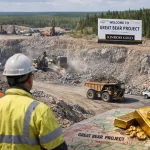
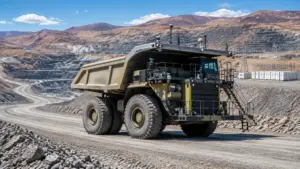
While most mid-tier gold producers spent 2025 managing inflation and squeezing existing deposits, Centerra Gold went the other direction. They drilled harder. And the numbers just validated that strategy in a big way.

The Vancouver-based miner reported year-end 2025 reserve figures that don't just move the needle: they reset it. Proven and probable gold reserves jumped 58% year-over-year to 5.5 million ounces. Copper reserves climbed 49% to 1.7 billion pounds. That's not incremental growth. That's a fundamental expansion of the company's mineable inventory.
The Drilling Campaign That Made It Happen
Centerra's exploration team put serious meterage downrange in 2025: 113.5 kilometres of drilling across 200 holes, totaling 56,835 metres of core. The result? Approximately 2 million ounces of gold and 500 million pounds of copper added to the mineral resource base.

The strategic calculus isn't subtle. In a market where gold prices have shattered the $5,000 milestone and copper is commanding $6/lb on supply deficit fears, reserve replacement isn't optional: it's existential. Centerra appears to have grasped that reality earlier than most.
More Read

Beyond the headline reserve numbers, measured and indicated resources inclusive of reserves now stand at 10.8 million ounces of gold and 3.6 billion pounds of copper as of December 31, 2025. Those figures represent the pipeline: the conversion path from resource to reserve over the next development cycle.

Mount Milligan: The Heavy Lifter
Mount Milligan in British Columbia did most of the heavy lifting in 2025. The mine complex added approximately 2 million ounces of gold and 500 million pounds of copper to its resource base during the year. That's not infill drilling picking up scraps at the margins. That's genuine resource expansion.
The asset also released a preliminary feasibility study extending mine life to 2045. Twenty years from now. That timeline matters in capital allocation discussions, particularly for institutional investors evaluating long-duration assets in jurisdictions with stable regulatory frameworks.
More Read

British Columbia isn't without permitting complexities, but it's not the Democratic Republic of Congo. The risk premium is manageable.

Mount Milligan's dual-commodity exposure: gold and copper: positions it directly in the path of two concurrent macro themes: monetary debasement driving gold higher and electrification driving structural copper deficits. Centerra benefits from both without having to bet the farm on either.
Kemess and Goldfield: The Next Chapters
At Kemess, also in British Columbia, Centerra completed 31,940 metres of drilling in 2025. The project remains in the development pipeline, but the exploration intensity suggests management sees value worth proving up systematically.
Goldfield, meanwhile, advanced to technical study stage with after-tax NPV of $245 million at $2,500 per ounce gold. That's conservative given current spot pricing north of $5,000. Run the same study at $3,500 or $4,000 gold: numbers that no longer sound absurd: and the project economics shift materially.
The question isn't whether Goldfield pencils out. It's whether Centerra can finance and permit it without diluting existing shareholders or taking on leverage that constrains operational flexibility elsewhere in the portfolio.
The 2026 Exploration Budget: Doubling Down
Centerra's 2026 exploration budget signals continued commitment: $40 to $50 million allocated across brownfield and greenfield programs. The split is telling. Half the budget: $20 to $25 million: goes to brownfield work at Mount Milligan, Kemess, and Öksüt. The other half funds greenfield and generative exploration.
That's a balanced approach. Brownfield drilling converts resources to reserves at existing operations, lowering finding costs and extending mine lives. Greenfield exploration hunts for the next Mount Milligan: higher risk, longer timeline, but potential for district-scale discoveries that redefine a company's asset base.

In an environment where major miners are pulling back on exploration spend to protect dividends and buybacks, mid-tiers like Centerra have an opening. If they can find it and prove it up, the majors will pay a premium to acquire it rather than drill it themselves. That's the playbook.
What the Market Isn't Pricing In
Centerra's reserve growth comes at an inflection point for both gold and copper fundamentals. Central banks continue accumulating gold at record rates heading into Q1 2026, providing a bid under prices that's structural rather than speculative. Copper faces a looming supply deficit that no amount of demand destruction seems capable of closing.
Centerra now holds more of both metals in proven and probable reserves than it did twelve months ago. Significantly more. In a supply-constrained world, that's optionality with intrinsic value.
The company also benefits from geographic concentration in stable jurisdictions: primarily Canada and Turkey. While resource nationalism remains a hedge consideration for mining majors globally, Centerra's footprint avoids the highest-risk geographies where permitting timelines stretch into decades and expropriation risk sits above zero.
The Execution Question
Reserve growth on paper matters. Converting those reserves into production at acceptable all-in sustaining costs matters more. Centerra's challenge over the next 24 months is translating this expanded resource base into actual metal output without blowing up the cost structure.

Inflation in mining inputs: energy, labor, explosives, steel: remains elevated even as commodity prices have surged. Margins can compress quickly if operational discipline slips or if permitting delays force projects into higher-cost construction windows.
The Mount Milligan mine life extension to 2045 buys time, but it also locks in capital commitments over two decades in an industry where commodity price cycles typically run seven to ten years. That's risk. Long-duration projects require long-duration conviction.
Where This Leaves Centerra in 2026
Centerra enters 2026 with a materially larger reserve base than most of its peer group added during 2025. That puts the company in rare company among mid-tier producers. The question now shifts from "can they find it?" to "can they build it and mine it profitably?"
The 2026 exploration budget suggests management intends to keep the exploration engine running while simultaneously advancing development projects toward production decisions. That's a high-wire act: balancing growth capital against sustaining capital against shareholder return expectations.
But in a market starved for new supply, companies that can actually replace and grow reserves have pricing power. Not at the mine mouth: commodity prices set that: but in M&A markets where majors increasingly look to acquire rather than explore.

Centerra's 58% gold reserve growth and 49% copper reserve growth in a single year puts the company on the radar. Whether that translates into production growth, margin expansion, or eventually a takeout premium depends entirely on execution from here.
The reserves are proven. The geology is confirmed. What happens next is entirely about management's ability to convert rock into cash flow without destroying value along the way.