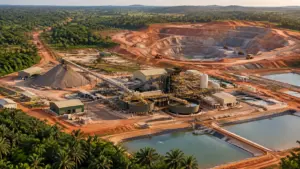
Indonesia’s coal fields are going electric. Not in a decade. Now.

XCMG just landed 100 pure-electric dump trucks in Indonesia as of January 2026, with another 32 units of 120-ton class XDE130 excavators already running at Cokal’s PT Borneo Bara Prima operation. Meanwhile, South Africa’s Exxaro is taking delivery of XDE260 diesel-electric trucks for its coal operations. This isn’t a pilot program. This is fleet replacement at scale.
The shift toward diesel-electric drive in mid-to-large payload classes is accelerating faster than most operators anticipated. The driver? Fuel cost savings of 15-20% compared to conventional diesel-mechanical systems. In operations running 24/7 haulage cycles, that’s not a rounding error. That’s millions of dollars per year per fleet.
The Indonesia Deployment: Cokal Goes All-In
Cokal’s decision to deploy 32 XDE130 units at PT Borneo Bara Prima represents one of the largest single-site electric haulage commitments in Southeast Asia. The 120-ton class excavators aren’t experimental units tucked into a corner of the operation. They’re running primary production cycles.

More Read

The XDE130 uses a diesel-electric drivetrain where the diesel engine powers a generator that feeds electric motors at the wheels. No mechanical transmission. No torque converter losses. Just direct electric drive with regenerative braking on descents. The fuel savings come from three sources: better thermal efficiency from the generator set running at optimal RPM, energy recovery during braking, and reduced parasitic losses from eliminating the traditional powertrain.

That 15-20% fuel cost reduction scales brutally when you’re burning thousands of liters per machine per month. At current Indonesian diesel prices hovering around $0.85-0.95 per liter for mining operations, a single XDE130 running 6,000 hours annually can save $40,000-50,000 in fuel costs alone. Multiply that by 32 units. That’s $1.28-1.6 million annually just from Cokal’s excavator fleet.
But fuel isn’t the only advantage. Diesel-electric systems deliver consistent power across the entire RPM range, eliminating the torque curve limitations of mechanical transmissions. That translates to faster cycle times, especially on grade. Operators are reporting 8-12% productivity improvements in addition to the fuel savings.
More Read
South Africa’s Exxaro Bet: XDE260 Trucks Enter the Fleet
Exxaro’s XDE260 deployment in South Africa follows the same economic calculus but at a different scale. The XDE260 targets the 240-260 tonne payload class, directly competing with Komatsu’s 930E and Caterpillar’s 797. These are the backbone trucks of large-scale coal operations.
South African coal mining faces unique cost pressures. Eskom’s electricity pricing volatility and diesel cost fluctuations make operational expense predictability critical. Diesel-electric trucks provide a hedge: lower fuel consumption means reduced exposure to diesel price spikes, while the electric drivetrain’s maintenance profile is significantly different from mechanical systems.
Traditional mining trucks use mechanical transmissions with 6-8 speeds, hydraulic systems for shift control, and complex final drives. Diesel-electric systems eliminate most of that. Fewer moving parts. Fewer failure points. The trade-off is increased electrical component complexity, but XCMG’s field data from over 100 units deployed in Indonesia suggests reliability is matching or exceeding conventional trucks.

Exxaro’s fleet economics are straightforward: if an XDE260 saves 18% on fuel (mid-range estimate) while maintaining 98% availability, the payback period on the higher upfront cost is 3-4 years. After that, it’s pure margin improvement. In a commodity business where operating cost per tonne defines survival, that matters.
Why Diesel-Electric Now? The Technology Maturation Curve
Diesel-electric drive isn’t new. Mining trucks have used it for decades, particularly in the ultra-class (400+ tonne) segment. What’s changed is the technology has migrated down into mid-to-large payload classes where cost sensitivity is higher.
Three factors are converging:
Component costs dropped. Power electronics, electric motors, and control systems that were prohibitively expensive for 130-260 tonne trucks five years ago are now economically viable. The proliferation of electric vehicle technology in other industries drove massive scale in motor and inverter production, pushing costs down 30-40% since 2020.
Generator efficiency improved. Modern diesel generator sets optimized for constant-speed operation achieve 38-42% thermal efficiency, significantly better than the 28-32% typical of diesel engines operating through mechanical transmissions across varying loads.
Operators got serious about total cost of ownership. When diesel was $0.50 per liter, fuel efficiency was nice to have. At $0.90-1.10 per liter across most mining regions, it’s survival. Operators are now running detailed TCO models that account for fuel, maintenance, availability, and productivity. Diesel-electric is winning those analyses.
The Fleet Race: Why XCMG Is Gaining Ground
XCMG’s competitive positioning in Indonesia and South Africa isn’t accidental. The company committed early to electric drive development while Western OEMs were still prioritizing autonomous systems and telematics platforms.
The numbers tell the story. XCMG delivered over 100 pure-electric dump trucks to Indonesia by January 2026. That’s not including the diesel-electric units or excavators. For context, the entire Indonesian mining equipment market absorbs roughly 300-400 large haul trucks annually across all manufacturers. XCMG is taking meaningful share.

Their approach differs from Caterpillar and Komatsu in two ways. First, XCMG offers diesel-electric as standard across multiple payload classes, not as a premium tier. Second, they’re pricing aggressively to build installed base, betting that service revenue and fleet expansion will follow once operators see the fuel savings in production data.
Cokal’s 32-unit order validates that strategy. When an operator commits to that fleet size, they’re not diversifying suppliers. They’re standardizing on XCMG for that equipment class. That creates vendor lock-in through parts inventory, technician training, and operational familiarity.
The Fuel Cost Advantage: Breaking Down the 15-20% Savings
Let’s put specific numbers to the fuel savings claim. A conventional 130-ton diesel-mechanical excavator running 6,000 hours annually in Indonesian coal operations typically consumes 55-65 liters per hour under load. That’s 330,000-390,000 liters per year per machine.
At $0.90 per liter, that’s $297,000-351,000 in annual fuel costs per excavator.
A diesel-electric XDE130 running the same duty cycle consumes 46-52 liters per hour. That’s 276,000-312,000 liters annually. At the same $0.90 per liter, fuel costs drop to $248,400-280,800.
The delta: $48,600-70,200 saved per machine per year. That’s 16-20% depending on duty cycle severity.
Multiply by 32 units at Cokal’s operation: $1.55-2.25 million in annual fuel cost savings. Over a 10-year equipment lifespan, that’s $15.5-22.5 million. Even accounting for higher upfront costs (diesel-electric systems typically command a 15-20% premium), the payback is clear.
For Exxaro’s XDE260 trucks, the economics are even more compelling. Larger trucks burn more fuel in absolute terms, so the percentage savings translate to bigger dollar figures. An XDE260 consuming 120-140 liters per hour versus 145-170 liters for a conventional equivalent generates $150,000-200,000 in annual fuel savings per truck.
What This Means for the Rest of the Industry
Caterpillar and Komatsu aren’t sitting idle. Both manufacturers offer diesel-electric options in their large truck ranges. But XCMG’s aggressive deployment in Indonesia and South Africa signals a strategic shift: electric drive is moving from niche to mainstream in the 130-260 tonne class.
The implications extend beyond OEM competition. Fuel suppliers are watching diesel consumption per tonne mined decline as electric drive adoption increases. That’s not a 2030 problem. It’s happening now in active operations.
Mining companies with large fleets face a capital allocation question: do they continue replacing aging trucks with conventional diesel-mechanical systems, or do they accelerate the transition to diesel-electric despite higher upfront costs? Cokal and Exxaro made their choice. Others will follow.

The autonomous haulage conversation complicates this further. Most autonomous systems were developed on conventional drivetrains. Integrating autonomous control with diesel-electric drive requires different software and sensor architectures. XCMG is developing that integration now, but it’s not production-ready at scale yet.
That creates a timing dilemma: deploy diesel-electric now and retrofit autonomous later, or wait for integrated systems and keep burning 15-20% more fuel in the meantime? Operators in high-fuel-cost regions are choosing the former. Get the fuel savings now, add autonomy in phase two.
The 2026 Inflection Point
If 2025 was about early adopters and demonstration projects, 2026 is about fleet-scale deployment. XCMG’s 100-unit delivery to Indonesia marks that transition. These aren’t test units. They’re production equipment running full duty cycles in commercial mining operations.
The XDE130 and XDE260 platforms represent XCMG’s bet that mid-to-large payload trucks will follow the same electrification path that ultra-class trucks took 15 years ago. The technology is proven. The economics work. The only question is adoption velocity.
Cokal’s commitment at PT Borneo Bara Prima and Exxaro’s fleet expansion in South Africa provide the answer. Adoption is accelerating. The fuel cost advantage is too large to ignore, especially in regions where diesel prices remain elevated and environmental regulations are tightening.
For operators running 30-50 trucks and excavators in 24/7 production cycles, that 15-20% fuel saving compounds quickly. It’s the difference between marginal profitability and healthy margins in a commodity business where every dollar per tonne matters.
The electric haulage shift isn’t coming. It’s here. XCMG is winning the fleet race because they arrived first with production-ready equipment at scale. Whether they maintain that lead depends on how quickly Caterpillar and Komatsu can match the economics while leveraging their service networks and installed base advantages.
But right now, in Indonesia and South Africa, XCMG trucks are running. And they’re saving operators real money on every load cycle.