By Charles Pitts & Salini Krishnan

Geology is indifferent to your net-zero timelines. This is the uncomfortable truth facing the global midstream as we cross into mid-March 2026. While Western policy circles debate the ethics of extraction, the ground is shifting, literally: in jurisdictions that have decided to stop apologizing for their mineral wealth.
Zambia is currently the epicenter of this shift. For years, the Copperbelt was seen as a legacy play, hampered by fiscal instability and erratic power grids. Today, it is the cornerstone of a $1 billion-plus roadmap aimed at tripling production. But as the copper bulls run, a secondary story is emerging: a brutal realization of operational fragility and a macro “inflation trap” that is hammering traditional safe havens like gold.
Welcome to the March 14, 2026, Skillings Mining Intelligence briefing. This isn’t just a market update; it’s a map of the new mineral sovereignty.
The Zambia Pivot: Tripling Down on the Red Metal
The narrative that African mining is too “risky” for Tier-1 capital is officially dead. Zambia’s stated goal to reach 3 million metric tonnes of annual copper production by 2031 is no longer a political talking point. It is a funded mandate.
More Read

The move is backed by a $10 billion private capital pipeline, including a massive $1.25 billion commitment from First Quantum Minerals. The signal to the market is clear: regulatory clarity beats geological convenience every time. We are seeing companies like Prospect Resources completely exit Zimbabwe: citing bureaucratic paralysis: to set up shop in Zambia’s copper-gold belt. They are chasing the “Zambian Signal,” a combination of streamlined licensing and a tax regime that doesn’t move the goalposts every fiscal quarter.

Production in 2026 is already projected to exceed 1 million tonnes, an 8% jump from 2025. This isn’t a rounding error. It’s a structural realignment. With First Quantum’s Kansanshi S3 expansion delivering its first commercial batches and Sinomine Resource Group prepping the $600 million Kitumba Mine for a September 2026 startup, the supply side is finally waking up.

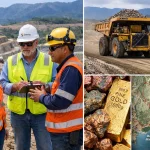
Caption: Mining industry professionals in safety gear review site plans in an open-pit mine, reflecting the global push for operational expansion in copper-rich jurisdictions.
More Read

But here is where it gets uncomfortable: despite the $13,000 copper forecasts we’ve been tracking, the “Andean thirst” remains a bottleneck for the competition. While Zambia fights droughts affecting its hydropower, it doesn’t face the same desalination hurdles currently choking the Chilean pipeline.
Operational Volatility: The Execution Gap
If Zambia represents the “bull” case for growth, the last 24 hours have provided a grim “bear” reminder of execution risk. Mining is hard. Doing it at scale in a high-inflation environment is harder.
Two major setbacks hit the wires this morning:
- Artemis Gold’s Blackwater Mine: A catastrophic ball mill failure has forced an immediate production halt. In an era where long-lead equipment delivery times are measured in years, not months, this is a nightmare scenario for shareholders.
- Rio Tinto’s Nemaska Lithium: Construction at the $500 million plant is slowing down. Officially, it’s a “strategic recalibration.” Unofficially? The lithium market’s current price oscillation is making $500 million capex decisions look a lot more dangerous than they did in 2024.
This operational stutter-step is exactly why the Vicuña District expansion and other brownfield pivots are becoming the preferred play for institutional investors. It is safer to buy a known quantity than to gamble on a greenfield startup that might break a ball mill on day ten.
The Middle East Trap: Gold, Oil, and the Cost of Extraction
The macro environment has taken a nasty turn. Gold, the perennial safety flight, is currently slipping below the $5,100 mark. That’s a second consecutive weekly loss.
Why? Because the Middle East energy-inflation trap has closed.
Inflation fears in the region are no longer driving investors into gold; they are driving investors out of risk assets as they prepare for a sustained $100 oil environment. BMO issued a stark warning this morning: if oil sustains triple digits, the operational costs for copper and iron ore extraction could spike by as much as 20%.
For miners, this is a double-edged sword. You get the high commodity prices, but your margins are cannibalized by the diesel and power required to haul the ore. It’s a “chickens-coming-home-to-roost” moment for ESG-heavy portfolios that neglected traditional energy security.

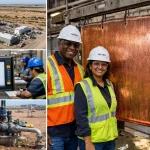
Caption: Modern mineral processing facilities are facing increased pressure from rising energy costs, forcing a shift toward more efficient, modular designs.
De-Risking the Supply Chain: The $110 Floor
While the majors struggle with ball mills and oil prices, the mid-tier is hammering out strategic alliances to break the Chinese stranglehold on critical minerals.
The most significant deal of the week involves Australia’s Lynas and its Japanese partners. They have established a $110/kg price floor for NdPr (Neodymium-Praseodymium). This isn’t just a contract; it’s an insulation layer. By guaranteeing a floor, Japan ensures its high-tech industry has a stable supply of rare earths regardless of how much China tries to undercut the market.
This is the blueprint for the future. We are moving away from “lowest cost” toward “highest certainty.”
Meanwhile, in the US, the regulatory tide is finally turning for non-traditional extraction. The Metals Company (TMC) has cleared a major hurdle for deep-sea mining exploration. Under a more aggressive, resource-focused US administration, the path toward seafloor mineral recovery is being cleared of the red tape that has kept it in limbo for a decade.
For projects like the Round Top buyout in Texas, this shift in sentiment is oxygen. The “missing middle”: refining and processing: is finally getting the capital it needs to ensure that when the copper leaves Zambia, it doesn’t have to stop in Shanghai before it reaches a US battery plant.
The 2026 Outlook: A Bifurcated Market
As we head into the second half of March, the mining industry is splitting into two camps.
On one side, you have the “Legacy Majors” struggling with aging infrastructure, grade decline, and the $100 oil threat. On the other, you have the “Agile Sovereign” players: Zambia, the US greenfield advocates, and the deep-sea pioneers: who are leveraging regulatory clarity to bypass the old bottlenecks.

Caption: Mining geologists examining core samples at high-altitude sites represent the ongoing search for high-grade deposits to offset the global grade decline crisis.
The data doesn’t lie: 2026 is the year where jurisdiction matters more than grade. You can have the richest copper deposit on the planet, but if you can’t get a permit or your power grid is failing, it’s just expensive rock.
Zambia has realized this. The question is, how many other nations will follow their lead before the supply deficit becomes a permanent drag on the global economy?