By Salini Krishnan

As the global energy transition accelerates in 2026, the pressure on copper producers to maximize output has reached an unprecedented level. With copper demand projected to outpace supply through the end of the decade, mining companies are no longer looking purely at expansion to meet targets; instead, they are looking inward. The industry’s focus has shifted toward “Operational Excellence,” a strategy where Artificial Intelligence (AI) and machine learning are deployed to squeeze every possible ounce of metal from existing assets.
In the current market, where smelting capacity has become a significant bottleneck, the efficiency of the mining and processing stages is paramount. AI-driven optimization is now responsible for throughput increases of 10% to 15% across major operations in Chile, Peru, and the United States, effectively adding the equivalent of a new mid-sized mine to the global supply chain without the need for additional permitting or excavation.
The Connected Mine: Real-Time Data Integration
The foundation of modern copper mining excellence lies in the “connected mine” architecture. By integrating millions of data points from Internet of Things (IoT) sensors embedded in everything from haul truck tires to primary crushers, AI systems create a “digital twin” of the entire operation.
Traditionally, mining data was analyzed in hindsight: weekly or monthly reports would identify where bottlenecks occurred. In 2026, the paradigm is predictive and instantaneous. Smart dispatch systems now track the exact cycle time of haulage fleets in real-time. If an excavator in a high-grade zone slows down due to mechanical fatigue, the AI automatically reroutes trucks to secondary targets or adjusts the speed of the primary crusher to prevent “slugging” the mill.
More Read

This granular visibility reduces equipment dead time and ensures that the flow of ore remains fluid. For large-scale operations, such as those highlighted in the Skillings Power List of 2026, these micro-adjustments prevent the “stop-start” inefficiency that historically plagued open-pit mines.


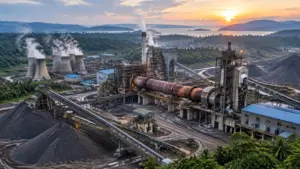
Caption: Advanced mineral processing facilities are now utilizing AI to synchronize throughput with real-time ore grade fluctuations.
Breaking Down Operational Silos: Mine-to-Mill Optimization
Perhaps the most significant leap in throughput has come from the integration of mine and plant operations into a single, AI-managed unit. Historically, the mine (extraction) and the mill (processing) functioned as isolated silos. The mine’s goal was to move as much rock as possible, while the mill’s goal was to process whatever arrived at its gates.
More Read

AI models now trace specific ore characteristics: such as hardness, mineralogy, and moisture content: from the blast hole all the way through the flotation circuit. By knowing exactly what is coming down the conveyor belt hours in advance, processing plants can adjust their grinding power, chemical dosages, and air flow in real-time.
Throughput Performance Metrics (2026 Industry Average)
| Operational Metric | Traditional Method | AI-Optimized (2026) | Percentage Gain |
|---|---|---|---|
| Throughput (tonnes/hour) | 4,200 | 4,830 | 15% |
| Recovery Rate (%) | 84.5% | 87.8% | 3.9% |
| Unplanned Downtime | 12% | 4% | 66% (Reduction) |
| Energy Consumption | Base | -8% | 8% (Reduction) |
As shown in the data above, the combination of increased throughput and higher recovery rates provides a compounding benefit to the bottom line. Companies like Codelco have pioneered this approach, utilizing digital brains to manage the complex non-linear functions of grinding mills. This effort is detailed in the latest reports on Codelco and Microsoft’s digital brain partnership, which serves as a blueprint for the 2026 outlook.

Caption: A conceptual diagram illustrating the flow of real-time data from the drill bit to the copper concentrate stage, managed by a centralized AI optimization engine.
Predictive Maintenance: Preventing the Multi-Million Dollar Failure
In copper mining, the cost of failure is astronomical. A single unplanned shutdown of a Semi-Autogenous Grinding (SAG) mill can cost an operator upwards of $500,000 per hour in lost production. AI-powered predictive maintenance has effectively moved the industry away from “reactive” repairs.
By analyzing vibration patterns, heat signatures, and oil samples through machine learning algorithms, maintenance teams can identify the “fingerprint” of a pending mechanical failure weeks before it occurs. This allows for scheduled maintenance during natural lulls in production or when ore grades are lower, ensuring that the plant is at 100% capacity when the highest-value material arrives.
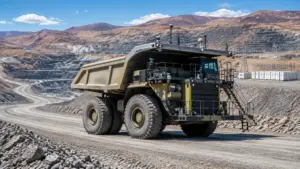
This asset protection extends to the haulage fleet. In regions like the Vicuña District, where extreme altitudes and rugged terrain put immense strain on machinery, AI monitoring is essential for maintaining the operational scale required to make these projects viable.

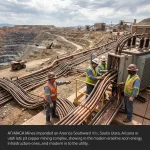
Caption: Heavy-duty components are now equipped with sensors that feed wear-and-tear data into predictive maintenance models to avoid catastrophic failures.
Autonomous Systems and Operational Continuity
The year 2026 has seen the maturation of Autonomous Haulage Systems (AHS). Unlike human operators, autonomous trucks do not require shift changes, lunch breaks, or bathroom stops. They operate with a level of precision that reduces fuel consumption and tire wear: two of the highest variable costs in mining.
However, the “AI advantage” goes beyond just driving the truck. AI systems optimize the entire traffic flow of the mine. In the copper-rich regions of Chile, autonomous fleets are being synchronized with AI-driven weather forecasting. If a high-altitude storm is predicted, the AI re-prioritizes the hauling of ore to stockpiles closer to the crusher, ensuring that the mill never runs dry even if the pit becomes temporarily inaccessible.

Caption: Chile remains the primary testing ground for AI-autonomous integration, given its massive operational scale and strategic mineral importance.
The 2026 Outlook: Challenges and Evolution
While the gains from AI are undeniable, the transition to fully optimized operations is not without its hurdles. The “human element” remains a critical factor. Training a traditional workforce to collaborate with AI “co-pilots” requires significant investment in change management. Furthermore, the integration of these systems necessitates a robust cybersecurity framework, as the reliance on digital infrastructure makes mines a target for high-stakes disruption.
Additionally, as throughput increases at the mine site, the industry must grapple with downstream capacity. Increased production at the mine level is only valuable if the concentrate can be refined. The U.S. funding bills for critical minerals are beginning to address the domestic side of this equation, but the global balance remains delicate.

Caption: An operational dashboard showing real-time throughput metrics, energy efficiency, and predictive maintenance alerts for a global copper mining portfolio.
Conclusion
Operational excellence in 2026 is defined by a company’s ability to turn data into copper. AI is no longer a peripheral technology; it is the central nervous system of the modern mine. By optimizing throughput, breaking down operational silos, and ensuring asset longevity through predictive maintenance, the copper industry is finding new ways to meet the world’s ravenous appetite for red metal.
As we look toward the second half of 2026, the distinction between “high-cost” and “low-cost” producers will increasingly depend on the sophistication of their digital infrastructure. In an era of declining ore grades, the smartest mines: not just the biggest ones: will lead the market.
Market Snapshot: Copper & Technology Leaders
- Copper Price (Spot): $4.85/lb
- Top AI Integration Lead: Codelco / Microsoft Partnership
- Growth Region: Vicuña District (Chile/Argentina)
- Key Risk: Downstream Smelting Bottlenecks
For more in-depth analysis on the technologies shaping the 2026 mineral landscape, visit our full archive of mining intelligence.