Silicon Valley doesn’t want to talk about dirt. They want to talk about Large Language Models, generative art, and the “democratization of intelligence.” But the shiny AI revolution has a dirty secret: it is built on the back of brutal, old-school extraction. Every time a ChatGPT query runs, it’s pulling on a physical thread that leads straight back to an open-pit mine.

The narrative that Big Tech is “decoupled” from the physical world is dead. In 2026, we’re seeing the most aggressive convergence of technology and mining in history. Microsoft, Google, and Amazon aren’t just buying software anymore; they are effectively becoming mining conglomerates by proxy. They are desperate for power, and power requires metals.
Welcome to the AI-Energy Nexus. This isn’t just a trend; it’s a multi-billion dollar gold rush that is fundamentally re-pricing the mining sector.
The Power Crunch: Data Centers as Metal Vacuums
The math is brutal. In 2024, U.S. data centers consumed about 183 terawatt-hours (TWh) of electricity. By 2030, that number is projected to hit 426 TWh. That’s not a rounding error. That’s a crisis. A single AI-focused hyperscale facility can consume as much electricity as 100,000 households. Some of the “gigawatt-scale” campuses currently under construction will dwarf that.
But you can’t transmit that power through the air. You need infrastructure.
More Read


Modern data centers require massive electrical infrastructure upgrades.

This infrastructure is a metal vacuum. To upgrade a grid to handle this kind of concentrated load, you need massive amounts of copper, aluminum, and steel. We aren’t just talking about a few extra wires; we’re talking about a total overhaul of the high-voltage transmission system.
Copper: The Nervous System of the AI Age
If AI is the brain, copper is the nervous system. Every GPU needs it. Every transformer requires it. Every mile of high-voltage cabling is packed with it. We’ve seen a lot of talk about “copper shortages” over the last decade, but the AI surge is the tipping point.
More Read

The problem? Geology doesn’t care about your quarterly earnings report. It takes 10 to 15 years to bring a Tier-1 copper mine online. Those two clocks: the speed of AI iteration and the speed of mine permitting: do not sync.
Take a look at the Oyu Tolgoi mine update. Even the world’s biggest projects are facing revenue-share demands and operational risks that make supply inelastic. When Big Tech comes knocking with a checkbook for 500,000 tons of cathode, they aren’t just placing an order; they’re starting a bidding war against the entire automotive and construction industries.

The Vicuña District represents the scale of new copper supply needed.
The strategic calculus here isn’t subtle: if you don’t own the supply, you don’t own the compute. We expect to see tech giants moving further upstream, perhaps even taking direct equity stakes in projects to bypass the volatility of the LME. Understanding copper processing 101 is no longer just for engineers; it’s now essential knowledge for any investor trying to front-run the data center build-out.
Uranium and the SMR Salvation
Renewables are great, but they don’t provide the 24/7 baseload power that a $5 billion data center requires. Solar doesn’t work at night, and wind is fickle. For Big Tech, the only answer that fits their “Net Zero” pledges while providing “Always On” power is nuclear.
Specifically, Small Modular Reactors (SMRs).
2026 is the year SMRs move from “cool PowerPoint” to “active construction site.” We’re seeing a massive shift in how uranium is perceived. It’s no longer the pariah of the energy world; it’s the green savior of the AI hallucination. This has sent the uranium market into a structural deficit that isn’t going away.
The “Gold Rush” here isn’t just for the fuel. It’s for the specialized metals required for reactor cores and shielding. While the world focuses on the uranium spot price, the real money is moving into the supply chains for the alloys and critical minerals that make these reactors possible.
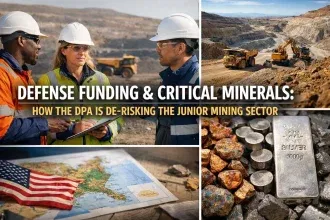
Government funding is increasingly de-risking critical mineral projects.
The Strategic Squeeze: Geopolitics Meets Silicon
And here is where it gets really uncomfortable. Most of the processing for these critical minerals is controlled by a single player: China.
As we noted in our analysis of China’s critical minerals export controls, the stranglehold on things like gallium, germanium, and graphite is a direct threat to the AI supply chain. You can design the best chip in the world in Cupertino, but if you can’t get the high-purity minerals to build it, you’re stuck.
This is driving a desperate scramble for domestic supply in the West. Projects like USA Rare Earth’s Round Top are no longer just “nice to have” mining plays. They are matters of national security and tech-sector survival. The price of these minerals is becoming secondary to the certainty of supply.

Efficient, domestic processing is the new frontier for mineral security.
2026/27 Forecast: The Multi-Year Bull Case
What happens next? If you’re waiting for a “correction” in the critical metals space, you might be waiting a long time. The demand profile for AI is not cyclical; it’s structural.
Our Forecast for 2026/27:
- Copper stays “Higher for Longer”: We anticipate copper prices to hover in the $4.50–$5.25/lb range as a base case, with a bull case pushing past $6.00 if data center construction accelerates as planned.
- Uranium Contracting Shifts: Look for long-term contract prices to decouple from the spot market as tech firms sign 20-year power purchase agreements (PPAs) tied directly to nuclear startups.
- Grid Metal Premiums: High-purity aluminum and electrical steel will see regional premiums as the U.S. and EU scramble to rebuild grids.
- M&A Heat: Expect “Non-Traditional” buyers. Don’t be surprised if a private equity arm of a major tech firm buys a junior miner outright just to secure the off-take.
The mining industry is used to being the “old man” of the economy: slow, dirty, and ignored until something goes wrong. Ironically, the most “futuristic” technology we’ve ever built has made the “old man” more relevant than ever.

Exploration activity is hitting record highs as tech demand surges.
The Grim Reality of Geology
You can’t “disrupt” geology. You can’t “Agile-sprint” your way through a 2,000-meter drill program. There is a fundamental physical limit to how fast we can pull these metals out of the ground.
Big Tech is used to moving fast and breaking things. But when they try to move fast in the mining sector, they find that the “things” they break are their own supply chains. The companies that will win the AI race aren’t necessarily those with the best algorithms. They are the ones who secured their copper, their uranium, and their rare earths in 2024 and 2025.
For everyone else, the AI revolution is going to be very, very expensive.
The strategic calculus isn’t subtle: electrification, digitization, and automation all lead to the same place. There’s not enough to go around. Those who realize this now are looking at the next multi-billion dollar gold rush. Those who don’t? They’ll be left staring at a “Server Unavailable” screen.