Most people think mining automation is about replacing a driver with a computer. They’re wrong.

By March 2026, the industry has realized that automating a single truck or a lone drill is just a parlor trick. The real money: the “Tier-1” money: is in the full-chain integration from the pit to the ship’s hull.
If your operation isn’t thinking in terms of a closed-loop, mine-to-port ecosystem, you aren’t just behind the curve. You’re becoming irrelevant.
The Death of the Operational Silo
For decades, mines operated as a series of disconnected handoffs. The pit crew blasted the rock, the haulage team moved it to the crusher, and the rail team eventually got it to the coast. Each step was a silo with its own inefficiencies and its own “human” variables.
In 2026, those silos are dead.
More Read

Tier-1 operators in the Pilbara and the Labrador Trough are now running “integrated value chains.” This means the autonomous haulage system (AHS) talks directly to the autonomous rail network, which synchronizes with the automated stockyard at the port.

It’s one continuous pulse of data and iron ore.
The strategic calculus here isn’t subtle: human error is expensive. A thirty-second delay at the primary crusher, multiplied by 365 days, is a multi-million dollar leak. Mine-to-port automation plugs that leak.
More Read
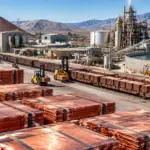

Efficiency starts at the plant but ends at the port.
Pilbara: The Blueprint for 2026
If you want to see what the 2026 standard looks like, look at Western Australia. The Pilbara has become the world’s largest laboratory for autonomous systems.
Rio Tinto’s AutoHaul: the world’s first fully autonomous, long-distance heavy-haul rail network: is no longer a “project.” It is the baseline. We’re seeing trains nearly 1.5 miles long traversing 1,000-mile round trips without a soul on board.
But the 2026 kicker is the interoperability.
In the early 2020s, you bought a Cat system or a Komatsu system, and they didn’t talk. Now, the 2026 tech standard demands “agnostic” integration. Tier-1 sites are using middleware that allows a Caterpillar 793F truck to yield to a Komatsu FrontRunner system at a busy intersection without a human controller breaking a sweat.
The results are brutal for competitors still using manual labor.
We’re talking about a 20% increase in equipment utilization. Per facility. That’s not a typo. When the machines don’t need lunch breaks, shift changes, or bathroom stops, the math changes fundamentally.
The Labrador Trough: North America’s Automation Front
While Australia gets the headlines, the Labrador Trough is where the North American standard is being hammered out.
Operators like the Iron Ore Company of Canada (IOC) and Champion Iron are dealing with environments that would make a Pilbara sensor freeze over. We’re talking -40°C, whiteout conditions, and permafrost issues.
In 2026, automation isn’t just about efficiency in the Trough; it’s about survival.
Rolling out autonomous haulage in sub-arctic conditions has forced a massive upgrade in Private LTE and 5G networks. You can’t run a 400-ton truck remotely if your latency is lagging. These sites are now effectively giant, high-speed outdoor data centers that happen to produce high-grade iron ore.

Autonomous heavy-haul trains are now the backbone of Tier-1 logistics.
The Brutal ROI of 2026
Let’s talk numbers, because the board doesn’t care about “cool tech” unless it moves the needle.
The ROI on mine-to-port automation is no longer a five-year “maybe.” In 2026, we’re seeing full capital recovery in under 30 months for Tier-1 brownfield conversions.
Here is why:
- Fuel Efficiency: AI-driven haulage optimizes every gear shift and braking event. We’re seeing a 15% reduction in diesel consumption across the board.
- Maintenance Costs: Predictive maintenance algorithms, fed by real-time sensor data, are extending tire life by 20%. Given that a single haul truck tire costs more than a luxury SUV, those numbers add up fast.
- Throughput Consistency: Automation removes the “cowboy” factor. Every cycle is identical. Every load is optimized.
But the most important metric? Safety.
Safety as a Data Point
In the old days, safety was a “culture.” In 2026, safety is a byproduct of removing humans from the line of fire.
Tier-1 operators are reporting a 30% to 40% reduction in Lost Time Injuries (LTIs) since the full-chain automation rollout began. When you move the operators from the cab of a truck to a climate-controlled Remote Operations Center (ROC) in Perth or Montreal, the risk profile drops to near zero.
It’s an uncomfortable truth for labor unions, but you can’t argue with the grim reality of the alternative. A machine doesn’t get fatigued at 3:00 AM on a Tuesday. A machine doesn’t get distracted by a text message.
Safety metrics are now a competitive advantage in securing ESG-focused investment. Investors in 2026 are looking at “automated safety” as a de-risking mechanism for their capital.

The modern “miner” spends more time with a mouse than a shovel.
The 2026 Tech Standards: What’s Under the Hood?
If you’re looking to audit your own site against the 2026 standard, here is the checklist:
- Edge Computing: Data isn’t being sent to the cloud and back for a decision. The trucks and shovels are making split-second decisions at the “edge” to avoid collisions.
- Digital Twins: Every Tier-1 site now has a 1:1 digital replica. Operators run “what-if” scenarios in the twin before changing a single setting in the physical mine.
- Zero-Trust Connectivity: With the rise of cyber warfare, mining networks are hardened like military bases. If a hacker hits the rail network, the mine-to-port connection is severed instantly to protect the hardware.
- Interoperability: If your software can’t talk to a competitor’s hardware via an open API, it’s considered legacy junk.
This tech stack is as essential as the copper processing equipment used to extract the minerals. Speaking of which, the demand for these systems is being driven by the global scramble for resources, complicated by geopolitical export controls that make operational efficiency the only variable operators can actually control.
The Human Capital Gap
Here is the nasty part of the 2026 reality: we have the tech, but we don’t have the people to run it.
The “skills gap” isn’t a future problem anymore. It’s a crisis. We’re desperate for mechatronics engineers, data scientists, and systems integrators who understand that a mine is a giant, moving robot.
Traditional mining degrees are being overhauled. If you aren’t learning Python alongside geology, you’re training for a job that doesn’t exist at the Tier-1 level.
Ironically, the automation that was supposed to solve the labor shortage has created a different kind of shortage. We’ve traded 500 truck drivers for 50 high-priced engineers, and those 50 engineers are much harder to find.

Global operations now require a fusion of site knowledge and tech savvy.
The Inflection Point
2026 marks the inflection point.
The gap between the “Automated Tier-1s” and the “Manual Tier-2s” is widening into a canyon. The automated giants are producing more, for less, with better safety records and lower carbon footprints.
They are capturing the market share because they can weather the price volatility that crushes manual operations. When iron ore or copper prices dip, the automated mine just keeps humming along at its optimized, low-cost baseline. The manual mine has to start cutting shifts.
It’s a brutal cycle.
If you’re waiting for the technology to “mature” or the price to come down, you’ve already lost. The standard has been set. The trucks are moving, the trains are rolling, and there isn’t anyone in the driver’s seat.
Welcome to the new reality. It’s efficient, it’s safe, and it’s completely unforgiving to those who hesitate.
The clock isn’t just ticking; it’s already synchronized to a GPS satellite. Your move.