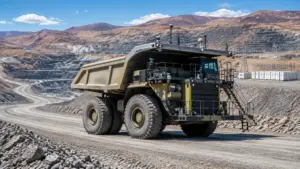
The first 1,000 hours of autonomous haul truck deployment separates the operators who actually know what they’re doing from those learning expensive lessons in real time.

That’s not hyperbole. It’s the window where your redundancy assumptions get tested, your GNSS coverage gaps reveal themselves, and your predictive maintenance protocols either work or don’t. Most autonomous haulage system (AHS) failures cluster in this early operational phase: not because the technology is fundamentally broken, but because implementation discipline collapses under production pressure.
2026 marks a critical inflection point. The technology works. We know this. Rio Tinto’s fleet in the Pilbara has logged millions of autonomous kilometers. Caterpillar and Komatsu systems are proven at scale. But the gap between “technology that works” and “implementation that doesn’t fail” remains brutally wide for operators deploying their first autonomous fleet.
The Hardware Redundancy You Actually Need
Single-point failures kill autonomous operations faster than any other failure mode.
The playbook starts with hardware-level redundancy that isn’t negotiable: dual power rails, redundant braking actuators, redundant steering systems, and parallel network architectures running CAN and Ethernet with continuous cross-checks. That’s baseline. Not a nice-to-have.
More Read



Your fault isolation systems need to trigger safe-state transitions within milliseconds: not seconds, milliseconds: when any monitored component reports an anomaly. This requires health monitoring across every critical subsystem with at least two independent sensors per component to eliminate false alarms that create operational chaos.
The compute architecture demands diversity. Deploy cores from different vendors to reduce common-mode risk. A single firmware bug in a single-vendor system can cascade across your entire fleet simultaneously. Modular design ensures automatic failover when any compute module degrades. One core fails, backup takes over, truck keeps rolling.
More Read

Per truck, that’s the standard. Anything less is gambling with uptime in a commodity environment where every lost hour compounds.
The GNSS Problem Nobody Wants to Talk About
Autonomous haul trucks default to fail-safe mode when GNSS signals degrade. They stop. Dead.
This happens more often than operators admit during pre-deployment planning. Pit walls interfere with satellite line-of-sight. Weather creates signal degradation. Electronic interference from other equipment creates dropout zones. Your trucks halt, your cycle times collapse, and your production plan unravels.
The solution isn’t better GNSS receivers: it’s integrating high-performance inertial navigation systems (INS) that use gyroscopes, accelerometers, and odometry for dead reckoning during signal loss. A properly calibrated INS allows continuous operation through GNSS outages lasting several minutes with minimal positional drift.
That’s the difference between a truck that stops when it hits a signal shadow and one that navigates through it autonomously while the system searches for satellite lock. The first scenario costs you 15-20 minutes per incident. The second maintains cycle time with near-zero impact.
Deploy this capability before you go live. Not after you discover how often your pit geometry creates signal gaps.
Predictive Maintenance as Operational Insurance
Predictive maintenance separates operators who understand autonomous systems from those treating them like manually-driven trucks with fancy software.
Your real-time dashboard needs to compile load conditions, tire wear patterns, wheel bearing status, brake temperature, hydraulic pressure trends, and weather impact data continuously. Not hourly. Continuously. The goal is anticipating maintenance requirements 24-48 hours before component performance degrades enough to trigger safety protocols.

Structure your maintenance windows around operational hours rather than waiting for failure signatures. A 750-hour service interval beats reactive maintenance every time because you’re controlling the timing rather than letting component degradation dictate your schedule.
Time between fault detection and remediation matters more than almost any other metric in the first 1,000 hours. A fault detected at 03:00 that doesn’t get remediated until the next shift creates 8+ hours of reduced fleet availability. That’s unacceptable when you’re still validating system reliability.
Mission Architecture That Actually Works
Extended autonomous operations require mission structuring that accounts for the operational realities of 24/7 hauling.
Break missions into multiple legs of 750-950 miles each over 72-hour operational windows. Build in 2-4 hours for charging and component inspection between legs. Refueling stops should take under 15 minutes: any longer and you’re losing the efficiency gains that justify autonomous deployment.
Night-window scheduling for charging and deeper maintenance reduces pit congestion while maintaining regulatory compliance for crew rest requirements. It also creates cleaner operational data because you’re isolating autonomous performance from manual traffic interference.
Monitor daily cycle metrics obsessively: moving time, energy consumed per ton-kilometer, charging duration, handoff readiness between shifts. Variance in these metrics signals emerging issues before they cascade into failures. A 7% increase in energy consumption per cycle over three consecutive days indicates developing mechanical resistance somewhere in the drivetrain. Catch it early, schedule proactive maintenance, avoid unplanned downtime.
Decision Logic and Fail-Safe Protocols That Hold Under Pressure
Your autonomous system’s decision chain follows a strict hierarchy: perception → fusion → prediction → planning → control.
Each stage needs enforcement of conservative behavior under uncertainty. If perception confidence drops below threshold in any zone, the system defaults to reduced-speed operation or safe stop: not aggressive pathfinding that assumes best-case conditions. This conservative logic costs you minor efficiency during edge cases but prevents major incidents when conditions genuinely deteriorate.
Emergency shutdown protocols must immediately halt vehicle operation when critical systems report errors. The shutdown sequence brings trucks to safe stops without creating secondary hazards from abrupt halting or trajectory deviation. Test these protocols exhaustively before deployment because you won’t get a second chance when they execute in production.
Formal takeover protocols to human operators or remote pilots need clearly defined thresholds. Define exactly when degradation in control quality triggers handoff. Ambiguity in these decision points creates dangerous gaps where neither autonomous system nor human operator has clear authority.
The 72-Hour Validation Window
The first 72 hours of autonomous operation reveal more about your implementation quality than the previous six months of planning.
Run parallel validation where manual operators shadow autonomous trucks for the entire initial period. This isn’t about backup: it’s about real-time comparison of decision-making under actual pit conditions. Where does the autonomous system make different routing choices than experienced operators? Why? Are those choices defensible based on optimization logic or are they exposing gaps in the operational model?
Data logging during this window needs to capture everything: every sensor reading, every decision point, every handoff, every anomaly. You’re building the baseline dataset that defines normal operation versus developing problems for the next 927 hours.
Expect surprises. Environmental conditions your simulation didn’t model. Traffic patterns that create unexpected conflicts. Weather impacts on sensor performance. Dust interference with LiDAR. Lighting conditions that affect computer vision reliability.
The operators who succeed in the first 1,000 hours are the ones who treat these surprises as data rather than problems. Log them, analyze them, adjust parameters, validate improvements, repeat.
What Matters Most
Autonomous haul trucks in 2026 aren’t bleeding-edge moonshots anymore. They’re proven technology with established implementation pathbooks.
The difference between successful deployment and expensive learning experiences comes down to discipline: redundancy that actually covers failure modes, navigation that handles signal degradation, maintenance that prevents rather than reacts, mission architecture that matches operational reality, and fail-safe logic that holds under pressure.
The first 1,000 hours test all of it simultaneously. Operators who execute the fundamentals consistently see uptime rates exceeding 95% and cycle time improvements of 20-30% compared to manual operations. Those who shortcut the playbook spend the same period troubleshooting failures that could have been designed out during planning.
The technology works. Your implementation either does or doesn’t.