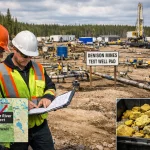
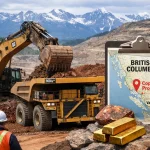
The mining industry talks a big game about innovation. Most of it is incremental optimization: bigger trucks, better sensors, marginally improved recovery rates.

Biomining is different. And the partnership between Genome BC and the University of British Columbia’s Biomining Research and Innovation for Metal-Mobilization (BRIMM) initiative is betting C$1 million that biology can solve extraction problems chemistry and physics can’t.
This isn’t laboratory curiosity anymore. It’s a deliberate de-risking strategy that could reshape how the industry approaches low-grade ores, complex waste streams, and tailings that conventional methods leave on the table.
The Biological Alternative
Traditional mining extraction relies on high temperatures, aggressive chemicals, and energy-intensive mechanical processes. It works. Until it doesn’t.
Low-grade ores don’t respond well to conventional methods. The economics fall apart. Tailings ponds accumulate metals that are technically recoverable but practically stranded. Waste streams contain valuable elements trapped in mineralogical structures that resist standard processing.
More Read



Biomining flips the approach. Instead of brute force, it deploys microorganisms: bacteria, fungi, archaea: that have spent millions of years evolving to extract specific metals from rock. These organisms produce organic acids, chelating agents, and enzymes that mobilize metals through oxidation and bioleaching processes.
The technology isn’t new. Copper producers have used heap bioleaching since the 1980s. But what Genome BC and BRIMM are doing is different: they’re using genomic tools to identify, optimize, and scale the specific microorganisms that work on specific ore types in specific conditions.
More Read
That precision is what changes the risk calculation.
De-Risking Through Three Pathways
The partnership structures risk reduction across three interconnected areas. Each addresses a different adoption barrier that’s kept biomining confined to niche applications.
Genomic Tools Development
Mining companies don’t want to be research labs. They want proven technologies with predictable performance metrics. The C$1 million investment over three years funds the development and validation of genomic tools that identify which microorganisms work, how fast they work, and under what conditions they optimize metal recovery.
This front-loads the R&D risk. Companies can adopt validated biological systems without bearing the cost: or timeline uncertainty: of developing those systems from scratch.
Training and Capacity Building
Technology adoption fails when the workforce can’t implement it. BRIMM is expanding training programs specifically designed to build genomics capacity within BC’s mining sector. This isn’t academic credential-building. It’s operational readiness.
The initiative trains metallurgists, process engineers, and site operators to work with biological systems that behave differently than chemical reagents. Microorganisms have life cycles. They respond to temperature, pH, nutrient availability, and competing organisms in ways that require different monitoring and control strategies.

Building that capacity before widespread deployment reduces the operational risk that accompanies unfamiliar technologies.
Research-to-Industry Translation
Academic papers don’t convince mining executives. Demonstrated results at operational scale do.
The partnership explicitly focuses on developing ground-level examples that show how biomining technologies function in actual mining operations: not just in lab flasks. These real-world validations provide the tangible evidence that reduces perceived risk and accelerates industrial adoption.
The Rio Tinto Integration
The strategic value multiplies through integration with the Rio Tinto Centre for Future Materials (RTCFM). Rio Tinto committed C$150 million over ten years to advance early-stage platform technologies at UBC. That’s not philanthropic research funding. It’s directed investment in technologies Rio Tinto believes will solve real operational challenges.
Research projects within the Biomining Innovation Partnership are eligible for co-funding through RTCFM’s “Grand Challenges” selection process. This creates a direct pathway from genomic research to deployment-focused development, with one of the world’s largest mining companies actively involved in defining the problems that need solving.
The alignment matters. Academic research can chase interesting questions that have no industrial application. This structure ensures biomining research directly addresses operational needs of global mining leaders: and that promising results have a clear path to commercial testing.
Where Biomining Changes the Economics
The technology creates value in three specific contexts where conventional extraction fails economically.
Low-Grade Ore Bodies
Grade decline is accelerating across most major commodities. Copper grades at many producing mines have dropped 30% over the past two decades. Gold, nickel, zinc: same story.
Lower grades mean higher processing costs per unit of recovered metal. At some point, the economics don’t work. The ore stays in the ground.
Biomining operates at lower capital cost and lower energy intensity than conventional processing. For ore bodies below the economic cutoff for traditional methods, biological extraction can shift the breakeven grade downward. That turns uneconomic resources into viable deposits.
Tailings Reprocessing
Mining companies are sitting on billions of tons of tailings that contain metals extractable with current commodity prices: but not with current processing economics.

Tailings present unique challenges. The easy-to-extract metals are already gone. What remains is locked in resistant mineralogical forms, often in fine particle sizes that don’t respond well to gravity separation or flotation.
Biological systems excel at mobilizing metals from these complex matrices. Several operations are already reprocessing tailings using bioleaching, turning environmental liabilities into revenue streams while reducing long-term closure costs.
Waste Stream Management
Mine water, process solutions, and contaminated runoff contain dissolved metals that regulatory frameworks increasingly require companies to capture and treat. Current treatment methods precipitate metals into sludges that create new disposal problems.
Biomining technologies can selectively recover valuable metals from these waste streams: turning compliance costs into partial revenue offsets. The organisms target specific metals, enabling separation that chemical precipitation can’t achieve efficiently.
The Genomic Advantage
What makes this partnership distinct from previous biomining research isn’t the concept: it’s the toolset.
Traditional bioleaching operations use naturally occurring microbial communities. They work, but nobody knows exactly which organisms are doing what, how efficiently, or how to optimize them for different conditions.
Genomic tools change that. Researchers can now sequence the genomes of organisms in bioleaching systems, identify the specific genes responsible for metal mobilization, and use that information to select or engineer organisms optimized for particular ore types.
This transforms biomining from an empirical art to a predictable engineering discipline. That predictability is what de-risks commercial adoption.
Timeline and Deployment Path
The three-year funding timeline isn’t arbitrary. It aligns with typical mining feasibility study and permitting cycles.
Year one focuses on genomic characterization and tool validation. Year two develops operational protocols and training programs. Year three demonstrates industrial application and prepares for commercial scale-up.
That cadence matches how mining companies make technology adoption decisions. Early-stage validation enables inclusion in prefeasibility studies. Demonstrated results at pilot scale support feasibility-level economic modeling. Proven operational protocols reduce permitting risk and support project financing.
The partnership isn’t trying to revolutionize the industry overnight. It’s building a foundation that de-risks each subsequent adoption stage.

What This Means for Resource Security
BC’s mining sector is positioning itself at the intersection of genomic technology and critical mineral supply chains. That positioning is strategic.
Global demand for copper, nickel, cobalt, and rare earths is accelerating faster than discovery and development of new high-grade deposits. The supply gap is real. The timeline to bring new conventional mines online is measured in decades.
Biomining won’t close that gap alone. But it changes what’s economically extractable from existing mining districts, operating mines, and historical tailings. That matters when every additional kilotonne of production capacity requires either a new discovery or improved recovery from existing resources.
The technology also aligns with increasingly stringent environmental requirements. Biological extraction operates at lower temperatures, uses fewer harsh chemicals, and generates less carbon emissions per unit of metal recovered than conventional pyrometallurgical or hydrometallurgical processes.
That advantage will compound as carbon pricing mechanisms expand and environmental compliance costs rise.
The Commercial Reality Check
Biomining isn’t a silver bullet. The technology works best in specific geological contexts with specific ore mineralogies under specific environmental conditions.
It’s slower than chemical processes. Biological systems operate on microbial lifecycles, not industrial timelines. A bioleaching operation might take months to achieve recovery rates a smelter reaches in hours.
It requires careful environmental management. Microorganisms are living systems with metabolic requirements. Temperature, pH, oxygen availability, and nutrient concentrations must stay within operational ranges. That adds monitoring and control complexity.
And it competes with established technologies that mine operators understand and trust.
But that’s precisely why the Genome BC-BRIMM partnership focuses on de-risking. They’re not promising to replace conventional extraction. They’re demonstrating where biological systems offer economic and environmental advantages: and building the infrastructure that lets companies adopt those systems without carrying development risk.
What Happens Next
The partnership is already operational. Research projects are moving through the co-funding evaluation process with RTCFM. Training programs are expanding enrollment. Genomic tools are being validated on ore samples from operating BC mines.
The real measure of success won’t be publications. It’ll be adoption. How many mining companies incorporate biomining into their flowsheets? How many feasibility studies include biological processing options? How many tailings reprocessing projects get financed based on bioleaching economics?
Those decisions will play out over the next 5-7 years as the technology matures and demonstration projects deliver results. The C$1 million investment and three-year timeline are just the initial commitment. If the partnership delivers validated tools and proven operational protocols, the follow-on investment will be substantially larger.
Mining companies are watching. The ones that understand where grade decline and environmental requirements are headed are already positioning themselves to adopt alternative extraction technologies. The question isn’t whether biomining becomes part of the industry’s toolkit.
The question is who builds that toolkit first: and who gets left extracting metal the hard way.