Canada finally woke up.

For decades, the mining narrative in British Columbia was almost exclusively about gold. If you found something else in the ore, it was a byproduct: a nice-to-have, or worse, a metallurgical headache. That era is officially over.
On March 16, 2026, the federal government updated its map of advanced critical metals projects. One name stood out not just for its ounces, but for its strategic chemistry: Canagold’s New Polaris project.
The project, located in the Tulsequah River valley of northwestern BC, is no longer being viewed through the narrow lens of a junior gold play. It is now a cornerstone of Canada’s domestic defense and industrial supply chain.
The reason? Antimony.
More Read

The Antimony Stranglehold
Most investors can’t point to antimony on a periodic table, but the Department of National Defence certainly can. It’s essential for everything from flame retardants to ammunition and high-capacity batteries.

The problem is the supply. China and Russia currently dominate the global market, creating a massive vulnerability for Western tech and defense sectors.
Canagold isn’t just digging for yellow metal anymore. They are sitting on one of the highest-grade gold-antimony deposits in North America. The strategic calculus here isn’t subtle: as global tensions rise, a secure, Canadian source of antimony becomes worth far more than its spot price.
More Read

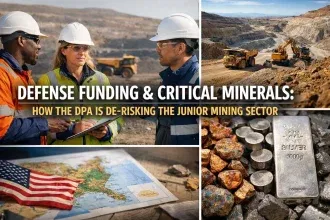
7,000 Meters of Truth: The 2026 Drilling Program
We are looking at a pivotal inflection point for the project. Canagold is preparing to launch a fully funded 7,000-meter diamond drilling program in June 2026.
This isn’t a “fishing expedition.” The goal is surgical.
The program is designed to expand the high-grade gold-antimony mineralization within and near the current mine plan. In mining, “high-grade” is a relative term that often gets abused by IR departments. At New Polaris, it’s a mathematical reality.
The July 2025 feasibility study already demonstrated robust economics. But this new drilling program aims to improve the early production years by targeting even higher-density zones. They’re looking to turn “indicated” into “proven” while potentially extending the mine life before the first shovel even hits the dirt.
For those following the broader market trends, this aggressive exploration mirrors the urgency seen in other sectors, such as Lithium’s 2026 rebound. When you have the resource, you don’t wait. You prove it.
By the Numbers: Why This Project Sticks
Let’s look at the data. That’s where the hype dies and the reality begins.
The project currently boasts:
- 5,630 tonnes of antimony metal in indicated resources.
- 1,195 tonnes in the inferred category.
- An average grade of 0.65% antimony in the indicated block.
That’s not a rounding error. That’s a crisis-mitigating volume of critical mineral.
Previous metallurgical testing has already confirmed excellent recovery rates. They aren’t reinventing the wheel on processing; they are just applying modern efficiency to a proven mineral suite. The feasibility study from last summer didn’t just look at how to get the gold out: it integrated the antimony recovery as a core component of the business model.

The Geopolitical Insurance Policy
Why does Canada care so much about New Polaris now?
Look at the U.S. Steel crossroads or the shift in global battery revolutions. There is a concerted effort to de-risk supply chains from Eastern hegemony.
Antimony is on the critical minerals list for a reason. If China throttles exports: which they have done with other minerals: Western manufacturers are left stranded. New Polaris provides a domestic “insurance policy.”
By producing antimony alongside gold, Canagold effectively lowers its gold production costs through significant byproduct credits. It’s a dual-threat asset: a profitable gold mine that doubles as a strategic mineral reserve.
Social License: The Taku River Tlingit Partnership
You can have all the gold and antimony in the world, but if you don’t have a partnership with the local community, you have a stranded asset.
Canagold didn’t make that mistake.
The Groundbreaking Collaboration Agreement with the Taku River Tlingit First Nation (TRTFN) is the foundation of this project. It’s not a “check the box” exercise. It’s a framework for long-term development that ensures the TRTFN are partners in the economic upside while protecting the environmental integrity of the Tulsequah River valley.
In 2026, social license is as critical as the drill bit. Without it, the project doesn’t move. With it, New Polaris becomes a model for how modern mining operates in British Columbia.

Infrastructure and the “Golden Triangle” Context
New Polaris sits in a legendary neighborhood. Northwestern BC’s Golden Triangle is home to some of the largest mineral deposits on Earth.
However, the region is also known for its rugged terrain and historical infrastructure challenges. Canagold’s approach has been pragmatic. By focusing on a high-grade underground operation, they minimize the surface footprint and the environmental impact, making the permitting process more streamlined than a massive open-pit operation.
The modular design of the proposed processing facility: detailed in the 2025 feasibility study: is a nod to the realities of remote Northern mining.
Build it efficiently. Run it cleanly. Get the critical minerals to market.
The 2026 Outlook: What Happens Next?
The clock is ticking. The June 2026 drilling program is the next major catalyst.
Expect to see assay results trickling out through the fall of 2026. If the drill bits confirm the expansion of these high-grade zones, the economic valuation of New Polaris will need to be re-written.
We aren’t just talking about gold prices anymore. We are talking about the “critical mineral premium.”
As the world continues to move toward electrification and advanced defense systems, the demand for antimony will only move in one direction. Supply, however, remains constrained.
Canagold is positioning itself to fill that gap.
A Stark Assessment
Here is the uncomfortable truth: Canada has plenty of “potential” projects. It has very few “advanced” projects that combine high-grade gold with essential critical minerals and a signed Indigenous partnership.
New Polaris is one of those rare exceptions.
The addition to the critical metals map isn’t just a government formality: it’s a signal to the market. The strategic importance of this site has been validated at the highest levels.
For more in-depth analysis on the shifts in the 2025-2026 mining landscape, you can review our previous coverage in the Skillings Mining Review March 2025 edition.
The 7,000-meter program starting in June isn’t just about finding more rock. It’s about securing a piece of the North American supply chain that has been neglected for too long.
The gold is the profit. The antimony is the strategy.
And in 2026, you need both to survive.