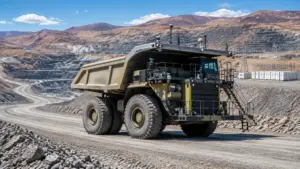
Caterpillar Inc. completed its acquisition of Australian mining software company RPMGlobal Holdings on February 17, 2026, marking a strategic expansion into data-driven mining technology and fleet-management software.

The deal, first announced in October 2025, integrates RPMGlobal's planning and simulation software: including HAULSIM and TALPAC: with Caterpillar's equipment portfolio and autonomous systems. Financial terms were not disclosed.
Why This Matters Now
The acquisition arrives as mining operators face mounting pressure to optimize fleet decisions around battery-electric, hybrid, and hydrogen-powered equipment. RPMGlobal's simulation tools allow mine planners to model these emerging technologies before committing capital: a capability that becomes critical as the industry transitions away from diesel.
"By combining RPMGlobal's software capabilities with Caterpillar's proven equipment and technology solutions, we will unlock new opportunities to help customers improve mine site performance," said Denise Johnson, group president of Caterpillar Resource Industries.

More Read

The integration creates a single-platform offering: equipment, software, and services bundled together rather than sold separately. For operators evaluating a $200 million fleet investment, the ability to simulate battery vs. hybrid vs. hydrogen scenarios using real-world haulage data can shift ROI calculations by millions.

What RPMGlobal Brings to the Table
Brisbane-based RPMGlobal provides software across the mining value chain: planning, scheduling, and site management. The company's tools help operators answer questions that determine project viability: Can we meet production targets with 15% fewer haul trucks? What happens to cycle times if we electrify the primary haulage circuit? How does battery swapping vs. opportunity charging affect net present value?
HAULSIM, one of RPMGlobal's flagship products, simulates haulage systems down to individual truck movements. TALPAC models truck and loader performance across varying terrain, grades, and payload configurations. These aren't theoretical exercises. They're decision-support tools that feed directly into capital allocation.
More Read

"The acquisition enables the companies to deeply integrate our solution sets to address mining industry challenges," said Richard Mathews, CEO of RPMGlobal.
RPMGlobal will continue operating under its own brand following the transaction: a signal that Caterpillar intends to preserve the software unit's market relationships and third-party equipment compatibility. That's notable. Many mining software acquisitions result in gradual drift toward proprietary ecosystems.
The Fleet Electrification Angle
The timing aligns with the mining industry's battery-electric pivot. Major miners including Rio Tinto, BHP, and Anglo American have committed to zero-emission fleets by 2030–2040. But the path isn't linear. Battery costs remain high. Hydrogen infrastructure is nascent. Trolley-assist systems work in some applications but not others.

RPMGlobal's simulation capability lets operators stress-test these scenarios before deploying capital. For a large open-pit copper mine evaluating a $300 million battery-electric haul truck fleet, the ability to model charging infrastructure, battery degradation, and payload penalties across a 20-year mine life is the difference between a viable project and a stranded asset.
Caterpillar's MineStar autonomous system already operates hundreds of trucks globally. Adding RPMGlobal's planning and scheduling software creates a closed loop: simulate fleet scenarios, deploy autonomous equipment, optimize in real-time using live data, then refine the model. That's the vertically integrated play.
What Changes for Customers
For mine operators, the acquisition means fewer vendors. Instead of buying Caterpillar equipment and licensing third-party software separately, customers can now procure integrated solutions on a single contract. That reduces vendor coordination risk but increases dependence on a single ecosystem.
For smaller software providers, the consolidation raises competitive pressure. If Caterpillar can offer bundled equipment-software packages at attractive pricing, standalone software vendors face margin compression.
For Caterpillar, the move signals recognition that mining value increasingly resides in software and operational efficiency rather than hardware specifications alone. A haul truck is a haul truck. How it's planned, scheduled, and optimized across a fleet? That's where competitive advantage lives.
The Broader M&A Context
This acquisition follows a pattern of mining-technology consolidation. Hexagon acquired Mineco in 2020. Sandvik completed multiple software bolt-ons between 2019 and 2024. Komatsu has steadily built its Joy Global digital portfolio since acquiring the company in 2017.
The strategic calculus isn't subtle: equipment OEMs recognize that software creates recurring revenue, higher margins, and customer lock-in. A mine that invests in integrated planning software rarely switches vendors mid-cycle. That's annuity income.
For mining industry observers tracking copper forecast 2026 dynamics and supply-side efficiency gains, software-driven optimization represents one pathway to close looming deficits without discovering new deposits. You can't disrupt geology. But you can extract more tons per hour with better fleet management.
What Happens Next
Caterpillar will likely pursue deeper integration between RPMGlobal's software and its Command for hauling autonomous system. Expect product announcements around predictive maintenance, battery-fleet optimization, and integrated mine-wide planning tools in the next 12–18 months.
For the mining industry, the transaction reinforces a shift: operational efficiency and data-driven decision-making increasingly determine project economics. The era of competing on equipment specifications alone is ending. The future runs on software: and Caterpillar just acquired a significant capability gap-filler.
RPMGlobal's continued brand independence suggests Caterpillar recognizes the value of maintaining third-party compatibility. But over time, the bundled equipment-software offering will likely become the default path for integrated mining projects. Welcome to the new reality: your haul truck and your planning software now come from the same vendor.