By Salini Krishnan

SANTIAGO, Chile : A high-stakes legal battle has erupted in the heart of the “Lithium Triangle,” pitting French mining conglomerate Eramet against Chile’s state-owned Empresa Nacional de Minería (ENAMI). The dispute centers on the Salares Altoandinos project, a world-class lithium deposit estimated to hold 4.5 million tonnes of lithium carbonate equivalent (LCE).
The litigation, which observers suggest could grind on for years, threatens to stall a $3 billion investment plan involving Rio Tinto and complicates the lithium strategy of Chile’s newly inaugurated President, Jose Antonio Kast. At the center of the “siege” is a fundamental clash between private property rights and sovereign control over strategic minerals.
The Standoff in the Highlands
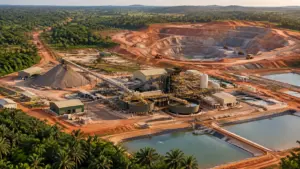
The Salares Altoandinos project, located in the high-altitude Atacama region, is one of the most promising undeveloped lithium resources on the planet. Eramet currently holds 99% of the mining concessions in the area, a portfolio it fortified with the $95 million acquisition of the Siete Salares project in late 2023.
However, holding mining rights in Chile does not automatically grant the right to extract lithium. Under Chilean law, lithium is classified as a “non-concessionable” resource, reserved strictly for the State. To move from exploration to extraction, a company requires a Special Lithium Operation Contract (CEOL) granted by the Ministry of Mining.
More Read

ENAMI, moving under a state mandate to expand Chile’s lithium output, has secured the CEOL for the Salares Altoandinos area. The state company plans to develop the site through a massive $3 billion joint venture with Rio Tinto. Eramet, finding its 99% land ownership bypassed by the state’s licensing power, has turned to the courts to block the project, claiming its property rights are being effectively expropriated without compensation.


A Conflict of Legal Frameworks
The legal battle hinges on a unique quirk of the Chilean Mining Code. While most minerals like copper and gold can be claimed via standard concessions, lithium has been a “material of nuclear interest” since 1979. This designation means the State owns all lithium in the ground, regardless of who owns the mining rights to the land above it.
More Read

“This is a classic ‘immovable object meets irresistible force’ scenario,” says a legal analyst familiar with Chilean mining law. “Eramet owns the ground, but ENAMI owns the permission to touch the lithium. Neither can move forward without the other, yet neither seems willing to blink.”
Eramet’s legal team argues that the granting of a CEOL to ENAMI over land where Eramet holds valid concessions constitutes a violation of constitutional protections for private property. ENAMI counters that the CEOL is an administrative act of the State regarding a resource the State legally owns.
The delay comes at a critical time for the global battery revolution. As the world shifts toward electric vehicles, the demand for high-purity lithium is projected to outstrip supply by the late 2020s. Any multi-year delay in Chile: the world’s second-largest producer: could send ripples through global supply chains.
The $3 Billion Rio Tinto Factor
The entry of Rio Tinto into the fray has raised the stakes significantly. The diversified mining giant, which has been aggressively pursuing lithium assets to balance its iron ore-heavy portfolio, viewed Salares Altoandinos as its flagship entry into the Chilean lithium sector.
In April 2026, Rio Tinto confirmed its intent to invest $3 billion alongside ENAMI to build a state-of-the-art Direct Lithium Extraction (DLE) facility. DLE technology is viewed as more sustainable than traditional evaporation ponds, as it reinjects brine back into the salt flats, preserving local water tables.
However, industry insiders suggest Rio Tinto’s investment is contingent on a “clean” legal title. “No major is going to pour three billion dollars into a project that is tied up in the Supreme Court for a decade,” notes a Santiago-based mining consultant.
Political Crossroads: The Kast Administration
The dispute is the first major test for President Jose Antonio Kast, who took office with a mandate to restore investor confidence and streamline mining approvals. Kast’s administration has expressed a desire to move away from the state-led “National Lithium Policy” of his predecessor, favoring a more market-oriented approach.
Yet, the Eramet-ENAMI dispute forces Kast into a corner. To support Eramet is to potentially undermine the State’s sovereign claim over lithium; to support ENAMI is to risk alienating foreign investors who fear the State can simply override established mining concessions.
The administration’s handling of this “siege” will be a bellwether for its broader mining policy. Industry players are closely watching whether Kast will attempt to mediate a settlement: perhaps by forcing a three-way partnership between ENAMI, Rio Tinto, and Eramet: or let the judicial process take its course.

Table: Salares Altoandinos Project Specifications (Estimated 2026 Data)
| Attribute | Detail |
|---|---|
| Total Estimated Resource | 4.5 Million Tonnes LCE |
| Projected Investment | $3.2 Billion USD |
| Proposed Technology | Direct Lithium Extraction (DLE) |
| Current CEOL Holder | ENAMI (State) |
| Mining Rights Holder | Eramet (99% of area) |
| Legal Status | Contested / In Litigation |
Market Implications and Regional Competition
While Chile remains mired in legal uncertainty, its neighbors in the Lithium Triangle: Argentina and Bolivia: are moving to capture market share. Argentina, in particular, has seen a surge in investment due to its more liberalized provincial mining laws.
The delay of Salares Altoandinos could lead to a shift in capital. Investors looking for exposure to the sector are already pivoting toward companies with clearer paths to production. For instance, recent analysis in the Skillings Stock Slam highlights alternative picks in the lithium and critical minerals space that are currently less burdened by geopolitical gridlock.
Furthermore, the uncertainty in Chile coincides with volatility in other commodity markets. The nickel market is currently adjusting to production cuts, and gold reserves have reached record highs in early 2026. This broader instability makes a multi-year legal battle over lithium even more unpalatable for institutional investors.

The Investigative View: What Happens Next?
The “Chile Lithium Siege” is not expected to be resolved in the 2026 calendar year. Legal experts point to several potential outcomes:
- The Forced Compromise: The Kast administration facilitates a deal where Eramet is brought into the ENAMI-Rio Tinto joint venture, likely in exchange for dropping the lawsuits and providing technical expertise.
- The Judicial Stalemate: The case moves through the Chilean Court of Appeals to the Supreme Court. This could freeze the project for 3–5 years, effectively removing Salares Altoandinos from the global supply map until the early 2030s.
- The Legislative Fix: The Chilean Congress introduces a new “Lithium Framework Law” designed to clarify the relationship between concessions and CEOLs, though the current political polarization makes this unlikely.
For Eramet, the stakes are existential for their South American strategy. After acquiring Siete Salares to secure a footprint in Chile, losing the right to develop the resource would be a significant blow to their lithium ambitions. For ENAMI, the project represents a chance to prove that a state-run company can partner effectively with global majors like Rio Tinto to deliver modern, DLE-based mining.
Conclusion
The battle over Salares Altoandinos is more than a dispute between two companies; it is a battle for the soul of Chile’s mining future. As the court proceedings begin, the global mining community will be watching closely. Whether Chile can resolve the tension between state sovereignty and private investment will determine its role in the energy transition for decades to come.
Stay tuned to Skillings Mining Review for ongoing coverage of this litigation and its impact on lithium prices and forecasts.