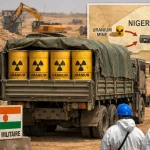
The Democratic Republic of Congo has placed a tantalum deposit currently controlled by M23 rebels on the table for U.S. investment, underscoring just how desperate Washington has become to break China’s stranglehold on critical minerals processing.

The Rubaya mine in North Kivu province, a major tantalum-producing site sitting in an active conflict zone, was added to Congo’s list of strategic assets available under the U.S.-DRC Strategic Partnership Agreement, according to senior officials from both countries who spoke Feb. 18 following the inaugural Joint Steering Committee meeting in Washington on Feb. 5.
That’s not a diplomatic footnote. That’s a geopolitical signal.
The Strategic Asset Reserve Framework
Congo submitted a comprehensive shortlist of state-owned mining assets to U.S. investors under what the agreement terms a Strategic Asset Reserve. The list includes manganese, copper-cobalt, gold, lithium, and other critical minerals across unlicensed and prospective mining areas.
The structure grants U.S. companies a right of first offer to these sites ahead of other investors, including Congolese entities.
More Read

Read that again: American firms get first dibs on Congolese mineral deposits before Congolese companies do.


The agreement mandates that Congo establish preferential tax and regulatory incentives for U.S. companies. It also requires U.S. firms to maintain majority ownership in projects developed under the partnership framework.
More Read

Here’s the kicker: the tantalum deposit being offered sits in territory controlled by M23 rebels, making operational security and supply chain continuity roughly as stable as a market rumor.
Why Tantalum Matters Now
Tantalum is a refractory metal critical to capacitors used in smartphones, laptops, automotive electronics, and defense systems. Global tantalum production was approximately 1,800 metric tons in 2024, with Congo accounting for roughly 35% of mined output.
But production is one thing. Processing is another.
China currently refines an estimated 60% of global tantalum concentrates into finished powder and wire. That processing chokepoint mirrors the broader challenge across cobalt, copper, lithium, and rare earths, where Beijing has systematically captured downstream value chains over the past two decades.
The Rubaya mine addition signals Washington’s willingness to accept operational and geopolitical risk in exchange for upstream supply access. The strategic calculus here isn’t subtle: physical control of ore bodies matters more than ideal operating conditions when your semiconductor supply chain depends on a geopolitical rival’s goodwill.

The M23 Variable
North Kivu has been unstable for years. M23, a rebel group with alleged Rwandan backing, controls significant territory in the province, including areas around key mining sites.
Operating a tantalum mine in an M23-controlled zone introduces layers of complexity that no feasibility study can fully model. Security costs. Extraction timelines. Transport logistics. Community relations in a conflict zone. Export route reliability.
And that’s before considering the reputational risk of sourcing minerals from an area where armed groups have historically been linked to conflict minerals financing.
The U.S. State Department, USAID, and Pentagon will need to navigate this minefield alongside whatever consortium of American companies steps forward. The agreement’s 180-day implementation timeline for initial project identification looks optimistic given these ground realities.
China’s Processing Dominance
The broader context driving this agreement is stark. China processes approximately 70% of global cobalt, 60% of lithium, and nearly 90% of rare earth elements. For copper, Congo’s primary export, Chinese smelters and refiners handle roughly 45% of global concentrate.
That vertical integration didn’t happen by accident. Beijing spent two decades building processing capacity, acquiring mining assets, and establishing long-term offtake agreements while Western companies focused on shareholder returns and asset-light business models.

Now the consequences are arriving. U.S. defense contractors, EV manufacturers, and tech companies face supply chains that route through Chinese processors regardless of where ore originates.
The Strategic Partnership Agreement attempts to short-circuit that dynamic by securing upstream access and theoretically building U.S.-controlled processing capacity. But construction timelines for smelters and refineries run 4-7 years minimum. Permitting adds another 2-4 years in most jurisdictions.
Meanwhile, Chinese processors continue expanding. China Molybdenum acquired Tenke Fungurume in Congo for $2.65 billion in 2016. Zhejiang Huayou Cobalt established multiple partnerships across Congolese copper-cobalt deposits. The Belt and Road Initiative funded infrastructure connecting Congolese mines to export routes through Tanzania and Angola.
The Sovereignty Question
Congolese lawyers and human rights organizations filed a constitutional challenge against the Strategic Partnership Agreement in January 2026, raising concerns about national sovereignty and the agreement’s terms.
The criticism centers on three issues: preferential treatment for foreign investors over domestic companies, majority ownership requirements that limit Congolese equity participation, and the right-of-first-offer mechanism that effectively grants U.S. firms veto power over asset development.
Those aren’t frivolous concerns. Resource nationalism has reshaped mining policy across Latin America, Africa, and Southeast Asia over the past decade. Governments in Chile, Indonesia, Zimbabwe, and Tanzania have all renegotiated mining contracts, increased royalty rates, or imposed export restrictions to capture greater economic benefits from mineral extraction.
Congo is moving in the opposite direction, granting unprecedented access to foreign companies in exchange for investment commitments and technology transfer promises.
The tension between immediate capital needs and long-term economic sovereignty will shape how this agreement evolves. President Félix Tshisekedi’s government needs foreign investment to develop mining infrastructure and create employment. But the political backlash from perceived asset giveaways could complicate implementation.
What U.S. Companies Are Actually Getting
The Strategic Asset Reserve isn’t a charity program. American firms participating in this framework will face significant capital requirements, operational challenges, and political risk.
Developing a greenfield tantalum project in North Kivu requires:
- Security infrastructure for personnel and equipment
- Community development programs to maintain social license
- Transport logistics through unstable territory to export points
- Processing partnerships or facilities to convert concentrate to refined products
- Environmental and human rights due diligence to satisfy U.S. regulations
- Political risk insurance to protect against expropriation or conflict disruption
The capital intensity runs into hundreds of millions for projects of commercial scale. The timeline from exploration to first production typically spans 5-8 years for base metals projects. Tantalum operations in conflict zones could extend that further.
Meanwhile, Chinese companies continue operating across Congo with established relationships, lower cost structures, and greater risk tolerance for unstable operating environments.
The Processing Gap
Even if U.S. companies successfully develop upstream mining assets in Congo, the processing bottleneck remains unresolved.
The United States currently operates zero commercial-scale tantalum processing facilities. Domestic cobalt refining capacity is minimal. Lithium hydroxide production is expanding but years behind Chinese capacity.
Building that processing infrastructure requires different skill sets, capital sources, and regulatory frameworks than mining operations. Refining and chemical processing face environmental permitting challenges, community opposition, and long construction timelines.
The Biden administration authorized $3.5 billion through the Defense Production Act for critical minerals processing. The Inflation Reduction Act provides tax credits for domestic battery supply chains. The CHIPS Act includes funding for semiconductor materials production.
But funding authorization and actual facility construction are separated by years of engineering, permitting, and execution risk. The first commercial-scale lithium hydroxide facility in the U.S. isn’t expected to reach full production until 2027. Cobalt refining capacity additions are in earlier stages.

Timeline and Implementation
The Strategic Partnership Agreement establishes a 180-day deadline for initial project identification and feasibility assessment. That puts the clock at early August 2026 for the first tranche of specific mining sites to move from strategic reserve to active development pipeline.
The Joint Steering Committee, comprising senior officials from the State Department, Commerce Department, USAID, and Congolese ministries, will oversee implementation and resolve disputes.
For the Rubaya tantalum deposit specifically, the timeline will depend on:
- Security stabilization in North Kivu
- M23’s territorial control and willingness to accommodate commercial operations
- U.S. company consortium formation and due diligence completion
- Offtake agreement negotiations with processors (likely Asian or European initially)
- Environmental and social impact assessments
- Community consultation and benefit-sharing frameworks
The optimistic case sees exploration teams on the ground by Q4 2026. The realistic case involves 12-18 months of preliminary work before meaningful capital deployment.
Market Implications
Tantalum prices have remained relatively stable over the past 24 months, trading in a range of $160-$180 per kilogram for tantalite concentrate. Unlike lithium or cobalt, tantalum hasn’t experienced the same boom-bust volatility driven by EV demand expectations.
But supply security concerns are building. Rwanda, Congo’s neighbor and alleged M23 backer, accounts for significant tantalum exports despite limited domestic reserves, raising questions about mineral laundering from Congolese sites.
The European Union’s Corporate Sustainability Due Diligence Directive and updates to the U.S. Dodd-Frank Act Section 1502 conflict minerals provisions are tightening traceability requirements for tantalum sourced from Central Africa.
These regulatory pressures create market opportunities for certified, conflict-free tantalum supply chains, which the U.S.-DRC partnership theoretically enables, assuming operational security issues can be resolved.
The Larger Strategic Game
The tantalum deposit offer is one piece of a broader reconfiguration of critical minerals supply chains driven by U.S.-China competition.
Washington has negotiated similar minerals partnerships with Australia, Canada, Zambia, and Brazil. The Minerals Security Partnership, a coalition of 14 countries, coordinates investment in supply chain diversification projects.
China, meanwhile, continues expanding its mineral footprint through state-owned enterprises, private companies, and Belt and Road infrastructure investments. In January, China Nonferrous Metal Mining Group announced a $1.8 billion expansion of copper production in Zambia. Zijin Mining purchased Continental Gold in Colombia for $1.4 billion in 2020 and has since expanded across South American projects.
The competition isn’t theoretical. It’s playing out in deal flow, capital deployment, and diplomatic maneuvering across mineral-rich developing countries.
Congo sits at the center of this competition due to its cobalt reserves (50% of global total), copper deposits (3.5% of global reserves but significant expansion potential), and critical minerals diversity including tantalum, tin, tungsten, and rare earths.
The Strategic Partnership Agreement represents Washington’s bet that capital, technology, and diplomatic engagement can outcompete Chinese financing and operational execution.
That’s a needle that’s almost impossible to thread given China’s 20-year head start, established relationships, and proven willingness to accept risk that Western companies typically avoid.
But the alternative, continued dependence on Chinese processing for minerals critical to defense systems, semiconductor production, and energy infrastructure, is strategically untenable from Washington’s perspective.
So Congo offers tantalum from a rebel-controlled mine, and the U.S. says yes. Welcome to critical minerals diplomacy in 2026.