The uncomfortable truth that most "green energy" evangelists ignore is that you cannot manifest a net-zero future out of thin air. You have to dig it out of the ground. And once you dig it up, you have to subject it to some of the most energy-intensive, chemically complex, and brutally physical processes on the planet.

Copper is the nervous system of the modern world. Between the massive surge in EV production and the localized hardening of electrical grids, global demand is screaming. But here’s the kicker: the average ore grade is dropping. We are working harder than ever to get less and less metal out of every ton of rock.
Understanding copper processing isn't just for metallurgists anymore; it’s for anyone trying to understand why supply chains are snapping. From the primary crushers to the final 99.99% pure cathode, the journey of a copper atom is a gauntlet of physics and fire.
Stage 1: Comminution: Breaking the Earth
The journey begins with comminution. That’s a fancy industry term for "smashing rocks into dust." When the ore leaves the pit, it’s often in chunks the size of a small car. To get the copper out, you have to liberate the minerals from the surrounding waste rock, or gangue.
This starts with primary crushing. Huge gyratory crushers chew through run-of-mine ore, reducing it to manageable sizes. But you can't stop there. To reach the liberation point: the size at which the copper mineral grains are actually exposed: the rock has to be ground down to the consistency of talcum powder.
More Read

This happens in SAG (Semi-Autogenous Grinding) mills and ball mills. These are massive, rotating cylinders filled with steel balls that tumble and crush the ore into a slurry.

The reality of the energy bill:
Comminution is the single most expensive part of a copper mine’s operational budget. It accounts for roughly 30% to 50% of a mine's total energy consumption. As ore grades decline, we have to grind more rock to get the same amount of copper. That’s not a rounding error; it’s a systemic challenge to the industry’s margins.

More Read
Stage 2: Froth Flotation: The Chemistry of Bubbles
Once the ore is a fine slurry, we move into the realm of surface chemistry. This is the concentration stage. Most of the world’s copper comes from sulfide ores (like chalcopyrite). You can’t just melt the slurry; it’s still 99% waste. You need to concentrate it.
Froth flotation is a beautiful, counterintuitive process. We take the slurry, add specific chemicals called "collectors" (like xanthates), and stir it in massive tanks called flotation cells.
Here is how the magic happens:
- The collectors attach to the copper minerals, making them hydrophobic (water-repellent).
- Air is pumped through the bottom of the tank, creating a storm of bubbles.
- The water-repellent copper minerals hitch a ride on the air bubbles and float to the surface.
- The waste rock: the gangue: stays at the bottom and is piped away to tailings ponds.
The result is a "concentrate" that is roughly 25% to 30% copper. We’ve gone from 0.5% in the ground to 30% in the froth. It’s a massive leap, but we’re still a long way from a finished product. We’re currently seeing this play out in real-time as companies look to optimize these recoveries. For instance, Hudbay’s Copper Mountain 2040 expansion is a prime example of how brownfield sites are trying to squeeze more life: and metal: out of existing footprints.
Stage 3: Smelting: Turning Up the Heat
If you’re dealing with sulfide ores, you can’t avoid the furnace. Smelting is where we separate the copper from the iron and sulfur that it’s chemically bonded to.
The concentrate is fed into a flash furnace along with oxygen-enriched air. The sulfur in the ore actually acts as a fuel, burning and providing much of the heat needed for the reaction. This produces two distinct layers:
- Matte: A molten mixture of copper sulfide and iron sulfide (about 50-70% copper).
- Slag: The waste material, mostly iron silicates, which floats on top and is skimmed off.
The matte then goes into a converter, where more oxygen is blown through the molten mass to burn off the remaining sulfur and oxidize the iron. What’s left is "blister copper." It’s about 98.5% pure. It gets its name from the bubbles of sulfur dioxide gas that get trapped as the metal cools, giving it a blistered appearance.
But 98.5% isn't good enough for a Tesla or a high-voltage transmission line. Even 1% impurity can drastically reduce copper’s electrical conductivity.

Stage 4: Electro-refining: The Final 0.01%
To get to the "four nines" (99.99% purity), we use electricity. This is the electro-refining stage.
We cast the blister copper into heavy plates called anodes. These anodes are hung in massive tanks filled with an acidic copper sulfate electrolyte. Between each anode, we hang a "starter sheet" or a permanent stainless steel cathode.
When we hit it with a low-voltage, high-amperage current, the copper atoms dissolve from the anode and migrate through the liquid to plate themselves onto the cathode. The impurities? They don't make the trip. They either stay in the solution or drop to the bottom of the tank as "anode slime."
The Silver Lining (Literally):
That anode slime isn't just junk. It often contains gold, silver, and platinum group metals. In many operations, the recovery of these byproducts is what makes the entire mine profitable. You can see the strategic importance of these precious metal streams in deals like the Lundin Gold silver stream, which highlights how secondary metals underpin primary copper and gold economics.
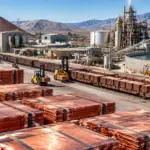
After about 10 to 14 days, the cathodes are pulled out. They are now 99.99% pure copper, ready to be melted and drawn into wire or rolled into sheets.
The Alternative Path: Oxide Ores and SX/EW
Not all copper is born in a furnace. For oxide ores (which are found closer to the surface), the industry uses a process called Solvent Extraction and Electrowinning (SX/EW).
Instead of crushing and smelting, we use heap leaching. The ore is piled onto massive lined pads and sprayed with a weak sulfuric acid solution. The acid trickles down, dissolving the copper and carrying it away in a "pregnant leach solution" (PLS).
The PLS then goes through solvent extraction to concentrate the copper before moving straight to electrowinning: a process similar to electro-refining that plates the copper directly onto cathodes. This path is generally cheaper and has a smaller carbon footprint, but it only works for specific types of mineralogy.

The 2026 Reality: Supply vs. Physics
The technical journey from crushing to cathode is well-understood, but the geopolitical and economic journey is becoming a minefield.
We’re seeing a tightening of the screws globally. Look at the recent data: Chilean copper output hit a five-month low despite resolving major strikes. When the world's largest producer stutters, the entire processing chain feels the vibration.
Furthermore, the "easy" copper is gone. We are moving into higher-risk jurisdictions and more complex ore bodies. The industry is responding with massive capital bets. Hudbay’s recent billion-dollar Arizona gambit is a clear signal: the fight for domestic copper processing capacity in the U.S. is officially in high gear.
Why It Matters for Investors and Operators
If you’re watching the markets, you have to look beyond the spot price. You have to look at the processing efficiency. A mine with a 0.4% grade that has mastered its flotation chemistry can often outperform a 0.6% grade mine with "dirty" concentrate that smelters penalize.
The strategic calculus isn't subtle:
- Energy Intensity: High power costs kill smelting and grinding margins.
- Water Scarcity: Flotation requires massive amounts of water, a growing problem in regions like the Atacama.
- Purity Standards: As electronics get smaller and more sophisticated, the tolerance for "dirty" copper is vanishing.
Copper processing is the bottleneck of the energy transition. You can have all the "green" policy goals you want, but until the rock hits the crusher and the current hits the cathode, it’s all just talk. The physics of mining doesn’t care about your timeline.
2026 marks an inflection point where the disconnect between "projected demand" and "actual processing capacity" will likely create a brutal reality check for the global market. Those who understand the flow: from the grit of the ball mill to the hum of the tank house: are the only ones who will see the crunch coming before it hits the bottom line.