As of mid-April 2026, the geopolitical map of the mining industry is being redrawn through a series of high-stakes negotiations between Washington and Brussels. The nearing EU-US Critical Minerals Accord represents a definitive shift from passive concern over Chinese supply chain dominance to active, state-led market intervention. This deep-dive analysis explores the mechanisms of this pact, the economic incentives being deployed to insulate Western miners, and the strategic imperative of securing the “backbone” metals of the modern era.

The New Architecture of Supply Chain Security
For years, the “China + 1” strategy was a corporate aspiration; in 2026, it has become a mandatory regulatory framework. The upcoming accord between the European Union and the United States is designed to create a “common market” for critical minerals that bypasses the traditional vulnerabilities of the global spot market.
At its core, the agreement seeks to harmonize the U.S. Inflation Reduction Act (IRA) incentives with the EU’s Strategic Move inside the $50B Critical Minerals Reserve Plan. By aligning these two massive economic blocs, the accord aims to ensure that minerals extracted or processed in Europe qualify for U.S. electric vehicle (EV) tax credits, and vice versa. This effectively creates a “privileged trading zone” for Tier-1 jurisdictions.
However, the pact goes beyond simple tax credits. It introduces a multi-layered defense against “weaponized” commodity pricing.
Price Floors and Subsidies: Fighting Market Volatility
One of the primary challenges for Western mining juniors has been the predatory pricing strategies often attributed to state-backed entities in the East. When a Western project nears completion, a sudden flood of supply can crash prices, rendering the new facility uncompetitive.
More Read

To counter this, the EU-US accord is expected to formalize the “Forge” framework, a mechanism that combines:

- Guaranteed Price Floors: For strategic metals like dysprosium, terbium, and lithium, the pact will establish minimum pricing for projects that meet specific environmental and labor standards. If market prices dip below this floor due to geopolitical manipulation, government-backed entities will step in as “buyers of last resort.”
- Adjustable Tariffs: These tariffs will be indexed against the carbon intensity and origin of the minerals, effectively penalizing “dirty” or non-transparent supply chains while rewarding those within the accord’s umbrella.
- Direct Capex Subsidies: Building on the momentum of U.S. funding bills that move projects faster in 2026, the accord will streamline joint investments into processing facilities on both sides of the Atlantic.

Context: The “Rare Earth War” of 2024-2025
The urgency behind this accord cannot be overstated. Throughout 2024 and 2025, Beijing implemented sweeping export controls on rare earth elements (REE) and gallium, responding to Western restrictions on high-end semiconductors. These controls weren’t just symbolic; they led to significant production halts in European magnet manufacturing and a spike in procurement costs for U.S. defense contractors.
More Read

As of late 2025, the EU was still sourcing nearly 100% of its heavy rare earths from China. The realization that an entire continent’s energy transition could be paused by a single administrative decree in Beijing has accelerated the search for internal solutions, such as the Per Geijer rare earths discovery in Sweden, which is now being fast-tracked under the new pact’s regulatory “green lanes.”
Strategic Defense and the Energy Transition Nexus
The Critical Minerals Accord isn’t just about car batteries. It is increasingly viewed as a defense treaty. Modern military hardware: from F-35 fighter jets to nuclear-powered submarines: requires massive quantities of specialized alloys and rare earth magnets.
The coordination on standards is a critical component of this. By establishing a shared “Global Green Standard” for mining, the EU and US are attempting to outmaneuver China not just on volume, but on ESG (Environmental, Social, and Governance) credentials. This standard will be used to gate-keep access to the lucrative defense and aerospace markets.
| Mineral | US/EU Dependency (2025 Est.) | Accord Strategy |
|---|---|---|
| Lithium | High | Joint investment in South American processing + domestic extraction. |
| Gallium/Germanium | Critical | Recycling mandates and state-backed stockpiling. |
| Heavy Rare Earths | Near-Total | Rapid development of REE separation plants in Norway and Texas. |
| Cobalt | High | De-risking DRC supply chains via the Lobito Corridor. |
Multilateral Expansion: Enlisting “Like-Minded” Partners
While the EU and US are the architects, the accord is designed to be inclusive of other “like-minded” nations. This is where the Minerals Security Partnership (MSP) becomes the operational arm of the policy. Countries like Japan, Australia, Canada, and South Korea are being integrated into the pricing and standards framework.
This multilateral approach is visible in projects like Rio Tinto’s expansion in lithium, where the capital is Western, the technology is Australian, and the end-market is a trans-Atlantic EV corridor.

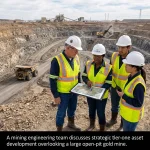
Caption: Mining engineers in safety gear review site plans in an open-pit mine, reflecting the global coordination required for mineral exploration.
The Challenges Ahead: Implementation and Cost
Despite the strategic alignment, hurdles remain. The primary concern among industry operators is the cost. Producing minerals under strict Western ESG standards with “price floor” protections is inherently more expensive than the current model. Consumers: and by extension, voters: may face higher prices for “de-risked” technology.
Furthermore, the “Buy American” provisions of the IRA continue to be a point of friction. European leaders are pushing for “permanent equivalency” to ensure their industries aren’t hollowed out by U.S. subsidies. The 2026 Accord is intended to be the legal bridge that resolves these disputes, creating a unified economic front.
2026 Outlook: A Bifurcated Market
As we move into the second half of 2026, the mining industry is witnessing the birth of a bifurcated market. On one side is the “Legacy Market,” dominated by traditional, low-cost, high-opacity supply chains. On the other is the “Accord Market,” characterized by:
- Higher transparency and data-driven sensing technology, as seen in the value of PDS data growth.
- State-supported project financing that favors long-term stability over short-term spot gains.
- A focus on circularity and secondary recovery to reduce the need for new primary extraction.
For operators and investors, the message is clear: the era of the “global” commodity is ending. The era of the “aligned” commodity has begun. Success in the 2026 landscape requires more than just high-grade ore; it requires a deep understanding of the geopolitical certifications that now dictate the flow of capital and material.
Market Snapshot: Strategic Metal Price Index (Q1 2026)
| Commodity | Index Change (QoQ) | Market Sentiment |
|---|---|---|
| Lithium Carbonate | +4.2% | Bullish: New US subsidies fueling demand. |
| Dysprosium Oxide | +12.8% | Volatile: Chinese export quotas remains tight. |
| Copper (LME) | +2.1% | Stable: Driven by AI-driven copper demand. |
| Iron Ore | -1.5% | Bearish: Whipsawing global steel markets. |
As the final details of the accord are etched into law, the mining sector stands at a crossroads. For those within the “Accord Market,” the path forward is paved with government guarantees and strategic certainty. For those outside it, the risks of 2026’s geopolitical volatility have never been higher.