By Penny Laneford

Mining more rock won’t save the North American energy transition. We’ve spent the last decade obsessed with extraction: digging holes in the ground and hoping the “invisible hand” of the market would somehow move that ore to a battery. It didn’t happen. Instead, we’ve watched a geographical disconnect cripple the supply chain, leaving raw materials stranded in the Canadian North while processing capacity remained a thousand miles away or, more likely, across the Pacific.
The industry is finally waking up to a brutal reality: geology is irrelevant without logistics.
In early 2026, the narrative has shifted from “where is the lithium?” to “how do we get it to the furnace?” The answer is the emerging Critical Minerals Corridor: a massive, integrated infrastructure play primarily orchestrated by BMI Group and bolstered by aggressive federal intervention. This isn’t just a series of roads; it’s a structural pivot designed to link the mineral-rich James Bay and Ring of Fire regions in Ontario to the industrial heartland of Quebec.
The BMI Group Strategy: More Than Just Real Estate
For years, the Canadian mining sector operated in silos. Juniors explored, majors extracted, and the midstream was someone else’s problem. BMI Group is challenging that establishment narrative. By acquiring and repurposing strategic industrial sites across Ontario and Quebec, they are building the physical “bridge” that has been missing.
More Read

The strategic calculus here isn’t subtle: link the extraction sites of the north to multimodal hubs in the south. BMI’s vision for a “Critical Minerals Corridor” focuses on creating a seamless flow from the mine gate to the refinery. They are positioning themselves as the landlord of the energy transition, securing the ports, rail spurs, and brownfield sites necessary to host the next generation of cathode active material (CAM) plants.

This isn’t speculative fluff. It’s a response to a desperate need for vertical integration. When we look at the structural pivot in copper or the projected lithium rebound of 2026, the common denominator is a lack of domestic processing. BMI Group is essentially betting that the company that controls the logistics controls the margin.

More Read
Bécancour: The $200M Validation
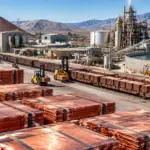
If you want to see the Corridor in action, look at the Port of Bécancour. The recent $200 million expansion clearance isn’t just a win for Quebec; it’s a signal to the global market that Canada is ready to handle the scale. Bécancour is rapidly evolving into a “Battery Valley,” but a valley is useless if you can’t get the ore into it.
The $200 million investment focuses on wharf upgrades and increasing the port’s capacity to handle bulk mineral concentrates. This is the “nasty” bottleneck no one likes to talk about. You can have the most advanced spodumene mine in the world, but if you’re waiting three weeks for a berth at a congested port, your ROI evaporates.
The expansion allows Bécancour to serve as the primary midstream hub for the entire corridor. It’s where the nickel from Ontario and the lithium from Quebec meet the chemicals and the cheap hydroelectric power required for refining.

Description: An infographic map showing the logistical flow of the Critical Minerals Corridor, connecting Northern Ontario’s “Ring of Fire” and James Bay lithium deposits to the Bécancour hub via rail and maritime routes.
The Infrastructure Stranglehold: Power and Rail
Connecting the dots requires more than just ambition. It requires megawatts and steel. The Canadian Infrastructure Bank has shifted its mandate, deploying a C$18 billion hammer toward projects that actually move the needle on critical minerals.
Take the power requirements alone. A modern refinery isn’t a workshop; it’s an industrial beast. We’re seeing upgrades like the $44.2 million Northwest Transmission Line system in BC and similar pushes in the East to ensure that when a processing plant comes online, it doesn’t crash the local grid.
Then there’s the rail. The corridor relies on the “Midstream Link”: a series of rail upgrades and multimodal terminals that allow for the efficient movement of ore.
- Northward: Empty cars moving mining equipment and supplies.
- Southward: Concentrates destined for Bécancour or Southern Ontario.
Per facility. That’s not a typo. The scale of movement required to satisfy the North American EV mandate is staggering. We are talking about millions of tonnes of material that currently have no efficient way to reach the coast.

2026: The Inflection Point for Mine Supply
Why does 2026 feel different? Because the “shiny AI revolution” and the electrification race have finally collided with the reality of supply timelines. The “wait and see” approach of 2023 and 2024 has been replaced by a frantic scramble for domestic security.
The Critical Minerals Corridor is Canada’s attempt to de-risk the supply chain for the Americans. Under the Inflation Reduction Act (IRA) and subsequent trade agreements, Canadian-processed minerals are treated as domestic. This gives the Ontario-Quebec corridor a massive competitive edge over offshore processing.
But here’s where it gets uncomfortable: the corridor is only as strong as its weakest link. If Northern Ontario cannot resolve its indigenous land-use agreements or if Quebec’s environmental permitting drags into 2027, the corridor becomes a very expensive road to nowhere. The $200 million Bécancour expansion is a clear statement of intent, but it is a singular victory in a much larger war.
Logistics as a Competitive Moat
Investors used to look at grade and tonnage. Now, they’re looking at proximity to the Corridor. A project 50 kilometers from a BMI-managed hub is worth exponentially more than a higher-grade deposit in the middle of a literal swamp with no rail access.
This is the “new math” of mining.
- Extraction cost: Variable.
- Processing cost: High.
- Logistics cost: The dealbreaker.
The Corridor addresses the dealbreaker. By consolidating the midstream, BMI Group and its partners are attempting to lower the barrier to entry for junior miners. If a junior doesn’t have to build its own refinery: if it can just “plug into” the Corridor: the economics of smaller deposits suddenly make sense.

Description: A high-action shot of the Bécancour waterfront, showing heavy machinery loading mineral concentrates onto a massive bulk carrier ship.
The Hard Truth
Canada has a history of being “hewers of wood and drawers of water.” We export the raw stuff and buy back the finished product at a 500% markup. The Critical Minerals Corridor is the first real attempt to break that cycle in the mining sector.
The $200M port expansion at Bécancour is a start. The BMI Group’s land acquisitions are a start. The Infrastructure Bank’s $18B mandate is a start. But the clock is ticking. China still controls the vast majority of midstream processing, and they aren’t exactly standing still while we clear wharves in Quebec.
We have the rocks. We now have the plan to move them. Whether we have the political will to finish the job before the next commodity cycle turns remains the $13,000-per-tonne question.