The global mining industry is currently gripped by a paralysis of scale. Everyone wants more copper, but almost nobody wants to write the check for a multi-billion-dollar greenfield project in a jurisdiction that doesn’t have a “AAA” credit rating. First Quantum Minerals is officially breaking that stalemate.

With its latest technical report filing for the Taca Taca project in Salta Province, Argentina, First Quantum isn’t just announcing a mine; it is placing a $5.25 billion bet on the future of the red metal. We aren’t talking about a modest expansion or a safe brownfield tweak. This is a massive, high-altitude, 35-year monster designed to pump out 291,000 tonnes of copper annually during its first decade.
To put that in perspective: that’s not just a contribution to the supply chain. It’s a structural shift. At a time when the world is staring down a massive copper deficit by the end of the decade, Taca Taca represents one of the few projects globally with the “heft” to move the needle. But the real story isn’t just the tonnage: it’s how First Quantum plans to extract it without becoming a carbon pariah.
The Brutal Numbers: Scale and Economics
Mining at this scale is a game of margins, and the Taca Taca numbers are, frankly, aggressive. First Quantum is eyeing an initial processing capacity of 40 million tonnes per annum (Mtpa), with a planned ramp-up to 60 Mtpa by the fifth year of operation.

More Read

The resource base is staggering. We are looking at 1.99 billion tonnes of proven and probable reserves at a 0.42% copper grade. In the current market, finding two billion tonnes of anything with a “4” in front of the decimal point is becoming an increasingly rare feat.

The economics tell a story of high risk and high reward. The project boasts an after-tax Net Present Value (NPV) of $5.92 billion at an 8% discount rate. More importantly for investors, the first-decade C1 cash costs are projected at $0.97 per pound. That places Taca Taca firmly in the lower quartile of the global cost curve. Even when the life-of-mine (LOM) costs rise to $1.26 per pound, the project remains a cash-flow machine.
Decarbonization as a Competitive Advantage
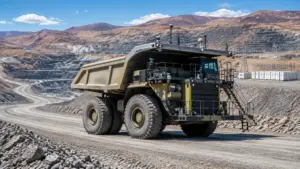
The most significant technical hurdle for massive open-pit mines today isn’t the geology: it’s the carbon footprint. Hauling billions of tonnes of rock using traditional diesel-electric trucks is increasingly incompatible with global ESG mandates and, more importantly, future carbon pricing.
More Read

First Quantum’s solution is the implementation of “trolley assist” haulage, part of their “Quantum Electra Haul” initiative. By using overhead electric lines to power trucks on the uphill climb out of the pit, the company can drastically cut diesel consumption. This isn’t just about being a “good corporate citizen”; it’s about operational efficiency. Diesel is expensive to transport to high-altitude Andean sites. Electricity, especially if sourced from renewables, is cheaper and more predictable.
The decarbonization strategy at Taca Taca includes:
- Grid Integration: A planned 122.5km transmission line to the 345kV Argentina–Chile system.
- Renewable Prioritization: Leveraging Chile’s massive renewable energy capacity to power Argentine operations.
- Autonomous Systems: Replicating the autonomous haulage and predictive maintenance systems already proven at their Sentinel and Kansanshi operations in Zambia.
These technologies are designed to lower the carbon intensity of every pound of copper produced, making Taca Taca a preferred supplier for Western OEMs who are increasingly scrutinizing the Scope 3 emissions of their raw material providers.

Argentina’s RIGI: The Regulatory Inflection Point
For years, Argentina was the “wait and see” jurisdiction of South America. While Chile and Peru built the world’s copper backbone, Argentina’s fiscal instability kept the big players on the sidelines. That changed with the Incentive Regime for Large Investments, or RIGI.
The RIGI reforms are a calculated effort by the Argentine government to provide the long-term fiscal stability required for $5 billion projects. For First Quantum, the RIGI application (targeted for July 2027) is the lynchpin. It offers tax certainty, customs exemptions, and, crucially, better access to foreign exchange markets. Without these reforms, Taca Taca would likely remain a stranded asset on a balance sheet.
Argentina is finally realizing that you cannot tax a mine into existence; you have to incentivize the capital to show up first. This regulatory shift is attracting a new wave of interest across the Vicuña District and beyond. As we’ve noted in our analysis of the resource realignment, the geography of mining is shifting toward jurisdictions that can offer both scale and stability.
The Multi-Metal Sweetener
While copper is the headline, Taca Taca is also a significant gold and molybdenum play. In the first decade, the project is expected to produce roughly 133,000 ounces of gold annually. That’s a significant credit that helps drive those sub-dollar C1 costs.
With gold prices recently topping $5,200 due to geopolitical jitters, the precious metals byproduct isn’t just a rounding error: it’s a massive buffer against copper price volatility. The project also adds 3,000 tonnes of molybdenum to the mix, providing further revenue diversification.

The Long Road to 2030: Timeline and Risks
Despite the optimism, Taca Taca is not a “quick win.” The timeline is long, and the capital requirements are heavy. First Quantum expects to complete the Environmental and Social Impact Assessment (ESIA) in the first half of 2026. Material spending isn’t slated until 2028, with first production not expected until the early 2030s.
The risks are familiar but formidable:
- Capital Intensity: A $5.25 billion capex is a heavy lift for any mid-cap or even large-cap miner. First Quantum will likely seek a joint venture partner to de-risk the build.
- Geopolitics: Argentina’s RIGI is a step in the right direction, but the country’s history of fiscal volatility means investors will be watching the 2027 elections closely.
- Water and Infrastructure: Building a massive processing plant at altitude requires significant water and logistical support. The plan to expand to 60 Mtpa by year five adds another layer of complexity to the supply chain.
For a deeper look at how other majors are handling these massive expansions, see our report on Freeport’s $7.5 billion Chile expansion. The trend is clear: the era of “easy copper” is over. Every new pound of supply now requires massive engineering, massive capital, and a massive tolerance for political risk.
The Verdict: A Necessary Monster
Taca Taca is exactly the kind of project the world needs if the energy transition is to remain anything more than a PowerPoint presentation. It provides the scale that junior miners simply cannot touch. By integrating trolley-assist technology and renewable power from day one, First Quantum is attempting to future-proof the operation against the inevitable carbon taxes of the 2030s.

The strategic calculus is simple: those who control the low-cost, low-carbon copper of the future will control the transition. First Quantum is currently leading that charge in Argentina. Whether they can execute on this 35-year vision without a major partner remains the $5 billion question.
For now, Taca Taca stands as a testament to the industry’s new reality: go big, go green, or go home. There is no middle ground left.