The US doesn’t have a mining problem. It has a processing crisis.

We’ve spent the last decade obsessed with finding the next big deposit. We scout the deserts of Arizona, the mountains of Idaho, and the lithium flats of Nevada. But here is the uncomfortable truth the industry likes to gloss over: You can dig up all the ore in the world, but if you have to ship it to Shanghai to turn it into something useful, you don’t own the supply chain. You’re just a glorified landlord for a foreign superpower’s raw materials.
Oklahoma isn’t playing that game. While other states are bogged down in decade-long permitting battles for new holes in the ground, the Sooner State is making a $4 billion bet on the “Missing Middle”: the refining and smelting capacity that actually dictates mineral sovereignty.
In the 2026 landscape of China’s critical minerals export controls, this isn’t just a smart economic move. It’s a survival strategy.
The Bottleneck: Why the Middle Matters
The “Missing Middle” is the industrial gap between the mine site and the final manufacturer. It’s where raw rock becomes battery-grade lithium carbonate or high-purity copper cathode. Historically, the US outsourced this “dirty” work because it was cheaper and environmentally easier to let someone else do it.
More Read

That bill has finally come due.

When we talk about copper, for instance, the process of moving from crushing to cathode is the exact point where the US loses its leverage. We export the concentrates and import the value-added products. Oklahoma is looking at that trade deficit and deciding to build a wall of high-spec industrial capacity instead.
The $4 Billion Aluminum Flex
The cornerstone of this strategy is the massive $4 billion investment from Emirates Global Aluminium (EGA). This isn’t just another factory; it’s a state-of-the-art aluminum smelter designed to plug a gaping hole in North American manufacturing.
More Read
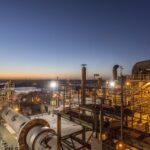
Aluminum is the backbone of everything from defense aerospace to EV frames. Yet, the US has seen its domestic smelting capacity gutted over the last twenty years. By bringing EGA into the fold, Oklahoma is positioning itself as a primary hub for a metal that is increasingly being viewed through the lens of national security.
Ironically, EGA’s move mirrors their global strategy, similar to their involvement in Ghana’s bauxite boom, but with a crucial twist: here, they are the ones providing the high-tech processing end of the stick.

High-tech refining facilities like these represent the “Missing Middle” the US desperately needs.
Stardust Power and the Lithium Logic
If the EGA smelter is the heavy hitter, Stardust Power’s lithium refinery in Muskogee is the precision strike.
Stardust isn’t mining lithium in Oklahoma. They are building a refinery at the Southside Industrial Park to process lithium feedstock from various sources into battery-grade material. This is the “Missing Middle” in action.
The strategic calculus here isn’t subtle:
- Feedstock Agnosticism: They don’t need a local mine to succeed.
- Value Capture: Refining adds a massive premium to the raw material price.
- Speed to Market: Building a refinery is: believe it or not: often faster than permitting a new greenfield mine in the current regulatory environment.
With up to $257 million in state and federal incentives, the project is a centerpiece of Governor Kevin Stitt’s vision to make Oklahoma “the best state in the nation for critical mineral manufacturing.”
Why Oklahoma? The Insider View
You might wonder why a mid-continent state is winning the refining war while the coasts are busy talking about “circular economies.” The answer is brutal and practical: power, permitting, and people.
Refining and smelting are energy-intensive. You can’t run a $4 billion aluminum smelter on hopes and dreams; you need a stable, affordable, and high-capacity power grid. Oklahoma has that. They also have a political climate that treats industrial development as a core mission rather than a necessary evil.
The state is effectively creating a “Refining Corridor” that bridges the gap between the raw resource states in the West and the manufacturing hubs in the Midwest and South. It’s a logistics play that cuts out the trans-Pacific shipping routes that have become the ultimate single point of failure for US industry.

The shift toward domestic processing is as much about logistics as it is about geology.
The Geopolitical Inflection Point of 2026
We are now in a period where “just-in-time” supply chains have been replaced by “just-in-case” sovereignty. As we look at the current market, the pressure on the US to decouple from Chinese processing has reached a boiling point.
China doesn’t just control the mines; they control the knowledge and the infrastructure of refining. By the time 2026 rolled around, the export restrictions on gallium, germanium, and graphite had already sent shockwaves through the tech sector. The Oklahoma model: investing in the “Missing Middle”: is the only logical response.
If you don’t control the processing, you don’t control the product. It’s that simple.
The Stranglehold on Copper and Beyond
Copper remains the bellwether. While we see massive projects like the Oyu Tolgoi mine ramping up production globally, the bottleneck remains the same: where does the concentrate go?
For decades, the answer was “East.”
Oklahoma’s bet is that the answer can be “Muskogee” or “Pryor.” By focusing on the midstream, Oklahoma is de-risking the entire US manufacturing sector. If a car company in Detroit can get its lithium and aluminum from a few hundred miles away rather than a few thousand, the entire risk profile of the American EV transition changes.
The Financial Reality: No Rounding Error
A $4 billion investment isn’t a pilot project. It’s an anchor.
When a company like EGA or Stardust Power drops that kind of capital, they are betting on a 30-year horizon. They are betting that the US government will continue to prioritize domestic content and that the “Missing Middle” will remain the most profitable and strategically important part of the chain.
It’s a bet that seems to be paying off. While junior miners struggle with defense funding and de-risking, midstream processors in pro-business states are finding the path to production much smoother.
Final Assessment: The New Map of Power
The map of US mineral power is being redrawn. It used to be defined by where the copper was in the ground. Now, it’s being defined by where the smelters are on the grid.
Oklahoma has realized something the federal government is only just starting to vocalize: extraction is a commodity business, but refining is a security business. By securing the middle of the supply chain, Oklahoma has effectively made itself the indispensable bridge for US mineral sovereignty.
The “Missing Middle” is being found. And it looks a lot like Muskogee.