NEW YORK : Open-pit gold miners are facing a critical margin squeeze as a new wave of energy inflation threatens to upend 2026 production guidance. According to a research note released Friday by Jefferies, the industry’s heavy reliance on diesel-powered haulage has created an “inflation trap” that could see all-in sustaining costs (AISC) jump by double digits before the end of the fiscal year.

The analytical report highlights a stark reality for the sector: for every 10% increase in the price of crude oil, the average open-pit miner sees an immediate $10 per ounce increase in production costs. With Middle East geopolitical tensions escalating and shipping lanes in the Strait of Hormuz remaining constricted, the mining industry is bracing for a supply-side shock that few anticipated during the budget cycles of late 2025.
The Mechanics of the Diesel Dependency
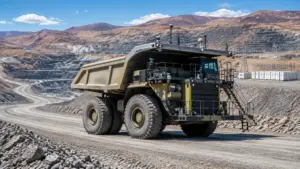
The vulnerability is a matter of physics and geology. Open-pit operations, which move millions of tonnes of waste rock to access ore bodies, are essentially massive logistics exercises powered by internal combustion. Unlike underground mines that can increasingly leverage electric rail or stationary conveyors, the open-pit model relies on a fleet of ultra-class haul trucks. These vehicles consume thousands of liters of diesel per shift.
Current data suggests that energy now accounts for approximately 12% of the average gold miner’s cost structure. When oil prices spike, the impact is not merely linear; it is compounding.
“The strategic calculus here isn’t subtle,” the Jefferies report noted. “Open-pit miners are essentially long on gold but short on oil. When those two prices de-couple, the margins vanish.”
More Read


Heavy-duty excavators and GET components are essential for large-scale open-pit operations, but their operation remains tethered to volatile fuel markets.

The industry is currently seeing fuel costs projected to rise by 6.25% year-over-year in 2026. However, that figure assumes a “base case” stability that is rapidly eroding. The recent escalation of regional conflict in the Middle East has prompted Tehran to restrict shipping through the Strait of Hormuz. For a global industry that relies on a steady flow of refined products, this is a choke point that cannot be easily bypassed.
Company Exposure: Who is at Risk?
The Jefferies analysis identified a specific group of producers whose asset portfolios make them particularly sensitive to this diesel shock. Topping the list is G Mining Ventures, whose production profile is derived 100% from open-pit operations. Without a diverse mix of underground assets to balance the energy load, the company’s AISC remains highly sensitive to the spot price of Brent crude.
More Read

Other major players facing significant exposure include:
- Endeavour Mining: 85% of production from open-pit assets.
- B2Gold: Between 78% and 83% exposure.
- OceanaGold: 71% of production tied to open-pit mining.
- Barrick Gold: 52% to 66% exposure depending on the regional site mix.
The pressure is already manifesting in quarterly reporting. While the gold price has remained resilient, the “inflation trap” means that record-high revenues are being offset by record-high expenses. It is a crisis of margin, not of demand.

Table: Estimated AISC Sensitivity to 10% Oil Price Increase by Company.
The Ripple Effect: Beyond the Fuel Tank
The diesel shock does not stop at the fuel pump. High energy prices historically act as a lead indicator for broader inflationary pressure across the mining supply chain.
“Energy prices eventually flow through electricity costs, consumables, labor, and equipment expenses,” said a senior analyst involved in the report. “That’s not a rounding error. That’s a structural threat to the bottom line.”
As transportation costs rise, the price of reagents, grinding media, and spare parts follows. Even the cost of site-based labor is under pressure as fly-in-fly-out (FIFO) logistics become more expensive to maintain. We have seen similar cycles before, but the speed of the 2026 move has left many procurement departments scrambling.
Some companies are looking to acquisitions to balance their portfolios. For instance, SSR Mining recently completed its acquisition of the CCV gold mine as part of a broader strategy to manage asset-level risks, though the move into different jurisdictions brings its own set of logistical hurdles.
Defensive Strategies: Hedging and Technology
In response to the diesel threat, mining executives are pivoting toward two primary defensive postures: financial hedging and accelerated electrification.
Hedging programs have become a lifeline for companies like B2Gold and Kinross. By locking in fuel prices 12 to 18 months in advance, these operators have created a temporary buffer. However, hedges eventually expire. If oil prices remain elevated through the second half of 2026, those companies will be forced to mark their costs to a much higher market reality.
The more permanent solution lies in decarbonization, but that clock does not sync with the immediate financial crisis. While companies like Thiess are prioritizing abatement over offsets in their fleet strategies, the transition to hydrogen or battery-electric haulage at scale remains years away for most active pits.

Mining professionals in safety gear review site plans as trucks operate in the background. The transition to automated and electric fleets is a long-term goal, but current operations remain diesel-heavy.
“You can’t disrupt geology,” says the report. “And you can’t replace a diesel engine in a 400-tonne truck overnight.”
The investment required for this transition is staggering. Recent estimates suggest the copper industry alone faces a $2.1 trillion investment gap to meet demand, much of which is driven by the very electrification needed to save the mining industry from its fuel dependency.
The Geopolitical Inflection Point
The immediate outlook for the gold sector is now inextricably linked to the geopolitical stability of the Middle East. The U.S. military actions in the region earlier this year have created a feedback loop of volatility. As shipping insurance rates climb and tankers are rerouted around the Cape of Good Hope, the landed cost of diesel in remote mining jurisdictions like West Africa and the Andes is hitting levels not seen since 2022.
This isn’t just a challenge for the majors. Junior miners and developers are finding it increasingly difficult to secure financing for open-pit projects. Lenders are now scrutinizing energy-intensity metrics as closely as they do grade and tonnage. If a project requires a massive haulage fleet to be viable, the “diesel risk” is often enough to stall a Final Investment Decision (FID).
A New Era of Operational Efficiency
For operators, the “inflation trap” is a mandate for extreme operational efficiency. We are seeing a surge in interest for eco-friendly mining technology and data-driven sensing. If you cannot change the price of the fuel, you must change how much of it you burn.
Techniques like pit-rim crushing and conveying (IPCC) are being revisited. By moving the primary crusher closer to the pit face and using electric conveyors to move ore to the mill, companies can significantly reduce their reliance on diesel-burning trucks.

Advanced mineral processing plants are integrating modular designs to improve efficiency, but the “inflation trap” remains a primary concern for the haulage phase.
“2026 marks the inflection point,” the Jefferies report concludes. “The era of cheap, reliable energy for the mining sector is over. The companies that survive the next 24 months will be those that treat energy as a strategic mineral, not just a utility.”
For investors, the message is clear: look past the headline gold price. The real story of 2026 is being written in the fuel tanks of the world’s largest machines. The margin squeeze is here, and for the open-pit specialists, there is nowhere to hide.
About the Author: Penny Laneford is a senior analyst and lead writer for Skillings Mining Review, specializing in the intersection of energy markets and mineral extraction.