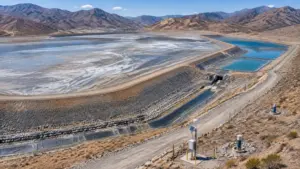
Northern Dynasty Minerals lost 45% of its market value in a single session after the Department of Justice filed a brief defending the Environmental Protection Agency’s Clean Water Act veto of the Pebble Mine project. The Feb. 16 filing wasn’t a surprise. But it was definitive.

The DOJ’s position is simple: the EPA’s 2023 determination blocking the proposed copper and gold mine in Alaska’s Bristol Bay watershed was lawful under the Clean Water Act. That determination established restrictions across roughly 308 square miles that effectively prohibit discharge of dredged or fill material associated with mining the Pebble deposit.
The filing lands as Northern Dynasty and its legal partners push toward a summary judgment ruling expected by the end of 2026. If the court sides with the government, the case ends without trial. If the court finds issues with the EPA’s process, Northern Dynasty gets another shot.
Those are long odds in a short window.

More Read

Thiessen Calls Out the Disconnect
Northern Dynasty CEO Ron Thiessen didn’t hold back in his response. He pointed to what he called a “stark contrast” between the Trump administration’s stated pro-development agenda and the DOJ’s defense of an Obama-era EPA action that preemptively vetoed the project before a permit application was even filed.

Thiessen’s complaint: the EPA used its Section 404(c) authority under the Clean Water Act to block the project in 2023 based on watershed protection concerns, but did so without allowing Northern Dynasty to submit a formal permit application under the standard National Environmental Policy Act review process.
The company argues this amounts to regulatory overreach. The DOJ argues the EPA acted within its statutory authority to protect aquatic resources of national importance. Both can’t be right.
More Read

The political angle cuts deeper than usual here. The Trump administration has signaled support for domestic critical mineral production and streamlined permitting. Copper is on every critical minerals list published by the federal government. Yet the DOJ, under that same administration, is defending a veto that blocks what would be one of the largest undeveloped copper deposits in North America.
That disconnect isn’t getting resolved at the agency level. It’s headed for the courts.
The Scale of What’s at Stake
The Pebble deposit isn’t small. Northern Dynasty’s preliminary economic assessment outlined a 20-year mine life producing an average of 287 million pounds of copper annually, along with 362,000 ounces of gold and 13 million pounds of molybdenum.
Over two decades, that translates to roughly 5.7 billion pounds of copper, 7.2 million ounces of gold, and 267 million pounds of molybdenum. Those numbers put Pebble in the same weight class as Tier 1 assets that anchor major mining portfolios.
Copper production of that magnitude would represent about 1.4% of current global annual supply. In a market facing a structural deficit driven by electrification and data center build-outs, that’s material tonnage. Gold production would rank Pebble among the top 20 gold mines globally by output.

But none of that matters if the ore stays in the ground.
The EPA’s 2023 determination didn’t evaluate the mine’s economic merits or its potential contribution to U.S. mineral security. It evaluated the risk to Bristol Bay’s salmon fishery, which supports a $1.5 billion annual industry and is a primary food source for Alaska Native communities in the region.
The agency concluded that large-scale mining in the watershed posed an unacceptable risk to aquatic ecosystems. That determination covers not just the immediate Pebble site but a broader area that includes more than 20 other mining claims.
Legal Timeline and the Path Forward
Northern Dynasty’s consolidated legal challenge includes the State of Alaska and two Alaska Native village corporations: Pedro Bay and Iliamna: which oppose the EPA’s veto. The case is moving through the U.S. District Court for the District of Alaska.
A summary judgment ruling is expected by the end of 2026. If the court upholds the EPA’s determination, Northern Dynasty’s options narrow to an appeal or abandoning the project. If the court vacates the determination, the EPA would need to either redo its analysis or allow Northern Dynasty to proceed with a permit application.
Two separate takings cases filed by Northern Dynasty and the State of Alaska are stayed pending resolution of the main case. Those cases argue the EPA’s action constitutes a regulatory taking of property rights without compensation. Takings claims are notoriously difficult to win, particularly before a property owner has been denied all economically viable uses.
Meanwhile, Alaska’s legislature is considering permanent statutory protections for the entire Bristol Bay Fisheries Reserve. That measure would address not only Pebble but the broader field of mining claims in the region. If passed, it would create a state-level backstop that exists independently of federal Clean Water Act authority.
Public opposition remains substantial. A 2024 survey showed 56% of Alaskans oppose the Pebble project. That’s not unanimous, but it’s a majority in the state where the mine would be built.

The Copper Supply Paradox
The Pebble veto creates a paradox that’s uncomfortable for anyone tracking global copper supply. The U.S. needs more domestic copper production to support electrification targets, reduce reliance on imports, and secure supply chains for defense and infrastructure. The Pebble deposit contains copper at a scale that would move the needle on domestic production.
Yet the same government agencies tasked with energy transition planning are defending regulatory actions that block development of that copper. The DOJ brief supporting the EPA veto doesn’t mention copper supply gaps, critical mineral strategy, or national security considerations. It focuses narrowly on whether the EPA followed proper procedure under the Clean Water Act.
That’s legally defensible. The Clean Water Act doesn’t include exemptions for critical minerals or national security. The statute directs the EPA to protect water quality and aquatic ecosystems. The agency says it did that. The courts will decide if it did so lawfully.
But the policy tension is real. The U.S. government is simultaneously publishing critical mineral strategies that emphasize domestic production while defending vetoes that block domestic production. Those positions can coexist legally. They can’t coexist logically.
The copper market isn’t waiting for that tension to resolve. Global refined copper production is expected to reach approximately 26.3 million metric tons in 2026, while demand is projected at 26.9 million metric tons. That’s a 600,000-metric-ton deficit in a market where new supply takes a decade to bring online.
Projects like Pebble don’t solve that deficit alone. But blocking projects like Pebble makes the deficit worse.
What Comes Next
Northern Dynasty faces a narrow path forward. The company has acknowledged that successful development would require achieving numerous technical, economic, and legal objectives: securing mining permits without opposition-related delays, demonstrating economic feasibility, completing detailed engineering, finding a development partner, and raising significant additional financing.
Each of those steps was already difficult before the DOJ brief. Now they’re harder.
The 45% share price decline reflects investor recognition that the DOJ’s position materially reduces the probability of the project moving forward. Markets price probability, and the probability shifted against Northern Dynasty on Feb. 16.
The summary judgment ruling will clarify whether the EPA’s process was legally sound. If the court upholds the veto, Northern Dynasty’s options contract sharply. If the court finds procedural flaws, the project gets another round. But even a favorable ruling doesn’t guarantee permits, partnerships, or financing.
Bristol Bay’s salmon run will continue regardless. The copper will stay in the ground until or unless a court decides otherwise. And the U.S. will continue importing the copper it says it needs to produce domestically.
That’s the paradox. And the DOJ brief just made it harder to resolve.