The mining industry is currently facing a reckoning that no amount of traditional "operational excellence" can fix. We are staring down a structural labor deficit that is, quite frankly, terrifying. While the world demands more copper for the energy transition, the people required to pull it out of the ground are disappearing.

Over 200,000 experienced miners in the U.S. will hit retirement age this decade. To replace them, American universities are graduating fewer than 400 mining engineers a year. The math doesn’t work. It’s a slow-motion train wreck for domestic supply chain security.
But here’s where the narrative shifts. Mariana Minerals isn’t trying to find more miners; they’re rewriting the software of extraction itself. With the recent acquisition of the Lisbon Valley Mining Company in Utah: now rebranded as Mariana Copper One: the company is attempting something far more radical than simple automation. They are deploying "Physical AI" at scale.
This isn’t about putting a remote control on a haul truck. It’s about MarianaOS: a unified platform designed to orchestrate an entire mining ecosystem autonomously.
The Lisbon Valley Pivot: From 2,500 to 50,000 Tonnes
When Mariana Minerals moved into Utah, they didn’t just buy a mine; they bought a laboratory for the future of American industry. Under its previous life as Lisbon Valley, the operation was producing a modest 2,500 metric tonnes of copper annually. It was a traditional, labor-heavy shop struggling against the usual headwinds of fluctuating grades and rising costs.
More Read

Mariana’s target? 50,000 metric tonnes of copper cathode per year by 2030.

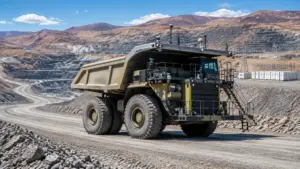
That is a 20-fold increase in output. In any other era, a jump of that magnitude would require a massive town-site, a thousand-person workforce, and a logistical nightmare. Mariana plans to do it with a fraction of the headcount, leaning instead on a fleet of autonomous hardware coordinated by a singular digital brain.
The strategic calculus here isn't subtle: if you can’t find the people, you have to build the intelligence.
More Read


MarianaOS: The Three Pillars of Autonomy
The industry has flirted with "digital twins" and "autonomous hauling" for years. Usually, these are siloed products: Komatsu trucks running one software, the processing plant running another, and the geologists using something else entirely. They don’t talk to each other.
MarianaOS is the antithesis of that fragmented approach. It is a unified software stack divided into three core modules:
- MineOS: This handles the "physical" side of the dirt. It orchestrates drilling, blasting, and hauling. Instead of a dispatcher telling a driver where to go, MineOS uses reinforcement learning to optimize routes in real-time based on ore grade, fuel efficiency, and pit conditions.
- PlantOS: This is the brain of the solvent extraction-electrowinning (SX-EW) facility. It monitors reagent levels, flow rates, and energy consumption, adjusting the chemistry on the fly to maximize recovery.
- CapitalProjectOS: Perhaps the most overlooked piece, this manages the expansion and infrastructure build-out, ensuring that as the mine scales, the digital architecture stays ahead of the physical steel.
By integrating these, Mariana isn't just automating tasks; they are orchestrating a system. When MineOS identifies a change in the ore's mineralogy at the face, PlantOS is already adjusting the leach pads before the first truck even arrives. That’s the "Physical AI" difference.
The Hybrid Feedstock Strategy: Geologic and Scrap
The 50,000-tonne goal isn't just coming from the ground. In a move that highlights the shifting reality of "urban mining," Mariana Copper One is designed to process both geologic ore and copper scrap.
Currently, the United States is one of the world’s largest exporters of copper scrap. We essentially ship our high-value waste to Asia, let them process it into finished goods, and buy it back at a premium. It’s a massive leak in our domestic industrial strategy.
Mariana intends to plug that leak. By utilizing their autonomy-first processing plant, they can blend traditional mined ore with scrap feedstocks. This reduces the carbon footprint per pound of copper produced and provides a hedge against the inherent risks of pure-play exploration.

(Suggested Prompt: A high-detail, documentary-style shot of a modern copper processing facility at night, illuminated by industrial floodlights, showing a mix of raw ore and processed scrap metal being moved by autonomous machinery.)
Why 2026 is the Inflection Point
The clock is ticking. Mariana Copper One is scheduled to begin its "autonomy-first" operations in April 2026. This isn't a pilot project in a distant corner of the Outback; it’s happening in San Juan County, Utah.
The timing is critical. As we’ve noted in our Skillings Mining Intelligence reports, the "Critical Minerals Corridor" in the Western U.S. is becoming a geopolitical battleground. With the U.S. government pouring billions into de-risking domestic supply chains, projects that can prove high-margin production without massive labor requirements are the new gold standard.
The Lisbon Valley site sits on a proven resource, but the "uncomfortable truth" is that Lisbon Valley failed under the old model. It was too small to be a major and too complex for a junior. By applying MarianaOS, the company is attempting to prove that software can turn a marginal asset into a tier-one producer.
The Human Element: Not Gone, Just Different
There is a common fear that Physical AI means the end of the miner. That’s a fundamental misunderstanding of the problem. We don’t have enough miners to begin with.
Mariana’s workforce isn't being "replaced": it's being evolved. The job site of 2026 won’t feature hundreds of people in the pit. Instead, it will be staffed by systems engineers, maintenance technicians, and remote operations monitors. These are high-paying, tech-heavy roles that are more attractive to a younger generation of workers who would otherwise never consider a career in extraction.
It’s a different kind of "grit-and-steel." It’s a world where a technician monitors a fleet of autonomous drills from a control room in Moab, intervening only when the AI encounters a scenario it hasn't mapped before.

Domestic Security and the Copper Gap
We have written extensively about the geopolitical surge and the $1B U.S. investment into critical minerals. But all the government funding in the world won't matter if we can't actually get the material out of the ground efficiently.
Copper is the "indispensable" metal. From EVs to data centers for the very AI that Mariana is using, the demand is relentless. If the U.S. wants to maintain its technological edge, it cannot rely solely on imports from jurisdictions that are increasingly aligned with our competitors.
Mariana Copper One is a test case for a new American industrialism. If they can successfully scale to 50,000 tonnes using MarianaOS, it provides a blueprint for every other "stranded" asset in the Western United States. There are dozens of Lisbon Valleys across Utah, Arizona, and Nevada: projects that are geologically sound but economically "stuck" due to labor costs and operational inefficiencies.
The Bottom Line
The future of mining isn't just deeper pits or bigger trucks. It’s better code.
Mariana Minerals’ move into Utah is a signal that the "Silicon Valley of Mining" might actually be in the high desert of the Colorado Plateau. By treating the mine as a unified software problem rather than a series of disconnected mechanical tasks, they are positioning themselves at the forefront of the most significant shift in extraction since the invention of the steam shovel.
It’s a high-stakes bet. Scaling to 50,000 metric tonnes is a massive lift. But in a world where the workforce is evaporating and the demand for copper is exploding, "Physical AI" isn't a luxury. It’s the only way forward.
April 2026 is when we find out if the software can handle the grit.
Social Media Snippet:
Mariana Minerals is turning Utah into a "Physical AI" powerhouse. By acquiring Lisbon Valley and deploying the unified MarianaOS, they aim to scale copper production 20x to 50,000 tonnes per year. This isn't just automation: it's a complete rewrite of the mining stack to solve the domestic labor crisis and secure the U.S. copper supply. #MiningTech #PhysicalAI #Copper #EnergyTransition #MarianaCopperOne