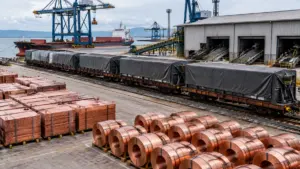
Representative image: copper-gold exploration drilling in Queensland.

By Charles Pitts
Copper exploration company QMines Limited (ASX:QML) has reported a 35-metre intersection grading 2.88% copper at its Mt Chalmers project in Queensland, with associated gold and silver results supporting ongoing metallurgical work for the project’s Definitive Feasibility Study.
The intersection returned 0.75 grams per tonne (g/t) gold and 3.3 g/t silver from 107 metres, including a higher-grade copper interval of 31 metres at 3.22% copper from 110 metres.
Individual assays from the drilling reached as high as 10.45% copper and 9.52 g/t gold, highlighting the variability and potential high-grade character of mineralisation at the historic copper-gold project.
A second hole returned 16 metres at 1.17% copper and 1.58 g/t gold. QMines said the results form part of an ongoing multi-rig drilling campaign designed to advance Mt Chalmers and provide additional geological and metallurgical information.

Key drill results from Mt Chalmers
| Drill result | From | Copper | Gold | Silver |
|---|---|---|---|---|
| 35m intersection | 107m | 2.88% | 0.75 g/t | 3.3 g/t |
| Included interval | 110m | 3.22% | Not reported | Not reported |
| Second hole | Not reported | 1.17% over 16m | 1.58 g/t over 16m | Not reported |
| Peak individual assay | Not reported | Up to 10.45% | Up to 9.52 g/t | Not reported |
The company has completed 24 holes for a combined 2,890 metres. Drilling is continuing as part of a planned 10,000-metre programme using multiple rigs.
Results support DFS metallurgy
The latest drilling comes as QMines advances the technical studies required to assess the development of Mt Chalmers. The company said the drilling is supporting the metallurgical component of the DFS, where test work is used to assess how efficiently copper, gold and other payable minerals can be recovered from the ore.
Metallurgical performance is a key consideration for project economics. Drill intersections provide more than an indication of grade: representative samples can be tested to determine mineralogy, recovery rates, concentrate quality and the processing conditions likely to be required in a future operation.
The 35-metre intersection is therefore relevant to both the geological model and the development study. If similar mineralisation is confirmed across additional holes, the results could help improve confidence in the continuity of higher-grade zones and refine the potential feed characteristics for a processing plant.
However, a drill intercept is not the same as a resource or reserve estimate. The reported intervals will need to be incorporated into geological interpretation and resource modelling, subject to further drilling, quality assurance and quality control, and technical review.
Multi-rig campaign continues
QMines is continuing drilling across Mt Chalmers while the latest results are assessed. The 10,000-metre programme is expected to test extensions of known mineralisation and provide additional information for mine planning and process design.
The company has not disclosed the full collar details and assay results for all holes in the information accompanying the latest update. Further results will be watched for their impact on the continuity, geometry and thickness of the mineralised zones.
The second reported hole, which returned 16 metres at 1.17% copper and 1.58 g/t gold, adds another mineralised interval to the campaign. Taken alongside the higher-grade 35-metre intercept, it indicates that drilling is encountering copper-gold mineralisation across more than one part of the target area.
For project developers, the quality of the wider drilling dataset is more important than any single result. The next stage is to determine whether the reported grades and widths can be traced between drill holes and whether they occur within zones that could be accessed and mined economically.
Tom Bartschi, QMines’ exploration manager, said the results support the company’s ongoing DFS metallurgical work and provide further encouragement for the continuing campaign at Mt Chalmers.
Queensland critical minerals backdrop
Mt Chalmers is being advanced within a broader Queensland copper-gold development strategy. QMines describes the project as its flagship asset within a planned multi-project production hub in central Queensland.
The company’s investor information states that the Mt Chalmers DFS is backed by a A$15 million investment from QIC, through the Queensland Critical Minerals Fund. The funding is intended to support the project through feasibility work and subsequent development stages.
The capital backing is significant because feasibility studies for mining projects require extensive spending before construction decisions can be made. Metallurgical test work, resource drilling, mine design, infrastructure planning, environmental studies and permitting can all influence the final development case.
Queensland also offers access to established infrastructure and mining services. QMines says Mt Chalmers is located within central Queensland and connected by rail to the Port of Gladstone, a regional industrial and export centre. Those logistical factors may be important in assessing transport, concentrate handling and future operating costs.
The project’s development case will nevertheless depend on the outcome of the DFS, including capital requirements, operating costs, recovery rates, mine life, permitting and financing arrangements.
Why the copper grades matter
Copper grades of nearly 3% over a 35-metre interval are material in an exploration and development context, particularly when accompanied by gold credits. Gold can contribute to revenue and may help offset some processing or mining costs, although the ultimate value depends on recoveries, payable terms, metallurgy and commodity prices.
The reported interval also contains silver, although the company has provided less information about its potential contribution in this update. The relative importance of each metal will be determined through further resource work and the project’s planned processing flowsheet.
Copper remains central to the expansion of electricity networks, renewable power infrastructure, electric vehicles and industrial equipment. That demand outlook has kept new copper supply projects under close scrutiny, particularly in jurisdictions with existing infrastructure and established regulatory systems.
Skillings has previously examined the market through its copper price forecast for 2026, while broader supply-chain considerations are covered in its analysis of critical minerals supply risks. For developers such as QMines, the market backdrop provides an incentive to progress projects, but does not remove the need for disciplined technical and financial evaluation.
What investors and operators will watch next
The next milestones at Mt Chalmers are likely to include:
- Further assay results from the ongoing 10,000-metre drilling programme.
- Updated interpretation of the high-grade copper-gold zones.
- Additional metallurgical test work for the DFS.
- Any change to the project’s mineral resource estimate.
- Mine design and production assumptions in the completed DFS.
- Updated capital and operating cost estimates.
- Permitting, infrastructure and construction-readiness milestones.
The immediate significance of the latest results is that they add a substantial, high-grade copper interval to the current drilling campaign while the project is moving through feasibility-stage work.
QMines’ official announcements page will provide the company’s subsequent disclosures, while the ASX company page for QML remains the primary market source for formal filings.
For now, the drilling supports the case for continued evaluation of Mt Chalmers. The broader test will be whether further holes confirm the scale and continuity of the mineralisation and whether the metallurgical results can be translated into a robust development plan.