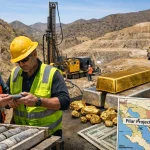
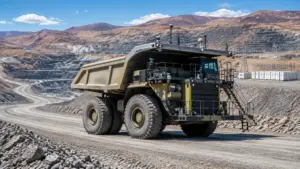
Nobody wants to admit this: Rio Tinto isn’t “diversifying.” It’s picking a side.

As of Feb. 20, 2026, the miner is steering 85% of its exploration budget into copper. Not “more copper.” Not “incremental.” Eighty-five percent. CEO Simon Trott underscored the shift in the company’s results briefing: copper is now the growth spine of the portfolio.
This isn’t messaging. It’s a mining exploration budget being rewritten in real time.
And the timing matters. The Glencore merger talks collapsed, ending what could have been a scale-jump M&A shortcut into a bigger copper footprint. No deal. No instant tonnage. So Rio is leaning harder into the drill bit—and into a copper-heavy pipeline it can control.
That’s the Rio Tinto copper strategy in one line: if you can’t buy supply, you try to discover it. Fast.
More Read

The Numbers Behind the Pivot
Rio Tinto reported net profit of $10 billion for 2025, down 14% year-on-year. That’s a meaningful decline, but the company still paid out a $6.5 billion ordinary dividend: its 10th consecutive year at the top end of its 60% payout ratio[1]. Trott’s message to investors was clear: we’re not in crisis mode. We’re repositioning.

Copper profit doubled to $7.4 billion last year, driven largely by the expansion at Oyu Tolgoi, the massive underground copper mine in Mongolia. That’s not a rounding error. That’s a business unit becoming a profit engine.

More Read

Iron ore remains Rio’s cash cow. It’s the most profitable segment, generating the bulk of free cash flow from Pilbara operations. But copper is now the growth anchor. And the capital allocation reflects it.
Rio achieved an 8% uplift in copper-equivalent production during 2025. The company is targeting a 3% compound annual growth rate in copper production through 2030[1]. That sounds modest until you map it against global supply constraints and the energy transition timeline.
Those two clocks do not sync.
What’s Driving the Bet on Copper
The strategic calculus here isn’t subtle. Global copper demand is accelerating faster than supply can respond. Electrification. Data centers. EV charging infrastructure. Grid expansion. Renewable energy build-out. All of it requires copper. Lots of it.
For a cleaner baseline on the copper deficit 2026 narrative, track the pricing and macro assumptions alongside our Copper Price Forecast 2026. The uncomfortable part: even if prices cooperate, supply lead times don’t. Permitting, power, water, metallurgy, community risk—none of it moves at the pace capital markets want.
The market is already treating 2026 as a squeeze year. And Rio is acting like it.
Rio knows this. So do BHP, Glencore, and Freeport-McMoRan. They’re all competing for the same limited pool of tier-one copper assets. When those deals don’t materialize: like the Glencore talks: you pivot to exploration and organic development.
Trott made the point explicitly: “We’re growing and we’re growing now.” Not waiting for perfect acquisition targets. Not delaying capital deployment. Growing through the drill bit.
Oyu Tolgoi: The Proof of Concept
The Oyu Tolgoi underground expansion in Mongolia is the flagship example of what Rio is trying to replicate. The project came online and ramped faster than expected, contributing materially to the doubling of copper profit in 2025.
Oyu Tolgoi isn’t just a mine. It’s a statement. It proves Rio can execute large-scale copper projects in complex jurisdictions. Mongolia isn’t Canada or Australia. It’s landlocked, politically sensitive, and logistically challenging. Rio delivered anyway.

That operational credibility matters when you’re asking investors to back an exploration-heavy copper strategy. It’s one thing to announce targets. It’s another to show you can hit them.
Winu: The Next Big Bet
The Winu copper-gold project in Western Australia’s Pilbara region is the next major test case. Rio completed a pre-feasibility study in late 2025 for processing capacity of up to 10 million tonnes per annum[1]. A full feasibility study is due by the end of 2026.
Sumitomo Metal Mining bought a 30% stake for $399 million in late 2024, validation that the asset has legs. Winu sits in the Paterson Province, a region known for high-grade copper-gold deposits but also for complex metallurgy and remote infrastructure challenges.
If Winu advances to construction, it becomes a cornerstone asset in Rio’s copper portfolio. If it stalls, the 85% exploration budget looks less like strategy and more like hope.
Rio is threading a needle here. They’re not just placing an order. They’re betting they can discover, develop, and deliver new copper production in a timeline that matches demand growth. That’s a needle that’s almost impossible to thread.
Iron Ore Isn’t Going Anywhere
Rio’s pivot to copper doesn’t mean iron ore is being abandoned. Far from it. Pilbara operations delivered record production in 2025, and iron ore remains the highest-margin business in the portfolio.
But iron ore growth is largely behind Rio. The Australian operations are mature. There’s optimization and efficiency gains to chase, but the step-change growth story is in copper.

This is portfolio management. You don’t kill the cash cow. You just stop feeding it all the growth capital.
The risk is that copper exploration doesn’t deliver on the timeline Rio needs. Exploration is a probability game. Most holes come up dry. Even when you hit something, it takes years to turn discovery into production. Rio is compressing that timeline wherever possible, but geology doesn’t care about your shareholder presentation.
The Competitive Landscape
Rio isn’t alone in this strategy. Every major miner with a balance sheet is hunting for copper exposure. BHP has been vocal about copper as a priority. Glencore already has one of the largest copper portfolios in the industry—still, the collapsed Glencore merger talks are a reminder that “just do M&A” is not a plan when valuations and structure don’t clear. Freeport lives and breathes copper.
The difference is execution and timing. Rio has capital, operational credibility, and relationships in key jurisdictions. But so do its competitors.
What Rio doesn’t have: yet: is the scale of copper production to match its peers. That’s what the 85% mining exploration budget tilt is designed to fix. But exploration takes time. And time is the one thing the energy transition isn’t offering in surplus.
If you want the broader context we’re tracking daily across the sector, start at the Skillings homepage for copper, M&A, policy, and project-level updates that move this story.
Check the broader copper demand dynamics here to understand why timing matters so much.
What Happens Next
Rio’s copper pivot is a multi-year bet. The 2026 feasibility study for Winu is the next major milestone. Beyond that, exploration results from the reweighted budget won’t show up for years. Investors are being asked to trust the process.
Trott’s emphasis on “growing now” suggests Rio will look for bolt-on acquisitions and joint ventures to accelerate timelines. The Sumitomo partnership at Winu is the template. Share the risk, share the capital, but retain control of the asset.
The macro backdrop supports the strategy. Copper prices are holding firm despite broader economic uncertainty. Demand fundamentals remain intact. Supply growth is constrained. That’s the environment where aggressive copper exploration makes sense.
But the risk is real. If global growth slows meaningfully, or if China’s property sector continues to deteriorate, copper demand could soften. Rio would be left holding a portfolio weighted toward a metal whose price is falling.
That’s not the base case. But it’s not impossible either.
The Uncomfortable Reality
Rio Tinto is making a calculated bet that the future of mining is copper-shaped. The 85% exploration budget allocation is the clearest signal yet that the company is repositioning away from bulk commodities and toward the metals of the energy transition.
Iron ore still pays the bills. But copper is where the growth story lives. Whether that bet pays off depends on execution, geology, and timing. Rio has two out of three under control.
The third one is up to the rocks.