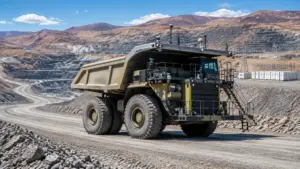
Autonomous haulage is no longer a novelty. Komatsu now counts 750+ autonomous trucks that have collectively moved 10+ billion metric tons of material—adding roughly 6 million tonnes per day—while Caterpillar’s MineStar™ Command ecosystem reports 8.6 billion tonnes hauled with no reported injuries. The storyline has shifted from “driverless trucks” to AI-native equipment platforms that perceive, plan, and orchestrate site operations in real time. The inflection point became unmistakable on Sept. 9, 2025, when Komatsu unveiled a strategic collaboration with Applied Intuition to embed “vehicle intelligence” directly into next-gen machines.

From Sensors to Decisions: What “Self-Aware” Looks Like
Today’s autonomy stacks fuse lidar, radar, and machine vision with predictive models that continuously update maps, avoid hazards, and optimize cycles without human inputs. Caterpillar’s recent sensor and autonomy updates—and its aggregates milestone at Luck Stone’s Bull Run Quarry (the first 1 million tons hauled autonomously in the sector)—show the technology working beyond mega-pits, in tighter, mixed-traffic footprints.
The closed-loop mine is taking shape. Beyond trucks, autonomy is extending to water trucks, drills, graders, and dozers so that dust suppression, road quality, and drilling programs feed the same dispatch logic. Caterpillar’s 789D Autonomous Water Truck automates delivery to prevent over- and under-watering—digitally tracking consumption and cutting waste—so haulage, visibility, and tire life all improve.
The Operating System of the Mine
A second shift is strategic: who controls the “mine OS.” OEMs and miners are racing to define the data, interfaces, and energy logic that run the pit. Sandvik’s acquisition of Universal Field Robots (UFR) reinforced its AutoMine roadmap across mixed tasks, while miners are linking autonomy with powertrains. BHP signed preliminary deals with CATL and BYD/FinDreams to co-develop heavy-equipment batteries, fast-charging, and even battery locomotives—precisely the areas where an AI dispatcher can schedule energy alongside shovel queues.
This platform race is nudging the industry toward interoperability standards. The publication of ISO 23725:2024 formalizes interfaces between autonomous haulage systems (AHS) and fleet management systems (FMS)—a key step so sites aren’t locked into bespoke integrations. GMG’s ongoing work on data/interoperability (e.g., OMF 2.0) complements that push. Together, they point to an ecosystem where autonomy, planning, and energy systems can plug-and-play across vendors.
More Read

Safety, Productivity—and Proof
The safety argument is now data-backed. Caterpillar cites no reported injuries across its 8.6-billion-tonne Command operations; Luck Stone proved autonomy’s viability in a suburban quarry. On the human-systems side, Rio Tinto recorded 1.78 million critical-risk-management verifications in 2024—evidence that autonomy augments, not replaces, disciplined controls. The productivity case is reinforced by digital twins and predictive maintenance, where industrial studies show double-digit cuts to downtime and maintenance spend as telemetry is turned into failure forecasts and workload balancing.

Where It’s Going Next: Autonomy + Batteries
Autonomy thrives on predictability—the same property battery-electric haulage needs to keep charge windows from cannibalizing output. That’s why Pilbara trials of battery trucks with Caterpillar and Komatsu, and BHP’s battery partnerships with CATL and BYD, matter beyond emissions: they let AI planners orchestrate energy with the same rigor they bring to shovels and dumps (e.g., dynamic charge scheduling, route selection that preserves state-of-charge, regenerative braking strategies). Expect mine dispatch to become energy dispatch.
Implementation Playbook (What Operators Are Actually Doing)
- Audit readiness: road standards, berms, intersections, and robust LTE/5G/private-Wi-Fi are non-negotiable for stable autonomy. (OEM commissioning guides reflect this reality.)
- Start constrained, then scale: one shovel–one dump circuits minimize crossings while teams learn new workflows.
- Instrument everything: tires, vibrations, payload, braking, and—as electrification arrives—charge events. This feeds predictive maintenance that major consultancies link to 15–30% cost reductions and sharp drops in unplanned downtime.
- Integrate safety systems: autonomy reduces exposure hours; rigorous CRM verification keeps defenses effective.
- Negotiate interfaces: use ISO 23725 and GMG guidance to protect data ownership and avoid one-way dependencies.
Why It Matters
For boards, “self-aware mines” translate to lower cost per tonne and higher utilization, with a credible pathway to Scope-1/2 cuts; for site leaders, they mean fewer exposure hours and steadier cycle times; for OEMs and integrators, the battleground is owning the brain—the algorithms and APIs that decide what moves, where, and when.
More Read

Skillings analysis
- From pilots to platforms. Komatsu’s Applied Intuition tie-up confirms AI is moving into the core machine stack, not riding as a bolt-on. Expect faster OTA feature cadence and tighter perception–control loops.
- Energy will be the new constraint. Battery trials plus BHP–CATL/BYD MOUs point to dispatch systems that schedule megawatts as carefully as trucks. Winners will treat energy as a first-class planning variable.
- Standards are the escape hatch. As platforms consolidate, ISO 23725 gives operators leverage to keep fleets mixed and data portable.
Outlook
Into Q4 2025, autonomy will spread from flagship pits to mid-tier operations and quarries, while first wave battery-electric pilots harden the runtime math for 2026. The quiet revolution isn’t just about removing drivers; it’s about teaching mines to think—to sense, predict, and allocate both iron and electrons with minimal human intervention.