By Salini Krishnan

The global mining sector is entering a period of aggressive consolidation and structural re-rating as the second half of 2026 begins. Driven by exceptionally bullish commodity forecasts and a pursuit of scale, several multi-billion-dollar transactions have redefined the landscape for gold and critical minerals. Investors are increasingly focusing on Price-to-Net Asset Value (P/NAV) metrics as senior producers and royalty companies undergo a valuation divergence.
From the massive US$5.1 billion merger between Equinox Gold and Orla Mining to the strategic vertical integration of Energy Fuels, the current capital cycle emphasizes "mine-to-market" security and diversified production profiles. At the same time, the streaming sector continues to provide non-dilutive capital for major expansions, highlighted by Triple Flag’s significant move in Australia.
The $5.1B Equinox Gold and Orla Mining Merger
The headline event in the precious metals space is the definitive agreement for Equinox Gold (EQX) to acquire Orla Mining (OLA) in an all-stock transaction valued at approximately US$5.1 billion. This merger creates a dominant North American-focused gold producer with a pro-forma equity value estimated between US$18 billion and US$18.5 billion.
The strategic rationale centers on the creation of a "new senior" producer. The combined entity is projected to deliver approximately 1.1 million ounces of annual gold production, supported by a robust pipeline of growth projects across the Americas. Post-merger, Equinox shareholders will hold roughly 67% of the company, while Orla shareholders will own 33%.

For investors, the deal addresses the "mid-tier discount" by providing the scale and liquidity necessary to attract generalist institutional capital. The integration of Orla’s low-cost, high-margin Camino Rojo mine in Mexico with Equinox’s diversified asset base: including the newly commissioned Greenstone mine in Ontario: establishes a resilient cash-flow profile capable of self-funding future expansions.

Rare Earth Verticalization: Energy Fuels’ $1.9B Strategic Shift
In the critical minerals segment, Energy Fuels (UUUU) has completed its US$1.9 billion acquisition of VAC (Vacuumschmelze), a leading German permanent magnet manufacturer. This transaction represents a fundamental shift from pure-play mining to a fully integrated "mine-to-magnet" supply chain.
By combining Energy Fuels’ upstream rare earth element (REE) resources and its separation capacity at the White Mesa Mill with VAC’s downstream manufacturing capabilities, the company is positioning itself as a primary Western alternative to Chinese supply chains. According to recent analysis on the Energy Fuels-VAC deal, this vertical integration allows the company to capture the full margin across the value chain, from raw ore to high-performance magnets used in electric vehicles and wind turbines.


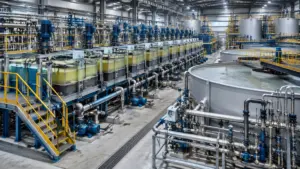
Industrial infrastructure supporting the vertical integration of rare earth element processing and magnet manufacturing.
Triple Flag’s $440M Gold Stream at Ravenswood
The royalty and streaming sector remains a vital source of capital for large-scale operations. Triple Flag Precious Metals (TFPM) recently announced a US$440 million gold stream acquisition on the Ravenswood gold mine in Queensland, Australia.
Under the terms of the agreement, Triple Flag is entitled to purchase 5.5% of payable gold from Ravenswood, with the rate dropping to 3.75% after the delivery of 194,200 ounces. First deliveries are anticipated in the third quarter of 2026. This move strengthens Triple Flag’s presence in a Tier-1 jurisdiction and adds a long-life asset to its portfolio during a period of record gold prices. The deal was funded through Triple Flag’s US$1 billion revolving credit facility, demonstrating the sector's significant dry powder for high-quality deployments.
Valuation Metrics: The P/NAV Re-Rating
A significant shift is occurring in how the market values mining equities. Traditionally, senior producers have traded at a discount to the P/NAV multiples of royalty and streaming companies. However, the recent consolidation wave and the resurgence of major producers are beginning to narrow this gap.
| Company Type | Current P/NAV Range (2026) | Historical Average | Trend |
|---|---|---|---|
| Seniors (Equinox, Agnico) | 0.85x – 1.15x | 0.70x – 0.90x | Upward Re-rating |
| Royalty/Streaming (Triple Flag, Franco-Nevada) | 1.80x – 2.20x | 1.60x – 2.00x | Stable/Premium |
| Developers (Advanced Stage) | 0.40x – 0.65x | 0.35x – 0.50x | Selective Breakouts |
This re-rating is particularly evident in developers with "world-class" economics. AbraSilver Resource Corp. has seen a significant market reaction following the updated pre-feasibility study for its Diablillos project. The study highlights a US$4.8 billion NPV breakout in a bull-case scenario (at current spot prices), positioning the project as one of the most attractive silver-gold developments globally. As reported in our detailed breakout analysis, the project’s rapid payback period of 1.5 years at spot prices has made it a prime target for potential M&A in the silver space.

Advanced underground drilling operations reflecting the technological push in high-NPV development projects.
Commodity Price Forecasts: The Road to 2027
Market sentiment is being buoyed by aggressive price targets from major financial institutions. Goldman Sachs has revised its long-term forecasts, projecting Gold at US$4,900/oz and Copper at US$15,000/t by 2027.
The gold forecast is driven by continued central bank accumulation and a structural shift in global inflation expectations. Meanwhile, the copper thesis relies on the "inelasticity" of supply in the face of skyrocketing demand from AI data centers and energy transition infrastructure. Goldman’s gold reset suggests that the current price levels are merely a baseline for a multi-year bull cycle.
Silver is also expected to outperform, with analysts targeting a range of US$55 to US$70/oz. The dual-threat nature of silver: as both a monetary asset and a critical industrial component in solar photovoltaics: is creating a supply deficit that current production levels cannot meet.
Strategic Outlook for Investors
The mining investment landscape in mid-2026 is characterized by "bigger is better" and "secure the supply chain." Operators are no longer content with being price-takers; they are aggressively moving to capture value through vertical integration and massive-scale mergers.
For investors, the key takeaways involve identifying companies that can successfully navigate the transition from developer to producer, or those participating in the P/NAV re-rating. While seniors like Equinox Gold offer diversified exposure, high-leverage plays like AbraSilver and strategic royalty partners like Triple Flag provide alternative paths to outsized returns in a high-commodity-price environment.
As we move toward 2027, the focus will remain on operational execution and the ability to bring new supply online to meet the demands of a resource-constrained global economy.

Investment-grade gold bullion reflects the strong macro-economic tailwinds driving sector-wide M&A activity.