By Charles Pitts
The Oyu Tolgoi ramp-up is one of the most consequential developments in the global copper market today. In 2026, Mongolia’s Gobi Desert is no longer a symbol of isolation. Instead, it stands as a beating hub of the global energy transition. At the center of this transformation, Rio Tinto and the Government of Mongolia are pushing deeper into the Hugo North Lift 1 deposit. Consequently, the project is shifting from a standard open-pit operation into a subterranean powerhouse. Furthermore, this transition will soon define the global copper supply chain for decades to come.
For industrial operators and institutional investors, the Oyu Tolgoi ramp-up is more than a production milestone. It is, moreover, a case study in technical resilience and geopolitical strategy. Copper demand is projected to double by 2035 to meet net-zero targets. As a result, OT’s path to becoming the world’s fourth-largest copper mine by 2030 is arguably the most critical development in the base metals sector today.

The Underground Pivot Driving the Oyu Tolgoi Ramp-Up: Mastery of Block Caving
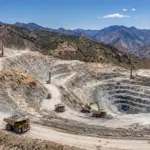
Oyu Tolgoi has produced copper from its open pit since 2011. However, roughly 80% of its total value lies more than 1.3 kilometers beneath the surface. Accessing this high-grade ore requires block caving — a complex, capital-intensive method that uses gravity to extract ore at depth.
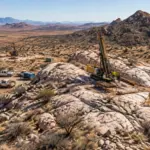
As of May 2026, the project has reached a critical operational junction. Production from Panel 0 is well-established. In addition, the first drawbells for Panel 2 are now active. This phased approach is essential for managing the immense geomechanical pressures at such depths. Unlike traditional stoping methods, block caving undercuts the ore body. Subsequently, the ore collapses under its own weight into a series of funnels called drawpoints.

The technical scale of the Oyu Tolgoi ramp-up is staggering. The underground mine features approximately 200 kilometers of tunnels — a subterranean network larger than the subway systems of many major cities. To support this expansion, Rio Tinto recently added 19 new Sandvik vehicles to its underground fleet. This brings the total operational fleet to nearly 80 specialized machines. Ultimately, this infrastructure targets the 500,000 tonnes of copper per year goal set for the 2028–2036 production window.
Oyu Tolgoi Ramp-Up Production Forecast (2025–2030)
| Period | Average Annual Copper Production (Tonnes) | Operational Status |
|---|---|---|
| 2025 | 170,000 – 190,000 | Ramp-up; Panel 0 active |
| 2026 | 210,000 – 240,000 | Current Phase; Panel 2 commencement |
| 2028–2036 | ~500,000 | Full production; 4th largest global mine |
| 2037+ | ~350,000 | Steady-state transition |
Data compiled from Rio Tinto Operational Guidance and Skillings Market Intelligence.
Strategic Proximity: How the Oyu Tolgoi Ramp-Up Feeds the Asian Battery Nexus
Geography is Oyu Tolgoi’s greatest competitive advantage. The mine sits just 80 kilometers north of the Mongolia-China border. Therefore, it connects directly to the world’s largest copper consumer. China currently accounts for more than 50% of global copper demand. This demand is, notably, driven by its dominance in electric vehicle manufacturing and renewable energy infrastructure.
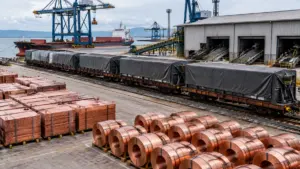
Other major copper producers in Chile and Peru face long maritime shipping routes and rising port congestion. By contrast, the Oyu Tolgoi ramp-up benefits from direct overland routes into the Chinese industrial heartland. This just-in-time supply capability is vital for the Asian battery market. Specifically, copper foil and wiring are in constant demand across battery and EV production lines.
As we noted in our recent copper market outlook, the logistical efficiency of the OT-China corridor significantly lowers the carbon footprint of the final refined product. Consequently, this factor is increasingly important to ESG-focused automakers sourcing raw materials for battery supply chains.
Navigating Jurisdictional Realities During the Oyu Tolgoi Ramp-Up
The road to the 2026 ramp-up has not been without hurdles. Nevertheless, the relationship between Rio Tinto and the Government of Mongolia has evolved from public tension into a working strategic partnership. The 2022 deal was a turning point. Under this agreement, Rio Tinto waived $2.4 billion in debt owed by the Mongolian government. This move allowed underground development to proceed at full speed.
However, 2026 brings new jurisdictional complexities. Development in Panel 1 remains paused as of mid-2025. The reason is licensing disputes involving the Entrée Resources joint venture area. Under Mongolian law, mining in unlicensed areas is prohibited. Therefore, the transfer of these licenses remains a key negotiation point between Entrée, Rio Tinto, and Ulaanbaatar.
Despite these regulatory friction points, the localization of the Oyu Tolgoi ramp-up stands as a major social success. Today, 97% of the mine’s workforce is Mongolian. This transition from an expat-heavy operation to a locally managed workforce has stabilized the project’s social license to operate. Moreover, the mine now accounts for nearly one-third of Mongolia’s GDP. As a result, its success has become a matter of national economic security.

Technical Challenges at Depth: Heat, Pressure, and Data
Mining at 1.3 kilometers below the surface creates extreme environmental challenges. Rock temperatures at these levels regularly exceed 50°C. Consequently, the site runs a massive ventilation and cooling system that consumes a significant share of the mine’s total power budget.
To manage these risks effectively, the Oyu Tolgoi operation has become a global leader in Digital Twin technology. Engineers map every meter of the 200-kilometer tunnel network in a real-time 3D environment. Furthermore, from a centralized surface control room, teams monitor seismic activity, airflow, and equipment health with millisecond precision. This data-driven approach is critical. In block caving, a single hang-up at a drawpoint — or an unexpected seismic event — can halt production for weeks.

The shift toward automation is also accelerating. The current fleet relies on conventional load-haul technology. However, engineers are integrating infrastructure for battery-electric vehicles (BEVs) into new underground sections. This transition will reduce ventilation requirements. It will also lower underground heat levels. As a result, operations become safer as the mine expands into deeper panels during the ongoing ramp-up.
2026 and Beyond: The Oyu Tolgoi Ramp-Up Roadmap to 500ktpa
As the Oyu Tolgoi ramp-up enters the second half of 2026, the focus remains on two key priorities. First, the team targets sustainable production from Panel 2. Second, it must resolve the Panel 1 licensing impasse. If the project achieves both milestones, it stays on track to reach peak capacity of 500,000 tonnes of copper per annum by 2028.
For the broader mining industry, this project represents the future of the mega-mine. It demonstrates that even the most technically daunting ore bodies can yield results. The key ingredients are high-tech engineering, massive capital commitment, and careful geopolitical management. Together, these factors make the Oyu Tolgoi ramp-up a template for the next generation of deep-level critical mineral projects.
The success of the OT ramp-up, therefore, serves as a bellwether for the entire industry. If Rio Tinto navigates the complexities of the Mongolian Gobi successfully, it creates a blueprint others can follow. For comparable examples, see our analysis of Simandou’s infrastructure risks, where similar frontier-project dynamics are at play.
Conclusion: Why the Oyu Tolgoi Ramp-Up Matters to the Entire Copper Market
Mongolia is no longer on the periphery of the mining world. In fact, it now sits at the center. The Oyu Tolgoi ramp-up delivers the most direct answer to the looming copper supply gap. By combining world-class block-caving technology with a strategic location next to the world’s largest consumer, OT is cementing its position as the most important copper hub of the 2020s.
For all stakeholders, the message is clear. The transition to underground mining at scale is no longer a future prospect — it is a current reality. Monitoring geotechnical and regulatory developments throughout the Oyu Tolgoi ramp-up is, therefore, essential for anyone tracking the future direction of the global copper market.
Shareable Social Snippet
LinkedIn/X: The Oyu Tolgoi ramp-up is officially on the move. With Panel 2 production starting and a 97% Mongolian workforce leading the charge, Rio Tinto’s flagship copper project is redefining the Gobi Desert as a global energy hub. Explore the technical and strategic drivers behind the world’s most critical copper ramp-up. #Mining #Copper #OyuTolgoi #EnergyTransition #Mongolia #RioTinto
To stay updated on daily mining news and expert analysis, subscribe to the
Skillings Mining Intelligence newsletter
and follow our coverage of
critical minerals.