The American mining industry is facing a terminal talent shortage that no amount of recruitment brochures can fix. We’ve spent fifty years offshoring extraction and devaluing the trades, and now, as the energy transition demands a mountain of copper, the hands required to pull it from the earth simply aren’t there.

Mariana Minerals isn’t trying to solve the labor crisis. They’re trying to bypass it.
By reopening the idled Centennial copper mine in Utah with a “tech-first” mandate, the startup is betting that Silicon Valley’s automation stack can succeed where traditional operational models have stalled. Backed by the likes of Andreessen Horowitz (a16z), Mariana is treating a copper mine less like a legacy industrial asset and more like a high-uptime data center with a hardware problem.
The strategic calculus here isn’t subtle: if you can’t find the miners, you build the robots.
Scaling the Unscalable: From 2,500 to 50,000 Tons
The Centennial mine, part of the Lisbon Valley complex, was never a tier-one behemoth. Under previous operators, it was a modest producer, churning out roughly 2,500 tons of copper annually. In the global context of the global battery revolution, that’s a rounding error.
More Read

Mariana’s blueprint calls for a 20-fold increase. They are targeting 50,000 tons of copper cathode per year by 2030.

That’s not an incremental improvement. That’s an industrial overhaul. To hit those numbers, the company is leveraging a 10,000-acre land package and an existing refining facility, but the real “secret sauce” is the deployment of a fully autonomous operational layer. We aren’t just talking about remote-controlled trucks; we’re talking about an AI-driven orchestration of the entire pit-to-solvent extraction (SX-EW) workflow.

More Read

The Andreessen Horowitz Bet: Mining as Software
It is deeply ironic that the same venture capital ecosystem that fueled the “software is eating the world” mantra is now pouring millions into a hole in the Utah desert. Mariana’s Series A in June 2025: supported by a16z, Breakthrough Energy Ventures, and Khosla Ventures: signals a shift in how the “Magnificent Seven” era of investors views critical minerals.
They aren’t investing in geology. They are investing in the removal of human variability.
CEO Turner Caldwell, a veteran of Tesla’s battery minerals division, understands the friction of the traditional supply chain. At Tesla, he saw how the U.S. steel future and battery pipelines were throttled by unpredictable raw material flows. By applying Tesla-style vertical integration and automation to Centennial, Mariana aims to de-risk the project’s timeline.
Autonomous Equipment: Beyond the Hype
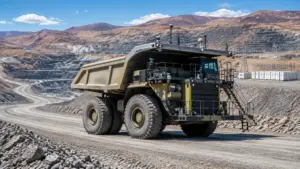
The “shiny AI revolution” usually lives in LLMs and chatbots. At Centennial, it lives in the hydraulic systems of haul trucks and the telemetry of drill rigs.
Mariana’s approach focuses on three technical pillars:
- Autonomous Haulage Systems (AHS): Removing the need for three-shift operator rotations in a region where housing and labor are at a premium.
- AI-Driven Drill and Blast: Using real-time geological data to optimize fragmentation, reducing the energy required for downstream crushing and leaching.
- Automated Heap Leach Management: Precision application of lixiviants to maximize recovery rates from lower-grade ores.
This isn’t innovation for the sake of a pitch deck. It’s a brutal necessity. The cost of labor and the scarcity of specialized mining engineers in the U.S. have turned traditional mid-tier mines into “zombie assets”: projects that are geologically viable but operationally impossible.

The “Mine of the Future” is a Resuscitation Project
Mariana isn’t digging a new hole from scratch. They are reviving an idled one. This strategy of “brownfield automation” is becoming a template for onshoring. We’ve seen similar movements with Anglo’s steelmaking coal ops and the rush to stabilize domestic supply chains.
The Centennial mine is the test bed. If Mariana can prove that a tech-heavy, lean-workforce model can scale a marginal asset into a 50,000-ton producer, the implications for U.S. mineral independence are massive. It turns every idled, “unprofitable” copper and lithium deposit in the Southwest into a potential candidate for a tech-driven restart.
But here’s where it gets really uncomfortable for the old guard: Mariana’s success would prove that the bottleneck wasn’t the grade of the ore: it was the inefficiency of the legacy mining model.

Critical Minerals and the Geopolitical Stranglehold
The timing of the Centennial reopening: slated for April 2026: is not accidental. With the global trade war reigniting and fresh tariffs shaking the market, the premium on “Made in America” copper is at an all-time high.
Copper is the throat of the green transition. You can’t build an EV, a wind turbine, or an AI data center without it. Currently, the U.S. is dangerously dependent on complex, overseas supply chains that are increasingly subject to geopolitical weaponization.
Mariana’s 50,000-ton target is more than a corporate goal; it’s a strategic asset for domestic security. 2026 marks the inflection point where “onshoring” stops being a campaign slogan and starts being a technical requirement for survival.
Technical Risks: Where the Blueprint Could Crack
Despite the high-octane backing, Mariana is fighting a two-front war.
First, there is the “technical debt” of physical reality. You can’t patch a broken axle with a software update. Autonomous equipment in a harsh, dusty, open-pit environment faces wear-and-tear that Silicon Valley engineers often underestimate. The durability of GET (Ground Engaging Tools) and the reliability of sensors in 110-degree Utah summers are non-trivial hurdles.
Second, there is the geological risk. While the Lisbon Valley area is well-mapped, scaling production 20x requires a level of geological consistency that nature rarely provides. If the ore body doesn’t behave, the most sophisticated AI in the world is just calculating losses more accurately.

The Talent Paradox
Ironically, while Mariana is automating the pit, they are competing for a different kind of talent. They don’t need 500 truck drivers; they need 50 world-class robotics engineers and data scientists.
As we’ve noted regarding skilled workforce shortages, the mining industry is now in a direct bidding war with Big Tech for the same pool of talent. Why would a robotics grad move to Moab when they could stay in Palo Alto? Mariana’s answer is the mission: the chance to build the “operating system for the earth.”
It’s a compelling pitch, but the execution remains to be seen.
The 2026 Outlook: A New Operational Reality
As April 2026 approaches, the industry is watching Centennial closely. This isn’t just another mine restart; it’s a stress test for the thesis that technology can overcome the structural decline of the American mining workforce.
If Mariana hits its 50,000-ton cathode target, it will trigger a wave of venture-backed acquisitions of idled assets across the Western United States. We are looking at a future where the “majors” might find themselves out-maneuvered by smaller, faster, tech-integrated firms that don’t carry the baggage of a century-old operational philosophy.
The strategic calculus isn’t subtle. The old way of mining is dying of a thousand talent-related cuts. The new way: Autonomous Utah: is just getting started.